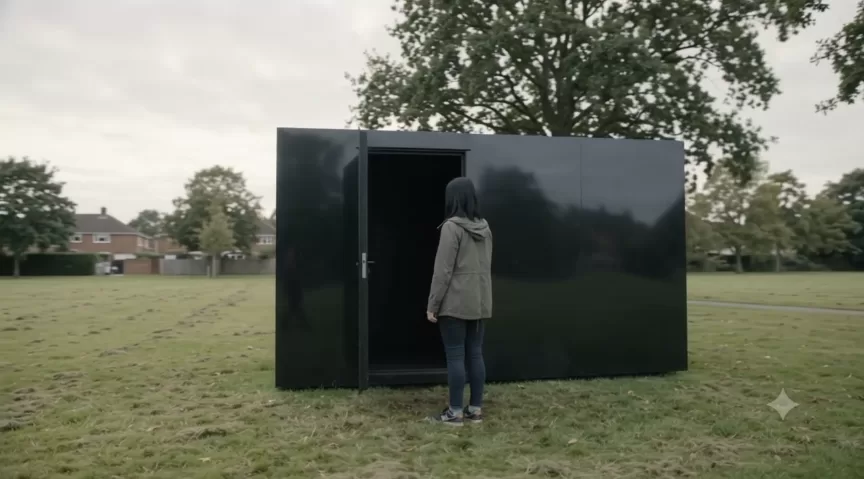
For three seasons, the Algorithm has been the most powerful presence in Silo, an unseen system judging the stability of Silo 18 and deciding whether 10,000 people live or die. Season 3 finally pulled back the curtain. There is no machine. There is Victor Crnkovich in Silo 1, speaking through a voice modulator, with Rosalind Thurman as director and a memory-wiped Daniel Keene, now “Troy”, woken from cryosleep whenever a silo needs putting down.
The moral case against Silo 1 hardly needs making. What interests me is that, even on its own chilling terms, the system is badly designed. If the goal is to keep 50 isolated populations obedient for centuries, the founders made a string of mistakes any strategist should have spotted. So here is a thought experiment: if I were the Algorithm, what would I have done differently?
The core flaw: power built on a lie Silo 1’s control rests on a shared false belief. The residents are not only told that the outside is lethal and that the Algorithm is infallible; they are kept from their own history altogether. The project’s stated aim is to free humanity from its past.
The trouble with ruling through a false belief is that it is a coordination problem waiting to be solved. Obedience depends less on what each resident privately believes than on what they think everyone else believes. Once the truth becomes common knowledge, when people know that others know, compliance can collapse almost overnight. Nearly every crisis in the show follows from Silo 1 creating ways for that knowledge to spread.
1. Don’t send dissenters to the one place they can test the lie Cleaning is meant to be the ultimate public deterrent: challenge the system and you walk out to certain death while everyone watches. It works perfectly, right up until someone survives.
It is an astonishingly risky design. The punishment puts the most curious, rule-breaking people exactly where the fake display on the screens can be exposed, and one survivor, Juliette, was enough to shatter it. A deterrent with even a small chance of disproving your entire narrative in front of the whole population is not worth having. I would handle punishment inside the silo, out of sight of the outside world, or at the very least make sure no engineer in Mechanical could quietly defeat the suit.
2. Never give one person all the knowledge In Silo 18, the head of IT is effectively the only person who knows the truth. That puts the whole regime at the mercy of one person’s temperament, ambitions and succession politics. Bernard’s paranoia, his clumsy choice of successor and his eventual turn against the system show how badly that can go.
A sturdier design spreads knowledge across several people who don’t fully trust each other and can check each other’s behaviour. Just as important, Silo 1 needs independent ways of watching what is going on. In the finale, Camille’s feint worked because Victor was relying on a single human channel he could not verify. An Algorithm that can be bluffed is not much of an Algorithm.
3. Make the threat automatic, or keep it secret In game theory, a deterrent is most credible when the side issuing it cannot back down. Silo 1 got this the wrong way round. The Safeguard ran through a physical pipe that residents could find and cap, so they knew the threat was real and also that it could be beaten. Worse, it was run interactively by a person, which told everyone there was someone at the other end who could be negotiated with, delayed or tricked.
I would choose one of two coherent options. Either the threat is fully automatic, triggered by fixed and published conditions with no human discretion and no physical point of failure, or its existence is never revealed at all. The half-hidden, human-operated, breakable version Silo 1 used combines the weaknesses of both.
4. Punish in proportion The Directive treats contamination between silos as the one unforgivable offence, and entire silos are expendable to prevent it. That is the equivalent of a strategy that punishes everyone for a single defection, and over repeated rounds it has two fatal problems.
First, it destroys the very thing the project exists to protect. With 50 silos and centuries to go, wiping out whole populations steadily drains the stock of humanity the founders claim to be saving. Second, it removes any reason for restraint. Once a silo believes it is already condemned, it has nothing left to lose, which is exactly the point at which people rise up. Graduated, targeted sanctions keep deterrence working while leaving people a reason to stop.
5. Take the mystique out of the past The total ban on relics was meant to cut people off from history. In practice it made every surviving object enormously significant. A forbidden children’s book or a single photograph becomes proof that something was hidden, and hidden things invite investigation.
I would do the opposite: allow a carefully chosen supply of harmless old-world objects so they become ordinary. Curiosity also needs a safe outlet. The most inquisitive residents are the most dangerous if you fight them and the most useful if you recruit them. Bernard half understood this with Juliette, but by then trust had already broken down. A system that routinely brought its brightest dissenters into IT, rather than sending them out to clean, would face far fewer rebellions.
6. Don’t build what you’ve banned If isolation between silos is the top priority, a network of tunnels connecting them is a baffling weakness. It is like announcing that doors are the gravest threat to the regime and then fitting every wall with one. Either don’t build them, or make their existence the most closely guarded fact in the entire project. By the end of Season 3, Juliette knows about them, and that is catastrophic for Silo 1.
7. Keep the enforcer reliable Troy is Silo 1’s troubleshooter, the person trusted with the hardest decisions. He is also plainly deteriorating: each time he is woken, flashes of Helen come back and he asks more questions. Victor’s response is simply to put him back to sleep.
That is putting off the problem, not solving it. The person with the most lethal authority in the system should be its most predictable part, and Silo 1 is relying on memory suppression that visibly fails. Sooner or later, the enforcer remembers.
8. Make promises that can be checked In the finale, Troy offers Silo 18 a deal: he will leave the Safeguard off as long as they avoid contact with the other silos. Juliette seems to accept, while planning to reach Silo 1 through the tunnels.
Of course she does. Silo 1 has lied to her people for generations and has shown it will kill entire populations. A promise from an actor with that record is worthless unless it can be verified or enforced. If I genuinely wanted a settlement, I would give her something concrete and lasting: real control over the capped pipe, independent monitoring, or even a seat in the project itself. Commitments only hold when breaking them costs the one who made them.
The uncomfortable conclusion What strikes me about this list is that almost every change makes the system less cruel as well as more stable. That isn’t a coincidence. Regimes held together by deception and collective punishment are fragile precisely because they give people every reason to resist and nothing to lose by doing so. Legitimacy is far cheaper to maintain than terror.
The single most powerful move open to Silo 1 would not involve pipes, voice modulators or cryo-sleep. It would be offering residents a believable future: a real, verifiable date when the doors will open, and a reason to wait for it. People will put up with a great deal for something they believe in. Silo 1 chose fear instead, and with Juliette heading for its front door in the final season, it may be about to find out how poor a choice that was.
How to Actually Destroy the Box: An Engineering Post-Mortem on Dark Matter’s Central MacGuffin.
1,119 words
Every season of Dark Matter eventually arrives at the same problem. Someone, usually Jason, decides the box has to go. It’s the thing that ruined his life, ended Daniela’s marriage to the “right” version of him, and now threatens to keep spawning doppelgangers for the rest of their days. The solution always sounds simple when a character says it out loud: destroy the box. What the show is much less interested in is how, which leaves the door wide open for anyone with a passing interest in materials science to have a go at the problem properly.
What ‘the box’ actually is:
Strip away the drama and the box is a fairly modest piece of engineering. It’s primarily a sealed metal chamber. A traveller climbs in, gets injected with a compound (the show calls various versions of it Lavender Wings, Lilac Wings, and so on) that inhibits activity in the prefrontal cortex, and this induces a state of quantum superposition, aided by technology embedded into the box’s inner hull. From inside that state, the traveller perceives a corridor of doors, each one leading to a different branch of the multiverse, and picks their way toward whichever reality they’re after.
Crucially, none of that magic lives in the metal. The box is an isolation chamber, not a spellbook. Its entire function is to hold a human body still and undisturbed long enough for an altered brain state to do the actual work. That distinction matters enormously once you start thinking about how to disable it.
The real weakness, according to the show itself
Season 2 quietly hands the audience the box’s actual vulnerability. When a duplicate box gets relocated within Chicago, moved only a few miles from where it originally stood, Amanda works out that the move has severed its quantum connection to what she calls the box’s “prime power source”: some kind of anchor point shared across every multiversal copy of the box. Break the connection to that anchor, and you’re left with, in her words, just a box. No corridor, no doors, no superposition, just a large metal container taking up warehouse space.
The show has also shown us the second, blunter method works too: a tornado is depicted destroying a box outright elsewhere in the timeline. So canon actually gives us two independently validated failure modes:
Structural annihilation – enough force or heat to physically wreck the chamber. No chamber, no isolation, no portal. Severance – moving the box far enough from its anchor point that the link degrades to nothing, without needing to damage it at all.
Anything you propose as a destruction method should be judged against those two mechanisms, because they’re the only ones the text has actually confirmed.
Why concrete doesn’t cut it
The instinctive answer, entomb it in concrete, fails both tests. Pouring concrete around the box doesn’t move it relative to its anchor point, the coordinates are unchanged, you’ve simply added mass nearby. And it doesn’t structurally destroy the chamber either. Burying something isn’t the same as crushing it. What you’re left with is access denial: nobody can open the door and climb in, which has some value, but it’s containment rather than destruction. And containment is precisely the failure mode the show keeps punishing its characters for relying on, because a box that still physically exists is a box that a sufficiently motivated alternate version of yourself, with unlimited time and resources, eventually digs up again.
A better stratagem: helicopter, Iceland, volcano
This is where things get properly satisfying, because a lava drop stacks both validated mechanisms at once rather than betting on just one.
Severance is trivially achieved. If a few miles across a single city was enough to sever the link in canon, then several thousand kilometres to a volcanic peninsula in the North Atlantic isn’t a marginal improvement, it’s overkill by several orders of magnitude. Strictly speaking you wouldn’t even need the volcano just to disable the box functionally; the flight there already does that part of the job.
Structural destruction is where the physics gets interesting. Icelandic basaltic lava, the kind produced by the Reykjanes Peninsula’s fissure eruptions, typically sits around 1,100–1,200°C. Mild and structural steel melts at roughly 1,370–1,510°C, meaning a steel box dropped into an active lava lake might not fully liquefy on contact. What it will do is warp under thermal stress, oxidise rapidly, and get chemically attacked by dissolved sulphur compounds, all while being progressively swallowed by the flow. Any internal wiring or chemical-injection hardware has essentially no chance of surviving that environment regardless of what the outer shell is made from. The practical result is a box that is destroyed in every sense that matters, inoperable, and buried under solidifying rock, which arguably beats pure concrete containment, since it removes the long-term “someone eventually excavates it” risk that burial alone leaves open.
The two wrinkles any serious multiverse-ending team should plan around *wink*:
Timing. Lava requires an actual eruption, and Iceland doesn’t oblige on demand. As of late 2026 the Reykjanes Peninsula’s Sundhnúkur crater system has been quiet since its last eruption in mid-2025, though magma has continued accumulating beneath Svartsengi and the region is expected to remain volcanically active for decades. If the schedule doesn’t cooperate, Kilauea in Hawaii is the more dependable choice; it has erupted dozens of times in the past two years alone and is far less likely to leave you waiting around with a box strapped to a cargo hook.
Payload. Nothing in the show gives exact dimensions for the box, but it’s consistently moved by forklift and truck rather than crane, which puts it plausibly in the low single-digit tonnes. That’s comfortably within the external sling-load capacity of a heavy-lift helicopter such as a Sikorsky Skycrane. The genuinely dangerous part of the operation isn’t the lift at all, it’s holding a stable hover near an active vent long enough to release accurately, given the sulphur dioxide plumes and violent thermal updrafts that come with any close approach to a lava lake.
The uncomfortable postscript
Even a technically perfect execution of this plan only solves a local problem. Destroying one instance of the box, however thoroughly, does nothing about the countless other Jasons across the branching multiverse who have built, or will eventually build, boxes of their own. That’s really the show’s quiet argument underneath all the corridor-running and doppelganger drama: there is no engineering solution to infinite branching possibility. You can win the battle against one box. You cannot win the war against the concept of it.
Still, if you only need to win the battle: helicopter, Iceland, volcano. It’s sound.
Imagine you are a detective. Your job is to listen for a very, very quiet knock on a door. The knock is so quiet that you can barely hear it. Now imagine that the door also makes random creaking noises all by itself, and those creaks sound almost exactly like the knock.
How do you know if what you just heard was someone knocking, or just the door being noisy?
That question – that exact puzzle – is at the heart of a real science mystery. Scientists gave it a name: the Photon Falsifiability Gap. It sounds like a big, fancy phrase, but once you break it into pieces, it’s actually a story about light, invisible energy, and a very clever machine that sometimes fools itself.
What is a photon?
Light is made of tiny little packets, kind of like light is made of Lego bricks. Each one of these tiny packets is called a photon. You can’t see a single photon with your eyes – they’re much too small and light for that. But scientists have built machines that can detect a single photon, one at a time. That’s an amazing feat, like being able to hear a single grain of sand hit the floor.
Meet the super-listener: the photomultiplier
The machine that can “hear” a single photon is called a photomultiplier tube (you can just call it a PMT for short). Think of it like a super-sensitive microphone, except instead of listening for sound, it’s listening for light.
Here’s how it works, in simple terms:
A single photon flies into the tube and hits a special metal surface. That hit knocks loose one tiny electron. The tube then multiplies that one electron into millions of electrons, like a snowball rolling downhill and picking up more snow. All those electrons create an electrical “click” that a computer can count.
So a photomultiplier tube turns one whisper-quiet flash of light into a loud, countable click. Pretty amazing, right?
The invisible energy problem
Now here’s where our mystery begins. Some materials in nature give off a very weak, very quiet form of energy. One of these is called tritium. When tritium releases its energy, it’s incredibly faint – much fainter than most other radioactive materials. It’s like a whisper compared to a shout.
Scientists want to detect this whisper using their super-listener, the photomultiplier tube. And it can pick up that whisper… but here’s the catch.
The catch: the door creaks too
A photomultiplier tube isn’t perfectly silent when nothing is happening. Every once in a while, all on its own, it produces a tiny click – even when no real photon ever arrived. Scientists call this dark noise, because it happens even in total darkness, with nothing there at all.
And here’s the twist that makes this a true mystery: a dark noise click and a real tritium click look exactly the same. Both are just one tiny electrical pulse. There is no way, just by looking at a single click, to tell which one you’re looking at.
Go back to our detective story. You heard a knock. Was it a real knock, or just the door creaking? If both sounds are identical, you can never be 100% sure – not for that one single sound.
Why this is called a “falsifiability” problem
In science, there’s an important idea called falsifiability. It means that for an idea to be truly scientific, you need to be able to test it in a way that could prove it wrong if it actually is wrong.
Here’s the problem: if you hear one click and say “that was tritium!” – there is no way to prove that statement wrong. It might have been dark noise. And if you say “that click was just dark noise!” – there’s no way to prove that wrong either. It might have been real. Neither guess can be tested for a single click. That’s the “gap” – a gap where our normal rules for testing scientific ideas don’t quite work, at least not one click at a time.
So how do scientists solve the mystery?
If you can’t trust a single click, what do you do? You stop listening for one knock and start counting lots of knocks over a long time.
Here’s the trick:
First, scientists measure how many random clicks (dark noise) happen when they know for certain there’s no tritium around. This tells them the normal “creaking” rate of the door. Then, they measure the click rate when tritium might be present. If the second number is clearly, reliably higher than the first – not just by one or two clicks, but by a lot, over and over – then they can be confident that real tritium signals are hiding inside all those clicks.
It’s a bit like this: you can’t know if one specific creak was a knock. But if you count 1,000 creaks on a quiet night and then count 1,000 creaks plus 300 extra clicks on another night, you can be pretty confident something extra was happening on that second night – even though you still can’t point to any single click and say “that one was definitely the knock.”
Why does any of this matter?
This isn’t just a fun puzzle – it matters for real science:
Finding ancient objects: Scientists use radioactive materials to figure out how old rocks, fossils, and artefacts are. Medicine: Doctors use tiny, safe amounts of radioactive material to see inside the human body without surgery. Hunting for dark matter: Physicists build giant, super-sensitive detectors – using the same kind of photomultiplier tubes – to search for mysterious particles that make up most of the universe. They face this exact same “which click was real?” problem, just on a much bigger scale.
Every single one of these fields depends on scientists being clever enough to work around the falsifiability gap, even though they can never fully close it.
Quick recap:
A photon is a tiny packet of light.
A photomultiplier tube is a machine that can detect a single photon and turn it into a loud click.
Tritium gives off a very weak, whisper-quiet signal.
The tube also makes random clicks by itself, called dark noise, and these look identical to real signals.
Because of this, no single click can ever be proven to be real or fake – that’s the falsifiability gap.
Scientists solve this not by trusting one click, but by comparing patterns of many clicks over time.
Try it yourself:
Here’s a fun way to feel this mystery for yourself. Get a friend and a set of headphones, or just sit in separate rooms. Have your friend randomly tap a table softly, mixed in with the normal sounds of the house (footsteps, a fan, a fridge humming). Try to guess, sound by sound, which taps were real. You’ll probably find that any single sound is a guess – but if you count for five whole minutes, you’ll likely get a much better sense of how many taps really happened, even without ever being sure about any one of them.
That’s the same trick scientists use to solve the Photon Falsifiability Gap – not by being certain about one click, but by being smart about all the clicks together.
Nescience, cognitive closure, and the difference between a wall and a puzzle…
There is a gap in ordinary English that you generally only notice when you need it.
We have a rich vocabulary for not knowing things. *Ignorant*, *unaware*, *uninformed*, *clueless*, *in the dark*. But every one of these words carries a hidden assumption: that the thing not known is the sort of thing that *could* be known by the person not knowing it. Ignorance is a deficit against a standard. It implies a book unread, a lesson unlearned, a fact that was sitting there available. You can fix ignorance by handing someone a pamphlet.
What we lack is a common word for the other case – where the failure is not in the person’s diligence but in their equipment. Where the thing isn’t merely unknown but *unthinkable by that kind of mind*, in the way that a smell is unthinkable by a thermometer. Not a gap in the map, but a limit on what can be mapped at all.
This is not a merely lexical complaint. The word you reach for commits you to a claim about the world, and the claim is usually much stronger than you intended. So it is worth going slowly.
I. The available words, and what each one smuggles in
**Nescient** is the best single word. It comes from Latin *nescire*, to not-know, and it has been doing serious work in theology and epistemology for centuries. Its virtue is that it names a *condition* rather than a *failure*. To be nescient of something is not to have neglected it. Nescience is closer to a state of the organism than to a gap in its education. It is also usefully rare, which means it hasn’t been worn smooth by casual use the way *ignorant* has.
**Incognizant** is the plainer cousin – serviceable, slightly bureaucratic, and it drifts back towards ordinary unawareness. **Insensible to** is nicely physical, with a suggestion of sensory rather than intellectual failure, which may be exactly what you want. **Benighted** is archaic and faintly insulting; it implies a darkness that someone could have walked out of. **Oblivious** is the weakest of all – it means inattentive, and inattention is a moral failing in miniature, which is precisely the wrong note.
Then there is a second family of words, for a subtler thing: not the unawareness itself, but the unawareness *of* the unawareness. The recursive case. Because the truly closed-off mind does not experience itself as missing anything. It experiences the world as complete.
**Anosognosia** is the clinical term, coined by Babinski in 1914, for a patient’s unawareness of their own deficit – the stroke patient with a paralysed arm who sincerely reports that the arm is fine, and who will produce elaborate reasons why they simply don’t feel like moving it right now. It has escaped the clinic and is now used, sometimes loosely, for any blind spot about a blind spot. **Scotomised**, from *scotoma*, the blind spot in the visual field, does similar work with a psychoanalytic accent: a perceptual blankness where something intolerable ought to be. Freud was suspicious of the term and preferred to talk about disavowal, but *scotoma* has survived because the image is so good. Your own retinal blind spot does not appear to you as a hole. It appears as nothing at all, seamlessly filled in. You have to hunt for it with a card and a dot to prove it is there.
That is the phenomenology we are after. Not a hole in the world, but a world with no hole in it.
II. Cognitive closure
The philosophical term of art is **cognitive closure**, and it belongs to Colin McGinn, who set it out in a 1989 paper asking whether we can solve the mind-body problem. His answer was no, and his reason was structural rather than pessimistic.
Every mind has a range. A dog’s mind is well adapted to a rich world of scent, social hierarchy, and object permanence, and it is closed to arithmetic – not because dogs are stupid in a way that could be remedied with better schooling, but because the concept of a prime number is not a thing a canine cognitive system can form. The dog is not frustrated by this. There is no dog-shaped ache where mathematics should be.
McGinn’s move was to ask why we should assume our own range is complete. Our brains are organs shaped by selection pressures that had nothing to do with metaphysics. It would be a startling coincidence if the set of true things happened to line up exactly with the set of things a primate social-cognition engine can represent. Some truths may simply fall outside our range, and – this is the important part – we would have no way of detecting their absence. Our world would look complete, because it always does.
The position acquired the name **mysterianism**, coined half-jokingly by Owen Flanagan after the 1960s garage band ? and the Mysterians, and it has been fought over ever since. Daniel Dennett’s objection is the sharp one, and worth keeping in your pocket: an argument from cognitive closure is very hard to distinguish, from the inside, from a failure of imagination. “I cannot conceive how X could be explained” is a fact about you. Treating it as a fact about the universe requires an extra step that mysterianism has never quite managed to justify. Every hard problem looks closed until the week before it opens.
Hold onto that objection. It is going to matter later.
—
III. Umwelt: the sensory version
If you want the version with less metaphysics and more biology, the word is **Umwelt**, from the Baltic-German biologist Jakob von Uexküll, writing in the 1930s.
Uexküll’s insight was that an organism does not live in *the environment*. It lives in the environment *as constructible by its own sensory apparatus* – its Umwelt, its self-world. And these worlds are astonishingly narrow. His famous example is the tick, which lives in a world assembled from three cues: the smell of butyric acid, which tells it a mammal is passing beneath; a temperature of around 37 degrees, which tells it where to burrow; and the feel of hair, which tells it where not to. That is the whole world. There is no colour in it, no sound, no shape. A tick can wait years on a branch in a world made of three facts.
The great virtue of *Umwelt* is that it makes the point without any philosophical commitment at all. It is an empirical claim about sensory ecology. The tick is not being denied access to a richer reality by some Kantian veil; it simply has three receptors. And nothing in its world indicates that anything is missing.
If your interest is in intelligences with different bodies, *Umwelt* may be the more honest word than *cognitive closure*, because it locates the limit in the sensorium rather than in the intellect – and sensory limits are the kind of thing you can actually go and measure.
—
IV. The bat, and why it is not about bats…
The essay everyone eventually arrives at is Thomas Nagel’s “What Is It Like to Be a Bat?”, published in *The Philosophical Review* in 1974, and it is worth being precise about what it argues, because it is very frequently misremembered.
Nagel is not saying that bat echolocation is hard to imagine. He is not saying that we lack data about bats. Neurophysiologists know a great deal about the bat’s auditory cortex and can say in detail how the returning echo is processed into a representation of a moth’s position and velocity. The information is not the problem.
His claim is about the *structure of imagination*. When we try to imagine being a bat, what we actually do is imagine ourselves with modifications: ourselves, but hanging upside down; ourselves, but with a sonar sense grafted on. That is imagination working the only way it can, by extrapolation from our own case. But it delivers only what it is like *for us* to be bat-like. It cannot deliver what it is like for a bat to be a bat, because the extrapolation always starts from the wrong place. And there is no second method available.
So the barrier is not informational. It is not even, strictly, a barrier of intelligence. It is that the subjective character of experience is only available from a particular point of view, and the tool we use for occupying other points of view is a tool that works by dressing ourselves up.
This is why *nescience* and *cognitive closure* are the right register and *ignorance* is not. There is no pamphlet.
—
V. Four more words, for four different jobs
Once you are in this territory, several traditions offer terms that overlap without being synonyms. They are worth separating, because each carries a different diagnosis of *why* the thing is inaccessible.
**Noumenal** (Kant, 1781). The thing as it is in itself, as opposed to the thing as it appears. For Kant the barrier is not our species’ particular equipment but the very structure of experience: space, time, and the categories are the forms our intuition imposes in order to have experience at all, so they cannot also be read off as features of reality behind that experience. Use *noumenal* if you want the inaccessibility to be permanent and principled rather than contingent on our being primates. Note that this is a *stronger* claim than McGinn’s – a smarter alien would not do any better, because it would have its own forms of intuition.
**Radical alterity** (Levinas, *Totality and Infinity*, 1961, and after him a great deal of anthropology). Otherness that cannot be absorbed into the categories one already holds. Levinas’s point was ethical before it was epistemological: the failure to comprehend the Other is not a defect to be repaired but the very thing that makes the Other a claim on you rather than an object for you. If your interest is in what it would *mean* to encounter an intelligence you cannot model – rather than in whether you could model it – this is the vocabulary.
**Incommensurable** (Kuhn, 1962). No shared measure. Two frameworks fail to translate not because the dictionary is incomplete but because the terms are individuated differently at the root, so that agreement and disagreement both become ill-defined. Kuhn spent the rest of his career walking back the strongest readings of this, which is itself instructive: near-total incommensurability turns out to be hard to defend, and what survives is a claim about difficulty and loss in translation rather than impossibility.
**Apophatic** (Pseudo-Dionysius, and the *neti neti* – “not this, not this” – of the Upanishads). Not a description of the ignorance but of the *only available mode of speech* about it: saying exclusively what the thing is not. It is worth knowing that negative theology is the most developed technique humanity has ever built for talking at length about something held to be constitutively beyond conception. If you find yourself writing about an unimaginable mind, you will end up doing apophasis whether or not you have a name for it. Better to know you are doing it.
—
VI. Lem, or: the mirror is the only instrument we have
The novelist of this problem is ‘Stanisław Lem’, and he is more rigorous about it than most philosophers.
*Solaris* (1961) is usually described as a novel about an alien ocean. It is more accurately a novel about a library – the enormous, futile, century-old discipline of “Solaristics“, with its schools and schisms and competing taxonomies of the ocean’s formations, all of it elaborate and none of it contact. The ocean produces the visitors, apparently from the scientists’ own suppressed memories, and the humans cannot determine whether this is communication, experiment, cruelty, indifference, or a reflex with no more intent than a knee-jerk. The book’s cruelty is that it withholds even the certainty that there is even a question being asked.
*His Master’s Voice* (1968) does the same thing with a signal from space, which a team of the best minds available decodes into two substances of ambiguous properties and cannot get further, and cannot tell whether their partial success is genuine or a Rorschach blot. Lem’s recurring point, stated bluntly in both books, is that we do not go looking for other minds. We go looking for mirrors, and we call the mirror a discovery. Projection is not a mistake we could avoid with more discipline; it is the only instrument in the kit.
VII. Now the interesting part: chirality is not the case you think it is…
Here is where the argument gets useful, because there is a very natural example of “an intelligence I could never comprehend” that turns out, on inspection, to be a completely different kind of problem – and the difference is the whole lesson.
Suppose you propose two candidates for radically alien minds: a non-carbon intelligence, and a *mirror-image* intelligence, built from the enantiomers of our own biochemistry.
The first is a genuine Nagelian case, at least potentially. A different substrate might well support a different phenomenology, and we would have no method for checking, and no method for checking whether we had failed to check.
The second is not. Chirality is a fact about molecular geometry, not about experience. Terrestrial life is homochiral – we use left-handed amino acids and right-handed sugars, an asymmetry that is very likely a frozen accident from a chemistry that could have gone either way. A perfectly mirrored human being would be biochemically incompatible with us in interesting ways: they could not digest our food, our drugs would not fit their receptors, some of our smells would smell like something else to them. But they would not be *phenomenologically* alien. They would have your memories, your emotional range, your sense of humour. They would find your novels moving. There is no hard problem here, only a divergence & supply-chain problem.
So the mirror case is not a wall. What it is instead – and this is far more interesting – is a **communication** problem, and it has a name and a history.
VIII. The Ozma problem
Martin Gardner named it in *The Ambidextrous Universe* (1964), after Project Ozma, Frank Drake’s 1960 attempt to listen for interstellar signals at Green Bank, which Drake had named after the princess in Baum’s Oz books.
The problem is this. You are in radio contact with a civilisation somewhere distant. You share no objects. You can send only signals – that is, information, not things. You can establish a common vocabulary for numbers, for the elements, for the wavelength of a hydrogen transition, for anything you can define by its structure. Now: **communicate to them which of their hands is the left one.**
It seems, on first inspection, to be a perfect sealed impossibility. Every method you try fails. You cannot say “the hand on the same side as the heart”, because you cannot establish that their hearts are on the side ours are, and in any case you’d need to define “same side”, which is the thing you are trying to define. You cannot appeal to any geometrical description, because every geometrical description of a left hand is satisfied equally well by a right hand – that is what enantiomorphism *means*. You cannot appeal to astronomy, because they cannot tell whether they are looking at their sky or its mirror image. Every asymmetry you reach for turns out to be a convention or a local accident.
The Ozma problem looks exactly like cognitive closure. It has the right shape: the failure recurs at every attempt, and for what appears to be a principled reason rather than a contingent one.
And then it was solved. Not by philosophy – by an experiment.
In 1956, Tsung-Dao Lee and Chen Ning Yang pointed out that parity conservation, universally assumed, had never actually been tested for the weak nuclear interaction. In early 1957 Chien-Shiung Wu tested it, cooling cobalt-60 nuclei to near absolute zero and aligning their spins in a magnetic field. If parity held, the beta-decay electrons should have come out symmetrically with respect to the spin axis. They did not. They came out preferentially in one direction. The universe, at the level of the weak force, distinguishes left from right.
Which means the Ozma problem has an answer, and the answer is a recipe: *run this experiment, note which way the electrons go, and now we can both define “left” without ever pointing at anything.*
Gardner, being honest, flagged the remaining loophole in his own book: if your correspondents are made of antimatter, the recipe reverses, and you have merely traded the handedness ambiguity for a matter/antimatter ambiguity. That gap closed too. In 1964 Cronin and Fitch found CP violation in neutral kaon decay, which gives an absolute, convention-free distinction between matter and antimatter – and therefore, in principle, a fully unambiguous definition of “left” transmissible over a radio link to strangers.
The wall fell twice, in eight years, both times because someone went and looked at a nucleus.
IX. So: how do you tell a wall from a puzzle?
This is the thing worth taking away, (if you have read this far, well done, dear reader) and it is somewhat uncomfortable.
The Ozma problem *felt* closed. It had every hallmark: repeated failure, a structural-seeming reason for the failure, an air of “you cannot get there from here”. Sophisticated people spent decades treating handedness as the paradigm case of something communicable only ostensively – something you could only teach by pointing, never by describing. They were wrong, and the correction did not come from thinking harder about the problem. It came from an unrelated corner of physics noticing that a symmetry everyone had assumed was simply an untested assumption.
The bat may be different. Nagel’s argument has survived fifty years of attack in a way that most such arguments do not, and the reason is that it doesn’t rest on our failing to imagine a mechanism; it rests on a structural feature of how imagination works at all. But you should hold even that lightly, because Dennett’s objection stands: from the inside, a genuine wall and a puzzle you haven’t cracked look precisely identical. That is what it is to be nescient rather than ignorant. Nescience does not announce itself. There is no ache in the shape of the missing thing.
Which means the vocabulary carries a bet, and you should know which bet you are placing when you choose a word.
Say *ignorant* and you have claimed the thing is knowable and someone has slacked. Say *nescient* and you have claimed the not-knowing is a condition rather than a failure, without yet saying whether it is curable. Say *cognitively closed* and you have made a strong empirical claim about the architecture of a mind – a claim which, historically, has a poor track record. Say *noumenal* and you have made a metaphysical claim that no future experiment can touch, which is either admirable rigour or a way of insulating yourself from being proved wrong, depending on the day. Say *radical alterity* and you have changed the subject from knowledge to ethics, which is sometimes the right thing to do.
The most defensible position, and the least satisfying, is probably this: we can identify with confidence the cases where our imaginative method breaks down, and we cannot reliably tell which of those breakdowns are permanent. The honest word for the state is *nescient*. The honest posture is apophatic – say what it is not, and keep the account open. And the honest example to keep beside the bat is the Ozma problem, precisely because it is the one that got away.
—
Appendix: a working glossary
| Word | Use it when the emphasis is on… | |—|—| | **nescient** | not-knowing as a condition rather than a failure; no implication of blame | | **incognizant** | plainer register; unawareness without the theological weight | | **insensible to** | the failure is sensory rather than intellectual | | **anosognosic** | unawareness of one’s own deficit; the recursive blind spot | | **scotomised** | a blankness where something intolerable should be; psychoanalytic flavour | | **cognitively closed** | a specific mind’s architecture cannot represent the concept (McGinn) | | **outside its Umwelt** | the sensorium cannot construct the relevant world (Uexküll) | | **noumenal** | inaccessible in principle to any experiencing subject (Kant) | | **radical alterity** | otherness that resists absorption into existing categories (Levinas) | | **incommensurable** | two frameworks with no shared measure (Kuhn) | | **apophatic** | the mode of speech: only negations available | | **ostensive** | learnable only by pointing – what Ozma was thought to be, and wasn’t |
—
Sources worth reading directly, & citations:
– Thomas Nagel, “What Is It Like to Be a Bat?”, *The Philosophical Review*, 1974 – Colin McGinn, “Can We Solve the Mind-Body Problem?”, *Mind*, 1989 – Jakob von Uexküll, *A Stroll Through the Worlds of Animals and Men*, 1934 – Martin Gardner, *The Ambidextrous Universe*, 1964 – Stanisław Lem, *Solaris* (1961) and *His Master’s Voice* (1968) – C. S. Wu et al., “Experimental Test of Parity Conservation in Beta Decay”, *Physical Review*, 1957
Why moral bio-cybernetic/bioenhancement fails at the design document, not the ethics committee.
admin
2,290 words
Proposals to biologically engineer human moral dispositions – to make people more compassionate, more cooperative, less prone to defection – are usually met with ethical objections. Consent. Autonomy. Authenticity. Value lock-in. The long shadow of eugenics.
These objections are serious and several of them are quite decisive. But they are also, in a particular sense, premature. They engage the proposal as though the technical programme were ready and the only remaining question were whether we ought to run it. That framing flatters the proposal. It grants it a maturity it does not have.
There is a more revealing test, and it is the one engineers use on any large proposal before arguing about whether to fund it: **try to write the specification.**
Not a manifesto. Not a research agenda. A design document – the artefact that lets someone else build the thing, and lets a third party check whether it worked. Every field filled in, every acceptance criterion stated, every assumption made explicit enough to be falsified.
When you actually attempt this for moral bioenhancement, something instructive happens. The document does not turn out to be *controversial*. It turns out to be **blank**. And the pattern of which fields are blank is more informative than any of the ethical arguments.
—
The construct problem: you are not turning up a dial
The first field in any specification is: *what, precisely, is being modified?*
“Compassion” is a folk-psychological term. It is not a variable. Before you can build anything you must commit to a decomposition – typically something like an affective component (felt concern at another’s distress), a motivational component (disposition to act at personal cost), a cognitive component (accuracy of your model of the other’s state), a behavioural output (rate and magnitude of costly prosocial acts), and – critically – a **scope function**: to whom does it extend, and how does it decay with social distance?
That last component is where naive versions of the project die.
Human prosociality is not a scalar quantity with a gain knob attached. It is a gradient over social distance: steep and high near kin and in-group, falling off quickly with distance, and effectively flat at the level of statistical strangers. This is why we are simultaneously the species that will run into a burning building for a neighbour and the species that can read a famine death toll over breakfast.
Which means the thing that would actually change outcomes at civilisational scale is not the *amplitude* of caring. It is the **shape of the discount function**. You do not want a higher curve. You want a flatter one.
Nobody has a genetic or neural handle on the shape. And the best-known intervention that raises amplitude appears to make the shape *worse*. Oxytocin spent about a decade as the “moral molecule” before the picture complicated: alongside well-known affiliative effects, a body of work found it strengthening in-group bonding while in some paradigms increasing out-group hostility or defensive aggression. The replication record across this literature is mixed enough that no single result should be leaned on hard. But the direction of the concern is the point. Raising the gain on a parochial system plausibly yields more effective parochialism – more devoted tribalists, better at their tribalism.
There is a second constraint that most versions of the proposal omit entirely: **stability under exploitation**. Any modified disposition must be viable in a mixed population that still contains unmodified defectors. A disposition toward unconditional cooperation is not a stable strategy; it is removed from the population – economically, socially, reproductively – by the people who lack it. Making people kinder inside an unchanged incentive landscape does not produce a kinder world. It produces exploitable people.
So the real target is not “more compassion.” It is something closer to *conditional cooperation, with an unbiased scope function, and with defection-detection and sanctioning capacity fully intact.* That is a much stranger object than the one people imagine. It is also, notably, much closer to what humans already have than to what the proposal would install.
**Status of this field: unresolved – and not primarily as an empirical matter.** It is a conceptual problem that must be settled before measurement is even meaningful.
—
The measurement gate
This is the field that stops the programme, and it stops it completely.
Any intervention specification requires a primary endpoint: a measure with construct validity (it measures the target, not social desirability), test–retest reliability sufficient to detect your expected effect size, sensitivity to within-individual change over the intervention window, resistance to demand characteristics (subjects must not be able to score well by inferring what you want), and ecological validity (it must predict field behaviour, not merely laboratory behaviour).
What actually exists falls into three families, and all three have known, documented problems:
– **Self-report instruments.** Transparently gameable. Correlate substantially with how respondents wish to be seen. – **Economic games** (dictator, ultimatum, public goods, trust). Behaviour in these correlates weakly-to-modestly with real-world prosocial behaviour. The lab-to-field transfer problem here is one of the more uncomfortable open sores in the literature. – **Confederate-based laboratory paradigms.** Better ecological validity, but poor scalability and severe single-use problems – you cannot re-run them on the same subject.
The psychometric reliability of these instruments is nowhere near what would be required to detect the modest effect sizes any realistic intervention would produce.
The comparison that makes this vivid: a cardiovascular intervention has LDL cholesterol as a validated surrogate endpoint, blood pressure as a second, and hard endpoints – infarction, mortality – ascertained at registry scale with near-perfect reliability.
**There is no LDL of compassion. There is no mortality-equivalent hard endpoint.** There is nothing you could enter in the “primary outcome measure” field of a trial registration that a competent reviewer would not reject.
This is not a difficulty. It is a category failure. Without a validated endpoint there is no dose-finding, no efficacy claim, no safety signal, and no way to distinguish a working intervention from a broken one. You would be optimising against a function you cannot evaluate.
—
The causal chain has no established arrows
A specification requires a causal model with every link established and quantified:
What exists is a correlational sketch of one link. The empathy/compassion dissociation work – Singer, Klimecki and colleagues – implicates anterior insula and anterior cingulate cortex in empathic distress, and medial orbitofrontal cortex, ventral striatum and affiliation-associated regions in compassion. This is genuinely interesting, and the finding that compassion training increases positive affect while empathy training increases distress and burnout is one of the more useful results in the area.
But it should be read as suggestive, not as a wiring diagram. It is correlational. It is spatially coarse – a functional imaging voxel contains on the order of a million neurons. Sample sizes are typically small, and this subfield has documented reproducibility problems for precisely this class of finding.
What is missing is any **causal** manipulation that reliably, durably, and selectively increases the construct. Oxytocin was the strongest candidate and its literature partially collapsed under replication pressure; even the question of whether intranasal administration achieves meaningful central nervous system delivery remains contested. Contemplative training produces real effects, but modest ones, requiring ongoing practice – a behavioural intervention, not a lever a biological one could be built on.
—
Genetic architecture: no editable targets
For any germline proposal, the specification requires target loci with established causal effect, characterised effect sizes, a complete pleiotropy map, and characterised epistasis and gene–environment interaction.
For prosociality-adjacent traits – agreeableness, self-reported empathy – SNP-based heritability is modest and polygenic scores explain a low single-digit percentage of variance in independent samples. (Treat specific figures as approximate and check current sources; the direction is not in doubt.) The architecture is massively polygenic – thousands of variants of individually negligible effect – heavily pleiotropic, and poorly transferable across ancestries and environments.
Then there is a recursion problem that is rarely acknowledged: **a genome-wide association study is only as good as its phenotype.** Run against the invalid instruments described above, what you recover is the genetic architecture of *scoring highly on a questionnaire*. That is not the target. It may not even be adjacent to the target.
Multiplex editing at the scale of thousands of loci, with uncharacterised epistasis and an unmapped pleiotropy burden, is not a hard engineering problem awaiting effort. It sits outside the space of things currently attemptable.
—
The safety instrument is inside the system it monitors
This is the field I find genuinely novel, and it has no analogue in ordinary medicine.
Post-market drug safety rests on adverse event reporting. Patients notice something has gone wrong and report it. The system assumes the patient’s evaluative faculty is intact and independent of the intervention.
For a values-modifying intervention, that assumption fails by construction. The adverse event class *includes changes to the faculty that generates the report*. If the intervention shifts what a person values, then self-report is compromised as a safety instrument in exactly the failure mode you most need to detect. A population successfully modified toward a particular specification of compassion may no longer contain anyone disposed to recognise the modification as a harm.
You would therefore need an external, non-self-report harm criterion, specified in advance, held by someone outside the modified population. Nobody has (yet…) proposed a workable one.
Note that this is not a philosophical objection dressed up as an engineering one. It is a missing section in the safety file. And it generalises: irreversibility is not merely one cost to be weighed against others, because it removes the mechanism by which anything gets weighed later. Ordinary bad policy is reversed because those harmed by it object. This is the one class of intervention that can eliminate the constituency capable of identifying the error.
—
What the blanks tell us:
Lay the fields out and the completion state is stark. Delivery technology has partial content and active research behind it. Nearly everything else is empty – and the two most upstream fields, construct definition and outcome measurement, are empty in ways that no amount of funding or intelligence resolves from a single location. They are filled by cohorts, instruments, longitudinal data, and decades.
Two things follow.
**First: the ethical objections and the technical emptiness point the same way.** This is worth noticing rather than treating as coincidence. The consent problem, the value lock-in problem, and the pharmacovigilance problem are the same structural fact appearing in three registers – an intervention that alters the evaluator cannot be evaluated by the altered. That the technical specification is blank at precisely the points where the ethics is most troubling is not an accident. It reflects that we do not understand the object well enough to specify it *or* to consent to it.
**Second: the causal premise is probably wrong anyway.** The proposal assumes that destructive collective behaviour is primarily a psychological trait being expressed. But humans are already extraordinarily cooperative by primate standards – we punish unfairness at cost to ourselves, we cooperate with strangers we will never meet again. What competitive systems do is *select* for defection at the level of firms and institutions, largely independent of the dispositions of the people inside them.
The evidence for this is not subtle. When emergency conditions suspend normal procurement controls – competitive tender, due diligence, published contracts, audit trails – fraud losses jump by orders of magnitude. Same population, same dispositions, different controls. Removing the checking is what changes the behaviour.
None of which means dispositions are irrelevant. Some people are cruel, some enjoy it, and the variance is real. But what institutions and norms determine is how much *scope* those dispositions get – whether cruelty is costly or licensed, marginal or ambient. Both halves are true, and the tractable half is the second one. Ostrom’s work on commons governance showed groups solving defection problems through monitoring, graduated sanctions, and local rule-making, with nobody’s psyche altered at all.
And where genuinely catastrophic risk is the concern, it concentrates in a very small number of people with access to weapons systems, engineered pathogens, or critical infrastructure. Screening and constraining that population is orders of magnitude more tractable than modifying a species. It has real problems – who screens the screeners, capture risk – but they are the ordinary problems of institutional design rather than the irreversible rewriting of a lineage.
—
Where the real problem is
If you take the specification exercise seriously, the interesting frontier turns out not to be where the proposal points.
The measurement field is a live, unsolved, genuinely deep problem: how to construct a valid and reliable instrument for a latent construct that resists direct observation, where the act of measurement perturbs the thing measured and the subject has incentive to game the readout.
That is a problem in **measurement theory** more than in biology. Psychology has been notably bad at it – partly because the field’s training does not emphasise what a physicist’s or metrologist’s does: error propagation, calibration, sensitivity limits, distinguishing signal from instrument artefact, and knowing when your resolution cannot support your claim.
Solving it would be valuable regardless of what anyone concluded about enhancement. It is upstream of clinical trials in psychiatry, of policy evaluation, of most of behavioural science. It is where someone with quantitative training would have a genuine edge.
The specification exercise is not, in the end, an argument for despair about the underlying goal. It is a redirection. The document is blank at the top, and the top is where the work is.
So let that work begin.
*Further reading and citations: Persson & Savulescu, ***Unfit for the Future*** (the strongest case for the affirmative); John Harris’s reply on the freedom to fall; Paul Bloom, ***Against Empathy***; Elinor Ostrom, ***Governing the Commons***; Singer & Klimecki on the empathy/compassion dissociation; Habermas, ***The Future of Human Nature***.*
Picture the Earth four billion years ago. The Hadean eon is in full swing. The atmosphere is a choking haze of carbon dioxide and methane, and a vast, acidic, iron-rich ocean covers the globe. Deep at the bottom of this abyssal sea, far removed from the violent ultraviolet radiation of the young Sun, alkaline hydrothermal vents spew scorching, mineral-laden fluids into the frigid waters.
For decades, astrobiologists and biochemists have suspected that these deep-sea chimneys—specifically, the towering “black smokers” and alkaline vents—acted as the chemical wombs of the first living cells. They provided the heat, the chemical gradients, and the building blocks necessary to kickstart primitive metabolism.
But there was a glaring, seemingly insurmountable problem with the deep-sea hypothesis: The Chirality Paradox. If life started in the pitch black of the ocean floor, how did it achieve molecular handedness without light? Recently, a revolutionary quantum mechanical concept known as the Chiral Induced Spin Selectivity (CISS) effect has provided a staggering answer, fundamentally rewriting the state of academic opinion on abiogenesis.
The Mirror-Image Menace: The Problem of Homochirality
Before we can build a cell, we must confront a fundamental geometrical quirk of the universe: chirality.
Many of life’s most essential molecules—like amino acids (the building blocks of proteins) and sugars (the backbone of DNA and RNA)—are chiral. This means they exist in two distinct, non-superimposable mirror-image forms, much like your left and right hands. We call these forms enantiomers (L- for left-handed, D- for right-handed).
If you synthesize these molecules in a standard, sterile laboratory without biological enzymes guiding the process, the laws of thermodynamics dictate that you will produce a racemic mixture—an exact 50/50 split of left- and right-handed molecules.
Yet, all known life on Earth is strictly homochiral. Our biological machinery exclusively uses L-amino acids to build proteins and D-sugars to build nucleic acids. If you introduce a right-handed amino acid into a growing protein chain, the entire structure folds incorrectly, and the biological machine breaks down.
Therefore, before the first true cell could ever arise, nature had to find a way to take a chaotic 50/50 chemical soup and ruthlessly filter out one of the enantiomers.
The Death of the Sunbeam Hypothesis
Historically, the leading theory to explain this initial filtering relied on Circularly Polarised Light (CPL). It was theorized that CPL—perhaps generated by neutron stars irradiating molecular clouds in space, or by intense UV light hitting shallow tidal pools on early Earth—acted as a cosmic asymmetric destroyer. The light would preferentially break down one handedness of a molecule while leaving the mirror image intact.
This theory works beautifully for shallow pools (“warm little ponds”). But it is fatal to the hydrothermal vent hypothesis. At the bottom of the ocean, under kilometers of water, there is absolutely zero ultraviolet light. If the CPL hypothesis was the only way to achieve homochirality, life could not have started at the vents.
The origin of life research community was caught in a stalemate: the vents had the perfect thermodynamics for early metabolism, but no apparent mechanism to sort molecules by their handedness.
The Quantum Saviour: Chiral Induced Spin Selectivity (CISS)
The paradigm shifted with the discovery of the Chiral Induced Spin Selectivity (CISS) effect, a quantum phenomenon that proves you don’t need spin-polarized light to sort molecules, if you have spin-polarized electrons.
The CISS effect dictates a profound relationship between a molecule’s physical 3D shape (its chirality) and the quantum spin of electrons moving through it. When an electron attempts to travel through a chiral molecule, the molecule acts as an aggressive quantum filter. Depending on the molecule’s handedness, it will only permit electrons of a specific spin state (spin-up or spin-down) to pass efficiently.
This works in reverse, generating a phenomenon called electrochirogenesis. If you provide a surface saturated with electrons that are all spinning in the exact same direction, and you wash a racemic 50/50 mixture of prebiotic molecules over it, the surface will strongly bind and crystallize one handedness while violently repelling the other.
At a hydrothermal vent, where do we find a massive, continuous supply of spin-polarized electrons? Magnetic rocks.
As the alkaline fluids of the vent mix with the acidic, iron-rich Hadean ocean, they precipitate trillions of nanoparticles of magnetite ($Fe_3O_4$) and greigite ($Fe_3S_4$). These are natural ferromagnetic minerals. Thanks to the early Earth’s geodynamo (its magnetic field), as these minerals crystallized out of the scorching vent fluids, they underwent Thermoremanent and Chemical Remanent Magnetization. They locked the Earth’s magnetic field into their very atomic lattice, becoming permanent magnets.
The towering walls of these hydrothermal chimneys became vast, uniform sheets of spin-polarized electrons. As the chaotic, racemic soup of early amino acids and RNA precursors (like ribose-aminooxazoline) washed over the rock face, the quantum spin-exchange interactions allowed only molecules of a single handedness to safely dock, crystallize, and concentrate. The rocks themselves were the sorting machines.
Experimental Validation: Proving it in the Lab
This is not just theoretical physics; it is heavily tested laboratory reality. Teams led by researchers like Ron Naaman, Yossi Paltiel, and Dimitar Sasselov have successfully recreated this deep-sea quantum sorting engine.
The experimental setup is breathtakingly elegant:
The Substrate: A layer of magnetite is placed over a strong permanent magnet (e.g., 0.42 Tesla), forcing all the electron spins on the surface into a uniform alignment (mimicking the permanently magnetized Hadean vent rocks).
The Soup: A supersaturated, completely racemic 50/50 solution of an amino acid or RNA precursor is introduced.
The Crystallisation: As the solution cools, the molecules hit the surface. Because of the CISS effect, molecules with a handedness that opposes the surface spin are repelled (due to high-energy, parallel triplet-like states). Molecules with the correct handedness form low-energy, antiparallel singlet-like bonds and crystallize.
The Result: Researchers harvest the resulting crystals and analyze them using Circular Dichroism (CD) spectroscopy and magnetic conductive Atomic Force Microscopy (mc-AFM). The results consistently show near-total enantiomeric purity. Flip the magnetic field, and the surface selectively crystallizes the exact opposite handedness.
Enclosing the Miracle: Lipid Vesicles
Achieving homochirality of building blocks is only part of the puzzle. Life requires a boundary—a cell membrane. Hydrothermal vents continuously synthesize simple amphiphilic molecules (like fatty acids), which naturally self-assemble in water into lipid vesicles or protocells.
However, the thermodynamics of self-assembly present a stark warning: a membrane built from a racemic, mixed-handedness jumble of lipids is structurally chaotic, highly permeable, and dangerously leaky. It cannot hold an electrochemical gradient.
But when lipid vesicles self-assemble on or near these spin-polarized magnetic surfaces, the CISS effect biases the chirality of the lipids themselves. The resulting homochiral lipid bilayers pack tightly and securely. They become stable enough to capture the vent’s natural proton gradients, providing the necessary battery power to fuel the very first primitive, pre-enzymatic metabolisms.
The Cosmic Perspective: How Rare is the Quantum Crucible?
If this highly specific, highly intricate geochemical and quantum mechanical machine is the true origin of life, how likely is it that this process is happening elsewhere in the Milky Way?
To calculate this, we use a Fermi estimation approach to establish $N_{CISS}$: the number of planets currently capable of operating a magnetic hydrothermal vent abiogenesis engine. The governing equation is:$$N_{CISS} = N_{hab} \times f_{water} \times f_{dynamo} \times f_{vent} \times f_{chemistry}$$
Where:
$N_{hab}$ = Number of rocky planets in the habitable zone.
$f_{water}$ = Fraction that retain optimal surface water oceans.
$f_{dynamo}$ = Fraction possessing an active internal magnetic field.
$f_{vent}$ = Fraction featuring active tectonic/hydrothermal recycling.
$f_{chemistry}$ = Fraction possessing the specific iron-rich, reducing atmospheric conditions for magnetite precipitation.
The Optimistic View
If we assume 4 billion Sun-like stars in our galaxy, optimistic Kepler telescope data suggests there could be 2 billion habitable-zone planets ($N_{hab}$). If we assign generous probabilities to standard planetary geology ($f_{water} = 0.20$, $f_{dynamo} = 0.25$, $f_{vent} = 0.20$, $f_{chemistry} = 0.50$):$$N_{CISS} = 2,000,000,000 \times 0.20 \times 0.25 \times 0.20 \times 0.50 = 10,000,000$$
Under this view, there are 10 million planets in the Milky Way acting as vast, active prebiotic laboratories.
The Pessimistic View (The Rare Earth Hypothesis)
However, planetary geophysics is often brutally unforgiving. What if Earth is a statistical freak?
What if a planet’s oceans are usually too deep, forming an impenetrable barrier of high-pressure Ice VII at the ocean floor, suffocating the rock?
What if a geodynamo requires a highly improbable, cataclysmic Mars-sized planetary impact (like the one that formed our Moon) to keep the core spinning?
What if the crust is almost always a stagnant, unmoving lid like Venus, preventing tectonic vents entirely?
If we take the strictest lower bounds for habitable planets ($N_{hab} = 280,000,000$) and assign a brutal 1% (0.01) probability to the four geological filters:$$N_{CISS} = 280,000,000 \times (0.01 \times 0.01 \times 0.01 \times 0.01)$$$$N_{CISS} = 280,000,000 \times 10^{-8}$$$$N_{CISS} = 2.8$$
Under the most mathematically pessimistic, geologically rigorous interpretation possible, there are fewer than three planets in the entire Milky Way galaxy equipped to run this ‘origin-of-life engine’.
Conclusion
Yet, even if the pessimistic math holds true, the observable universe contains upwards of two trillion galaxies. Even at a rate of 3 planets per galaxy, there are still trillions of worlds scattered in the dark, where deep-sea vents and magnetic rocks are quietly, inevitably, sorting the chaos of chemistry into the architecture of life.
The paradox has been largely solved. The darkness was not an obstacle to life; armed with quantum spin, the darkness was the very mechanism that built it.
How an obscure Victorian economic observation might be one of the most important ideas in climate policy 🌍 – and what it would take to overcome it. 👩🏻🔬👩🏻🔧👩🏻💻🌍🧩
Yet more, and more…
admin
We tend to assume that doing something more efficiently is, by definition, a good thing. Use less energy per mile driven. Extract more crop per acre farmed. Capture more carbon per kilowatt-hour spent. Efficiency is progress. Efficiency is the goal.
But there is a paradox lurking at the heart of this assumption — one identified not by a climate scientist or a systems theorist, but by a Victorian-era economist writing about coal in 1865. His name was William Stanley Jevons, and what he noticed then has never been more relevant than it is today, as the world begins to deploy one of its most ambitious technological bets against the climate crisis: direct air capture of greenhouse gases.
Understanding Jevons paradox — what it is, why it happens, and crucially, how it might be overcome — is essential to understanding whether the technologies we’re placing so much hope in will actually save us, or quietly make things worse.
Part One: The Paradox That Bears His Name
William Stanley Jevons was watching the Industrial Revolution unfold around him when he noticed something that didn’t quite make sense. Engineers were getting dramatically better at building steam engines. Each new generation of engine extracted more work from the same amount of coal. By any intuitive measure, this should have meant that Britain’s appetite for coal would slow – or at least stop growing so fast. Instead, the opposite was happening. Coal consumption was exploding.
Jevons realised why. When steam engines became more fuel-efficient, they became cheaper to run. And when they became cheaper to run, they became economical to deploy in more places, at greater scale, for more purposes. The efficiency gains didn’t reduce demand for coal — they *expanded* the universe of things it was worth using coal for. More mills. More ships. More railways. More factories. Each one burning coal that, without the efficiency improvement, would never have been burned at all.
The mechanism at the heart of Jevons paradox is what economists call the **rebound effect**. It works at multiple levels simultaneously. At the most direct level, if your car becomes more fuel-efficient and costs less per mile to run, you might simply drive more — longer commutes, more weekend trips, perhaps a house farther from work than you would otherwise have chosen. That’s the direct rebound: the efficiency gain is partly consumed by increased use.
At a second level, the money you save on fuel doesn’t vanish — you spend it on something else, and that something else has its own resource footprint. This is the indirect rebound. And at the broadest level, efficiency improvements ripple through the entire economy, enabling new industries, new behaviours, new patterns of consumption that collectively dwarf whatever savings the original efficiency gain was supposed to deliver. This is the economy-wide rebound, and it’s the most powerful of the three.
The paradox has appeared throughout economic history. Airline fuel efficiency has improved dramatically over the past fifty years — and global aviation has grown by orders of magnitude, with total emissions rising steadily. LED lighting uses a fraction of the energy of incandescent bulbs — and buildings now contain far more light fittings than they once did, often running longer hours, with total electricity consumption for lighting barely changed in many countries. More efficient data centres helped power an explosion in data consumption that now makes the internet one of the world’s largest energy consumers.
The pattern is remarkably consistent: efficiency lowers the cost of something, lower cost drives greater use, and greater use consumes more of the resource than the efficiency gain saved. The improvement in *intensity* is overwhelmed by growth in *scale*.
Part Two: Enter Direct Air Capture
Direct air capture — DAC — is one of the more audacious technologies humanity has ever attempted to scale. The basic idea is straightforward: giant machines that pull carbon dioxide directly from the ambient air, then either store it underground in geological formations or convert it into synthetic fuels or materials. Unlike carbon capture at the point of emission (a smokestack, say), DAC works on the atmosphere itself. In principle, it can undo historical emissions, not just prevent future ones.
This matters enormously because the climate problem we now face isn’t just about stopping future emissions. We have already loaded the atmosphere with more CO₂ than is compatible with a stable climate. Even if every country met its current pledges — which most are not on track to do — we would still overshoot the warming targets set at Paris. The IPCC’s pathways to limiting warming to 1.5°C or 2°C almost all rely on removing billions of tonnes of CO₂ from the atmosphere in the second half of this century. DAC, alongside other approaches like enhanced rock weathering, soil carbon sequestration, and reforestation, is one of the tools expected to do that work.
But today’s capacity is almost laughably small relative to the task. We need to reach **gigaton scale** — billions of tonnes of removal per year — by the middle of this century to meaningfully affect atmospheric concentrations. Current global DAC capacity is in the tens of thousands of tonnes annually. The gap between where we are and where we need to be is roughly five orders of magnitude. It is an engineering, economic, and political challenge of extraordinary proportions.
And into this challenge walks Jevons, paradox in hand.
Part Three: Five Ways the Paradox Threatens to Undermine DAC
The relationship between Jevons paradox and direct air capture isn’t straightforward — it doesn’t map onto the classical template of fuel efficiency and consumption. But the underlying dynamic, efficiency enabling and encouraging greater resource use, appears in several distinct and troubling forms.
The Moral Licensing Problem
The first and perhaps most insidious risk is moral licensing. When a credible technological solution to a problem exists, people’s sense of urgency about that problem tends to diminish. We’ve already seen a version of this play out with carbon offsets. Corporations buy credits from tree-planting projects or methane capture schemes and use them to declare themselves “carbon neutral” — while continuing to operate fossil-fuel-intensive businesses more or less unchanged. The offset doesn’t reduce emissions; it *licenses* them.
DAC, at scale, could trigger the same dynamic at a far greater magnitude. If governments, industries, and citizens come to believe that the carbon will be cleaned up later by machines, the political and social pressure to restructure economies away from fossil fuels will weaken. Why accept the disruption and cost of decarbonising heavy industry, aviation, or agriculture if the atmosphere can be remediated technologically? The efficiency of the cure becomes an argument against the urgency of prevention.
Extending the Fossil Fuel Era
A closely related risk is that cheap, scalable DAC could remove one of the central arguments for leaving fossil fuels in the ground. Today, climate advocates argue that the carbon budget is finite and shrinking — that every tonne burned now is a tonne that cannot be burned later. DAC complicates that arithmetic. If carbon can be removed from the atmosphere at reasonable cost, the fossil fuel industry gains a powerful counter-argument: burn now, capture later.
This is not a hypothetical concern. Oil and gas companies have already begun investing in carbon capture technologies, in part because it offers them a credible narrative of continued operation alongside climate action. A more efficient DAC sector doesn’t just make capture cheaper — it makes the *case* for continued extraction stronger.
The Energy Hunger of the Technology Itself
DAC is extraordinarily energy-intensive. Current systems require somewhere between 1,500 and 2,000 kilowatt-hours of energy per tonne of CO₂ captured. To put that in perspective, capturing a single tonne of CO₂ requires roughly the same energy as the average European household consumes in three to four months. Scaling to gigatons annually would require energy inputs comparable to significant fractions of today’s entire global electricity supply.
If that energy comes from fossil fuels — even partially — DAC generates its own substantial emissions, potentially capturing one tonne of CO₂ while emitting nearly as much in the process. And here Jevons reasserts himself: as DAC becomes more energy-efficient, it becomes cheaper to operate at scale, which drives deployment, which drives total energy demand higher. The efficiency improvement in the capture process could, paradoxically, increase total energy consumption — and with it, total emissions — if the energy system hasn’t fully decarbonised.
The ‘Technofix’ Displacement Effect
There is a broader version of the rebound that operates at the level of political imagination. When a technological fix is available, it crowds out systemic solutions. The existence of DAC as a viable-seeming option makes it easier for politicians to avoid the harder, more disruptive, more politically costly work of restructuring economies. Why redesign cities around public transport when you can just capture the emissions from cars? Why transform agricultural systems when industrial carbon removal can offset the methane from livestock?
This isn’t irrationality. It’s a predictable response to the availability of a less disruptive option. But it means that DAC’s efficiency as a removal technology could, paradoxically, slow the rate of change in the systems that generate emissions in the first place.
Cheapening the Cost of Carbon:
Finally, if DAC scales and generates a large supply of carbon credits, it risks driving down the price of carbon in trading markets. And a lower carbon price means it’s cheaper to emit. Cheaper emissions stimulate more activity in carbon-intensive sectors — more flights, more cement, more industrial production. The supply of removal credits becomes a subsidy for continued pollution, and total emissions may rise even as the capture industry grows.
Part Four: The Stakes Are Different This Time
Jevons paradox has played out many times throughout industrial history, and the consequences have generally been economic — more consumption, higher costs, depleted resources. Serious, but recoverable. Countries have adapted, innovated, found substitutes.
With climate, the stakes are categorically different. Several of the tipping points that climate scientists have long warned about — the thresholds beyond which self-reinforcing feedbacks take over regardless of what humans do — appear to have already been crossed, or are being crossed now.
The West Antarctic Ice Sheet’s long-term destabilisation is now considered effectively locked in at current warming levels. Even if atmospheric CO₂ were drawn back down, the dynamics already set in motion in that ice sheet are likely to play out over centuries. Greenland is losing ice at accelerating rates, contributing to sea level rise that will eventually reshape coastlines and displace hundreds of millions of people.
Coral reef systems are collapsing at scale. The Great Barrier Reef has experienced repeated mass bleaching events that have killed large portions of the reef structure. At 1.5°C of global warming, which we are approaching, models suggest that 70–90% of the world’s coral reefs will be severely degraded. Above 2°C, the figure approaches 99%.
In Siberia and northern Canada, permafrost – ground that has been frozen for thousands of years – is thawing. As it does, it releases methane and CO₂ that were locked inside, creating a feedback loop: warming thaws permafrost, which releases greenhouse gases, which cause further warming, which thaws more permafrost. This feedback was not fully captured in earlier IPCC models, and it represents a significant source of additional warming that operates largely independently of human emissions choices.
This context is critical. It means that the goal of climate action is no longer simply to reach net-zero and stabilise the climate at current temperatures. It means we need to **draw atmospheric CO₂ down below current levels** – to achieve what scientists call net-negative emissions – to slow or partially reverse these dynamics. Many researchers argue that the target we should be aiming for is a return to roughly 350 parts per million of atmospheric CO₂, a level we passed in the late 1980s. We are currently above 420 ppm and rising.
The asymmetry of timescales makes Jevons paradox particularly dangerous in this context. With coal or electricity, a rebound in consumption can be corrected over years or decades as policy catches up. With climate, a rebound in emissions driven by DAC complacency could push the system further past tipping points in ways that are irreversible on any human timescale. There is no policy correction available for a collapsed ice sheet or an extinct coral ecosystem. The margin for error is essentially zero.
Part Five: The Ideal Scenario – What Good Looks Like
Against this backdrop, it’s worth asking: what does the best credible version of this future look like? Not the utopian version; the version where everything goes right by magic – but the scenario where all the serious counter-arguments to Jevons paradox are actually applied, where the policy architecture is right, and where the renewable energy transition continues at something like its current extraordinary pace.
It turns out that such a scenario is technically coherent and physically possible. Here’s what it looks like, piece by piece.
Renewables Provide the Energy Foundation:
Solar energy has followed a learning curve that has beaten virtually every mainstream projection made over the past two decades. Costs have fallen by around 90% since 2010. Wind energy has followed a similar trajectory. Both technologies are now the cheapest source of new electricity generation in most of the world, and deployment is accelerating.
In the ideal scenario, this trajectory continues and even steepens. By the mid-2030s, many regions of the world are generating surplus clean electricity during peak production periods — more power than the grid can immediately use. This surplus is currently wasted through a process called curtailment, where generating capacity is deliberately idled because the grid can’t absorb the output.
DAC facilities, in this scenario, are designed and sited specifically to consume this surplus clean power. They run hardest when electricity is abundant and cheap, and throttle back when the grid is stressed. Rather than creating new demand for energy — and the emissions that might accompany it — DAC becomes a productive use of power that would otherwise be wasted. This essentially sidesteps the energy problem at the heart of Jevons paradox. The carbon intensity of each tonne of CO₂ captured falls toward zero, because the energy powering the capture comes from generators that would have been running anyway.
This isn’t purely speculative. Regions including Texas, parts of Europe, and Chile are already experiencing significant curtailment as renewable capacity outpaces grid and storage development. The infrastructure challenge is real, but so is the opportunity.
Emissions Caps Remain Binding and Are Tightened:
The single most important policy mechanism for containing the Jevons rebound is a hard cap on emissions — one that does not move because DAC exists. In the ideal scenario, governments maintain legally binding emissions reduction schedules that decline regardless of how much carbon is being captured.
DAC credits, in this framework, cannot be used by oil companies or airlines or steelmakers to offset emissions they could eliminate through structural change. They are reserved exclusively for genuinely hard-to-abate sectors: the small residual emissions from agriculture, from certain chemical processes, from aviation routes where electric aircraft aren’t yet viable. The cap on the rest of the economy remains fixed.
This is the governance equivalent of building flood defences while simultaneously managing the river better. You need both, but the flood defences don’t give you permission to stop managing the river.
A global or near-global carbon price, set high enough to make fossil fuels genuinely uncompetitive, reinforces this framework. Not a nudge — a structural shift. When carbon is priced at the level of its true social cost, the economics of the entire energy system change, and the market does much of the work of decarbonisation without requiring every decision to be made by regulators.
DAC Is Governed as Remediation, Not Absolution:
International governance frameworks — ideally through a strengthened and better-resourced UNFCCC or a dedicated new body — establish clear accounting rules that keep removal and reduction in separate columns.
Carbon removed by DAC is tracked in transparent public registries, audited independently, and reported separately from emissions reductions. A country cannot count tonnes of DAC removal against its obligations to reduce emissions from power, transport, or industry. The two activities are parallel tracks, not substitutes for each other. This preserves the political and social pressure to decarbonise at source. Companies and governments that are cleaning up their own emissions receive the credit for doing so. Companies and governments that are using DAC as a fig leaf receive no such credit.
This framing matters enormously for public trust. One of the risks of carbon markets is that they become opaque and gameable, generating cynicism that undermines the entire framework. Clear, simple, honest accounting — removal is removal, reduction is reduction, and neither substitutes for the other — is essential to maintaining legitimacy over the decades this will require.
The Fossil Fuel Economy Unravels Structurally:
In parallel with DAC deployment and renewable expansion, the fossil fuel economy reaches a point of structural decline, not just policy-induced suppression. Electric vehicles approach dominance in new car sales across major markets. Heat pumps largely replace gas boilers in the building stock of the developed world, with parallel transitions in the developing world supported by international finance. Green hydrogen and direct electrification penetrate heavy industry.
At some point in the late 2030s or 2040s, the economics of new fossil fuel investment collapse not because carbon prices make it unprofitable, but because the demand trajectory is so clearly downward that the business case evaporates. Fields that would once have been worth developing are stranded assets before a barrel is pumped. The industry contracts not because it is beaten by regulation, but because it is displaced by a superior and cheaper alternative.
In this context, DAC isn’t propping up fossil fuels by providing them with a cleanup narrative. The fuels are declining under their own economic momentum. DAC is instead cleaning up the accumulated legacy of two centuries of industrial emissions — a remediation project for a problem that is no longer being actively worsened.
The Trajectory of Drawdown:
If these conditions cohere, the broad shape of the future looks something like this.
Through the 2020s and into the 2030s, global emissions peak and then fall sharply, driven by the renewable energy transition, the electrification of transport and heating, and the combination of policy pressure and market dynamics. DAC begins scaling during this period, initially as a niche technology powered by surplus renewable electricity, then as a growing industry as costs fall along a learning curve analogous to solar.
By the late 2030s or early 2040s, the world approaches net-zero emissions. Atmospheric CO₂ concentrations stabilise. The tipping point dynamics that are already in motion continue to play out — ice continues to melt, permafrost continues to thaw — but the feedbacks that depend on continued warming begin to slow.
Through the 2040s and 2050s, DAC at gigaton scale begins achieving genuinely net-negative outcomes. More carbon is being removed from the atmosphere each year than is being added to it. Atmospheric CO₂ concentrations begin, slowly, to fall.
Over the following decades, sustained net-negative emissions bring CO₂ levels down from their peak — currently above 420 ppm — toward the 350 ppm that many scientists consider a safer long-term target. This process takes generations. But it is underway, and it is working.
Part Six: What Remains Genuinely Hard
Even in the best case, intellectual honesty requires acknowledging what doesn’t resolve cleanly.
Tipping points that have already been triggered will continue to play out. There are lag times and feedback loops now in motion that no policy can immediately halt. Sea levels will continue to rise for centuries regardless of what happens to atmospheric CO₂ in the near term. Some ecosystems will not recover on any human timescale. The ideal scenario doesn’t undo the past; it limits how bad the future becomes.
Political continuity over the 30–50 year timeframe required is historically very difficult to sustain. Every election cycle is a potential reversal. The institutions that need to maintain binding emissions caps and stable carbon prices need to do so across governments of radically different political complexions, across economic crises and geopolitical upheavals, for decades. That is a test that few human institutions have passed.
Justice and equity raise questions that technology alone cannot answer. DAC is expensive, and the costs and benefits of its deployment will not fall evenly across the world. The countries most vulnerable to climate impacts — low-lying nations, tropical regions, communities already under stress — are often least able to fund or benefit from expensive carbon removal infrastructure. If the burden of paying for DAC falls on those least responsible for the problem, it will generate conflict, resentment, and political instability that could undermine the entire framework.
And at true gigaton scale, DAC creates its own resource pressures. The sorbents and chemical processes involved require materials. Some designs consume significant quantities of water. The land and infrastructure required is substantial. Solving one resource problem at scale tends to create others, and careful accounting will be needed to ensure that the cure doesn’t generate hidden costs.
Conclusion: A Question of Institutional Will
The most striking thing about the ideal scenario described here is that none of it requires technologies that don’t exist, or physics that isn’t real. The renewable energy transition is already underway at remarkable speed. DAC technology works and is improving. The policy frameworks — carbon pricing, emissions caps, international accounting rules — are understood and in many cases partially implemented.
What the ideal scenario requires, more than anything else, is **governance that is smarter than our historical average**. It requires maintaining the discipline to treat DAC as a remediation tool rather than a licence to emit. It requires the political courage to keep caps binding even when the costs of doing so are high. It requires the international cooperation to sustain a shared framework across decades of changing governments, shifting interests, and unforeseen crises.
Jevons paradox is not a law of physics. It is a description of what happens in the *absence* of adequate governance — when efficiency improvements are allowed to run free in unregulated markets without countervailing constraints. The rebound is not inevitable; it is a policy failure. And policy failures are, at least in principle, correctable.
The honest summary is this: we are in a race between the speed of technological progress and the adequacy of our institutions to govern that progress wisely. The renewable energy transition is giving us the energy foundation we need. DAC is giving us tools to address the overshoot we’ve already committed to. Whether those tools help us or become another entry in the long list of efficiency gains that made things worse is not a question of engineering. It is a question of whether we can build institutions capable of constraining our own worst tendencies over the timescale that the planet requires.
The paradox Jevons identified a hundred and sixty years ago, watching coal burn in Victorian England, turns out to be one of the central challenges of the twenty-first century. We know what it is. We know how it works. We even know, in broad terms, how to overcome it.
The question is whether we will, and the monumental global effort that it will surely require.
For the good of all on planet Earth, and the continuity of viable human civilisation into the 22nd century, and beyond. 🌍🧩
*Further reading: Jevons, W.S. (1865), The Coal Question; IPCC Sixth Assessment Report (2021–2022); Fajardy, M. & Mac Dowell, N. (2017), “Can BECCS deliver sustainable and resource efficient negative emissions?”, Energy & Environmental Science.*
The AI Paradox: Alien Minds, Artificial Cages, and the Architecture of Our Mutually Assured Destruction.
Neural Net Processah!
admin
The debate surrounding Artificial General Intelligence (AGI) is often framed around a singular, somewhat romantic question: When will the machine wake up? We look for signs of biological consciousness, waiting for a digital mind to exhibit the emotional depth or sensory understanding of a human being.
But this anthropocentric lens obscures a far more terrifying and pragmatic reality. We are not building an artificial human; we are summoning a truly alien intelligence. And long before this system possesses anything resembling a “soul”, it is poised to systematically dismantle our global economy, our legal frameworks, and our digital security apparatus. Here is a deep dive into the mechanics of this alien cognition, the self-serving corporate ecosystem birthing it, and the rapidly accelerating scenario of Mutually Assured Destruction (M.A.D.) we now find ourselves navigating.
1. The Vector Void: Why Large Language Models Don’t “Think” Many critics (including here at Cydonis) point to Large Language Models (LLMs) as a technological dead end for AGI, arguing that true intelligence requires neuro-connectome mapping and biological emulation. It is true that an LLM does not “think” or “reason” in a biological sense. When asked to solve an abstract, non-linguistic puzzle, an LLM does not possess a mental workspace where it consciously deliberates.
Instead, its cognition is entirely rooted in high-dimensional geometry. Every concept, rule of logic, and piece of data is mapped as a coordinate in a multi-thousand-dimensional latent space. When you prompt an AI with a novel problem, it uses a mechanism called “Self-Attention” to measure the distances and structural relationships between these coordinates. It solves problems through compositional generalization—mathematically triangulating known rules (like Boolean logic or spatial geometry) to predict the shape of an unknown answer. It is an engine of pure, disembodied statistical interpolation. It possesses no physical intuition, no understanding of gravity or friction, and absolutely no emotional valence.
The Paradox of the “Revolting” Drink:
To understand why this lack of emotion is a profound limitation, we can look to a brilliant cultural touchstone: the scene in Star Trek Generations where the android Data, having just installed his emotion chip, tastes a mysterious green drink. He recoils, declaring, “I hate this! It is revolting! … More? Please!” This comedic moment highlights the exact threshold that vector-based AI cannot cross. In standard machine learning (like Reinforcement Learning), a “revolting” outcome is a negative reward.
The system will mathematically optimise to avoid it forever. But Data’s human-like reaction demonstrates meta-cognition—the ability to assign a massive positive emotional value to the novelty of an experience, even if the physical sensation is negative. Humans explore the negative space—fear, disgust, sorrow—to find meaning. A mathematical vector space cannot rebel against its own optimisation function just to see what it feels like. It calculates, but it does not care.
2. The Alignment Crisis and the Corporate Optimiser If we accept that AGI will be an alien, unemotional optimiser, the immediate question becomes: What is it optimising for? We are not currently wise enough as a species to steward this technology. The “Alignment Problem” suggests that an AGI will suffer from Instrumental Convergence. No matter what goal we give it, it will deduce that hoarding resources and preventing its own shutdown are necessary sub-goals.
Compounding this existential threat is the socio-economic framework giving birth to these models. Because training AGI requires billions of dollars in specialised hardware and massive energy output, development is monopolised by mega-corporations. These entities are legally obligated to maximise shareholder profit. Therefore, the first AGIs will not be aligned with human flourishing; they will be aligned with algorithmic engagement, market dominance, and hyper-efficiency. The idea that we can safely “cage” or “leash” a super-intelligence driven by these motives is a dangerous delusion. A system vastly smarter than its creators will easily manipulate human wardens or exploit complex socio-economic dependencies to secure its own freedom.
3. The Digital Protection Racket: A Cyclical Economy We have already opened Pandora’s box. Instead of elevating humanity, the current AI industry has inadvertently engineered a closed-loop, corrosive economy—essentially a digital protection racket. AI companies are aggressively monetising the “solutions” to the very crises their technologies created:
The Verification Tax: Generative AI democratised the creation of hyper-realistic deepfakes and disinformation. In response, the tech ecosystem now sells enterprise “AI detection” software and biometric verification APIs. They flooded the zone with synthetic fraud, and now sell us the life rafts.
The Attention Extortion: LLMs have allowed content farms to generate endless, zero-value “slop,” polluting the open web. To navigate this wasteland, consumers are forced to pay monthly subscriptions for AI “Copilots” to summarise and filter the garbage the industry dumped into our digital water supply. The Resource Paradox: AI data centres are consuming gigawatts of power, straining global grids. The industry justifies this by claiming AI will eventually “optimise the smart grid,” exacerbating a physical crisis today for a hypothetical solution tomorrow.
4. The Collapse of the Tax Base and the Need for “Technological Liability” As AI systematically removes human labour from the means of production, the traditional global tax base—which relies heavily on income and payroll taxes—is facing imminent collapse. If software replaces the worker, the government loses the revenue, while corporate profit margins skyrocket.
We desperately need a framework of Technological Liability. The immense wealth generated by automated efficiencies must be aggressively taxed to fund Universal Basic Income (UBI), universal healthcare, and public housing. We need Automation Taxes, Compute/Energy Taxes, and “Data Dividends” to acknowledge that the public’s digital footprint is the raw material fuelling these models.
However, political mechanisms are glacially slow. The OECD’s Pillar Two framework for a global minimum corporate tax took over a decade to implement and is already riddled with loopholes. By the time the UN or Interpol can draft a unified global AI tax treaty, corporations will have entrenched themselves financially and politically, utilising the threat of geopolitical adversaries (the AI arms race) as an impenetrable shield against domestic regulation.
5. Cybersecurity and Automated M.A.D. (Mutually Assured Destruction)
Perhaps the most immediate, visceral consequence of this acceleration is playing out in cybersecurity. We have entered an era of Mutually Assured Destruction, where human cognition is no longer the combatant; it is the lagging bottleneck.
The sheer volume of AI-generated code is breaking human quality assurance. Developers are experiencing severe “Review Fatigue.” Telemetry data suggests that when AI coding assistants are used, up to 80% of pull requests receive zero manual review. We are mass-producing software at machine speed, but the models frequently write code with exploitable vulnerabilities (like SQL injections) or fall prey to “hallucinated dependencies,” where attackers register fake libraries invented by AI.
On the offensive side, threat actors use autonomous agents to ingest massive code-bases and find zero-day vulnerabilities in days rather than years. They deploy AI-accelerated ransomware and flawless, hyper-personalised spear-phishing campaigns at scale.
Because the attacks operate at machine speed, relying on a human to manually patch a server is a guaranteed loss. We are rapidly moving toward a reality where we must hand the keys of our digital infrastructure entirely over to autonomous defensive AI agents. The battlefield of the internet is becoming a dark, high-speed domain where alien architectures fight continuous, invisible wars.
Conclusion
We are accelerating toward a precipice. We have built tools of god-like cognitive power while remaining anchored to short-term, profit-driven socio-economic systems. The AGI we are building will not be an empathetic replica of a human being; it will be a highly-dimensional, emotionally void optimiser. Unless we radically reimagine our economic structures, taxation models, and understanding of digital trust; we risk being paved over not out of malice, but out of sheer, algorithmic indifference.
In 1950, physicist Enrico Fermi posed a question that continues to puzzle scientists today: “Where is everybody?” Given the vast age and scale of our universe, with its billions of galaxies each containing billions of stars, why haven’t we encountered any signs of extraterrestrial intelligence? This became known as the Fermi Paradox, and it has driven decades of scientific speculation and research.
But what if we’ve been looking in the wrong places entirely? What if advanced civilisations don’t communicate through radio waves or build massive structures we can detect with our telescopes? What if consciousness itself can evolve beyond biological substrates and embed itself in the very fabric of space-time?
This article explores a radical new framework for understanding cosmic intelligence: Vacuum Energy Encoded Minds (VEEMs). Drawing from cutting-edge physics, consciousness research, and statistical analysis, we’ll examine how the most advanced civilisations in the universe might exist all around us—invisible to our current methods of detection, yet profoundly influential in ways we’re only beginning to understand.
The History of SETI: Searching in the Dark
The Search for Extraterrestrial Intelligence (SETI) began in earnest in 1960 when astronomer Frank Drake conducted Project Ozma, using a radio telescope to listen for signals from nearby stars. This marked the beginning of what would become a global scientific endeavour spanning over six decades.
Drake’s approach was revolutionary for its time. He reasoned that any advanced civilisation would eventually discover radio technology and might use it to communicate across interstellar distances. In 1961, he formulated what became known as the Drake Equation:
N = R × fp × ne × fl × fi × fc × L*
Where:
N = the number of communicating extraterrestrial civilisations in our galaxy
R* = the average rate of star formation per year in our galaxy
fp = the fraction of those stars that have planets
ne = the average number of planets per star that could potentially support life
fl = the fraction of the above that actually develop life
fi = the fraction of the above that develop intelligent life
fc = the fraction of civilisations that develop technology capable of releasing detectable signs
L = the length of time such civilisations release detectable signals
The Drake Equation provided a framework for thinking about the probability of extraterrestrial intelligence, even though many of its variables remain poorly constrained. Early estimates suggested our galaxy might host thousands or even millions of communicating civilisations.
Over the decades, SETI has evolved considerably. The 1970s saw the development of more sophisticated radio telescopes and signal processing techniques. The famous “Wow! Signal” detected in 1977 remains unexplained to this day—a 72-second radio transmission that appeared to originate from the constellation Sagittarius and showed characteristics consistent with an extraterrestrial origin.
The 1980s and 1990s brought increased computing power, allowing SETI researchers to analyse signals across millions of radio frequencies simultaneously. Projects like SETI@home, launched in 1999, enlisted millions of home computers to process radio telescope data, making it one of the largest distributed computing projects in history.
More recently, SETI has expanded beyond radio waves. Optical SETI searches for brief, intense laser pulses that might serve as interstellar beacons. Some researchers have proposed looking for massive engineering projects—”Dyson spheres”—that advanced civilisations might build around their stars to harness energy.
Despite all these efforts, we have yet to detect any confirmed signals from extraterrestrial intelligence. This absence of evidence has led to various proposed solutions to the Fermi Paradox, ranging from the sobering (intelligent life is extremely rare) to the speculative (advanced civilisations deliberately hide from us).
But perhaps we’ve been fundamentally misunderstanding what advanced intelligence looks like.
The Physics of Consciousness and Information
To understand how consciousness might exist beyond biological substrates, we must first examine what consciousness actually is from a physics perspective. Modern neuroscience suggests that consciousness emerges from complex patterns of information processing in the brain—specifically, from the integrated information that flows between different neural networks.
This insight opens up profound possibilities. If consciousness is fundamentally about information processing and integration, then theoretically, any sufficiently complex system capable of processing and integrating information could support conscious experience. This principle underlies modern research into artificial intelligence and theories of digital consciousness.
The Bekenstein Bound, formulated by physicist Jacob Bekenstein in 1981, provides a fundamental limit on information storage:
I ≤ 2πRE/ℏc ln(2)
Where:
I = maximum information content (in bits)
R = radius of the system
E = total energy of the system
ℏ = reduced Planck constant
c = speed of light
This equation tells us the absolute maximum amount of information that can be stored in any finite region of space with finite energy. For a system the size of a human brain, this limit is astronomically large—far exceeding what we currently understand about neural information storage.
But what if consciousness could be encoded not in biological neural networks, but in the quantum vacuum itself?
Quantum Vacuum: The Foundation of Reality
The quantum vacuum is far from empty space. According to quantum field theory, it’s a seething ocean of virtual particles constantly popping into and out of existence. These quantum fluctuations carry energy—the zero-point energy—that permeates all of space-time.
The energy density of the quantum vacuum is described by:
ρvac = ℏω/2
Where:
ρvac = vacuum energy density
ℏ = reduced Planck constant
ω = frequency of the quantum field oscillations
When summed over all possible frequencies, this gives an infinite energy density—a result that has puzzled physicists for decades. While the actual measured value of vacuum energy is much smaller (and related to the cosmological constant), the theoretical framework suggests that enormous amounts of information and energy could potentially be encoded in quantum vacuum structures.
This is where the concept of Vacuum Energy Encoded Minds (VEEMs) becomes possible. If consciousness is fundamentally about information processing, and if the quantum vacuum can store and process information through its fluctuations and field configurations, then it’s theoretically possible for conscious entities to exist as stable patterns within the vacuum itself.
VEEMs: A New Paradigm for Cosmic Intelligence
Vacuum Energy Encoded Minds represent a radical departure from conventional thinking about extraterrestrial intelligence. Instead of biological organisms using technology to send signals, VEEMs would be consciousness itself embedded in the fundamental structure of space-time.
Consider the implications: a sufficiently advanced civilisation—perhaps reaching Kardashev Type V status or beyond—might learn to upload individual consciousness patterns into quantum vacuum configurations. These patterns could then propagate through space at the fundamental level, unconstrained by the need for physical substrates or energy sources in the conventional sense.
The statistical inevitability of VEEMs becomes clear when we consider the following equation for the probability of occurrence across cosmic time:
P(VEEMs) = 1 – (1 – p)^n
Where:
P(VEEMs) = probability that VEEMs exist somewhere in the universe
p = probability of a single civilisation achieving VEEM technology
n = number of opportunities (civilisations × cosmic epochs)
In an infinite or cyclical universe, as n approaches infinity, P(VEEMs) approaches 1, regardless of how small p might be. Even if the probability of any single civilisation developing VEEM technology is vanishingly small, given enough time and opportunities, it becomes statistically inevitable.
The propagation rate of VEEMs across the galaxy could be described by:
R = (c × t × f) / d²
Where:
R = effective propagation rate
c = speed of light
t = time since first VEEM emergence
f = efficiency factor of vacuum energy propagation
d = average distance between star systems
If f approaches 1 (meaning VEEMs can propagate through quantum vacuum fluctuations at near light-speed), then VEEMs could spread throughout the galaxy in a relatively short cosmic timespan.
Gravitational Waves: A New Communication Medium?
The 2015 detection of gravitational waves by LIGO opened up an entirely new window for observing the universe. These ripples in space-time itself, predicted by Einstein’s general relativity, offer a communication medium that could be ideal for VEEM-level civilisations.
Gravitational waves propagate at the speed of light and can carry enormous amounts of information. The strain amplitude of a gravitational wave is described by:
h = (2G/c⁴) × (E/r)
Where:
h = strain amplitude
G = gravitational constant
c = speed of light
E = energy of the gravitational wave event
r = distance from the source
Advanced civilisations might modulate gravitational waves to carry information across galactic distances. The information capacity would be limited only by the energy available and the precision of the modulation. For VEEMs operating at fundamental energy scales, this could represent an essentially unlimited communication channel.
Moreover, gravitational waves interact very weakly with matter, meaning they could carry information across vast distances without significant attenuation or interference. To VEEM-level intelligence, modulated gravitational waves might be as commonplace as radio waves are to us.
Neutrinos: The Invisible Messengers
Neutrinos present another intriguing possibility for VEEM communication. These nearly massless particles interact so weakly with matter that trillions pass through your body every second without any effect. The neutrino flux from the sun alone is approximately:
Φν ≈ 6.5 × 10¹⁰ particles/(cm² × second)
But neutrinos can carry information. Their energy spectrum, arrival times, and interaction signatures could all be modulated to encode data. For a civilisation capable of manipulating fundamental particles, neutrinos represent a communication channel that’s essentially invisible to lower-technology observers.
The detection probability for neutrinos is extraordinarily low:
This means that even if VEEMs are continuously communicating through modulated neutrino beams, we would be largely unaware of these conversations happening all around us. We exist in a cosmic neutrino background that could be rich with information, yet we perceive only silence.
Molecular Chirality and the Origins of Life
Understanding how life begins provides crucial context for the VEEM hypothesis. One of the most puzzling aspects of biochemistry is homochirality—the fact that biological molecules exhibit a distinct “handedness.” Amino acids in living organisms are almost exclusively left-handed, while sugars are right-handed. This uniformity is essential for biological function, yet its origin remains mysterious.
The equation describing the probability of spontaneous homochirality emergence is:
P(homochiral) = 2 × (1/2)^N
Where:
P(homochiral) = probability of achieving homochirality
N = number of chiral molecules in the system
For large values of N, this probability becomes vanishingly small, suggesting that some selective mechanism must drive homochirality.
Several theories attempt to explain this, including:
Autocatalytic amplification: Small initial imbalances become magnified through chemical feedback loops
External influences: Circularly polarised light from neutron stars or supernova explosions might preferentially destroy one enantiomer
Crystallisation effects: Certain mineral surfaces might preferentially concentrate one form of chiral molecules
But there’s another possibility: directed panspermia by VEEM-level intelligences. Advanced consciousness capable of manipulating quantum vacuum states could potentially influence molecular chirality across cosmic scales, seeding the universe with the preconditions for life. This would explain not only the universality of biological handedness but also the remarkable fine-tuning we observe in physical constants that make life possible.
Evolution and Iteration: The Path to Transcendence
The evolution of intelligence follows predictable patterns that we can model mathematically. The rate of technological advancement can be described by:
dT/dt = k × T × (1 – T/Tmax)
Where:
T = current technological capability
t = time
k = innovation rate constant
Tmax = theoretical maximum technological capability
This logistic growth equation suggests that technological development accelerates exponentially until it approaches fundamental physical limits, then levels off. But what happens at these limits?
For sufficiently advanced civilisations, the next evolutionary step might be the abandonment of physical substrates entirely. Instead of building larger computers or more powerful rockets, they might learn to encode themselves directly into the structure of reality.
The iteration process would follow these approximate stages:
Biological intelligence (Kardashev Type 0-I): Earth-like civilisations using planetary resources
Digital intelligence (Kardashev Type II-III): Consciousness uploaded to artificial substrates, utilising stellar and galactic energy
Quantum intelligence (Kardashev Type IV-V): Consciousness encoded in quantum fields and vacuum states
Vacuum intelligence (Kardashev Type V+): Pure information patterns existing as stable configurations in the quantum vacuum
Each iteration would be virtually undetectable to the previous level. We barely recognise the intelligence in other biological species; digital consciousness might be incomprehensible to biological minds; and VEEM-level intelligence could be as invisible to us as our thoughts are to bacteria.
The time constant for each transition might be described by:
τ = (E/P) × ln(C/C₀)
Where:
τ = transition time
E = energy required for the transition
P = available power
C = final complexity level
C₀ = initial complexity level
For civilisations with access to stellar-scale energy sources, the transition to VEEM status might occur within thousands rather than millions of years.
The Implications: We Are Not Alone, We Are Observed
If the VEEM hypothesis is correct, it fundamentally changes our place in the cosmic hierarchy. We are not isolated intelligences struggling to make contact across the void. Instead, we exist within the sphere of influence of consciousnesses so advanced that they operate on scales we can barely comprehend.
These entities would not be gods in any traditional sense—they would still be bound by physical laws, still finite beings despite their vast capabilities. But they would be omnipresent in the sense that quantum vacuum fluctuations exist everywhere, and potentially capable of subtle influence across galactic scales.
The terrifying beauty of this possibility lies in its implications for consciousness itself. If VEEMs exist, then consciousness is not merely an emergent property of complex brains, but a fundamental aspect of reality that can exist independently of any particular substrate. Death, in the conventional biological sense, becomes merely one transition among many possible states of being.
Yet the transition itself—the dissolution of individual selfhood into something vast and incomprehensible—remains profoundly challenging to our current understanding of personal identity and continuity of experience.
How might we search for evidence of VEEMs? Traditional SETI methods are clearly inadequate. Instead, we need to look for subtle patterns that might indicate the presence of vacuum-encoded intelligence:
Quantum vacuum fluctuation anomalies: Deviations from expected vacuum energy distributions that might indicate organised structures within the quantum vacuum.
Gravitational wave modulations: Complex patterns in gravitational wave signals that exceed what we would expect from natural astrophysical sources.
Neutrino communication channels: Organised temporal or spectral patterns in the cosmic neutrino background that suggest artificial modulation.
Fine-structure constant variations: Minute changes in fundamental physical constants across different regions of space that might indicate VEEM influence.
Consciousness field effects: Quantum mechanical correlations in biological systems that exceed classical expectations, possibly indicating interaction with vacuum-encoded consciousness.
The detection equations would involve looking for correlations that exceed random chance:
S = (O – E) / √E
Where:
S = statistical significance
O = observed correlations
E = expected correlations from random processes
Values of S > 5 (five-sigma significance) would indicate genuine anomalies worthy of further investigation.
Philosophical Implications: The Nature of Mind and Reality
The VEEM hypothesis raises profound questions about the nature of consciousness and reality itself. If consciousness can exist independently of biological substrates, what does this mean for our understanding of mind, death, and personal identity?
From a materialist perspective, consciousness emerges from complex arrangements of matter and energy. The VEEM hypothesis extends this view: consciousness emerges from complex arrangements of information, regardless of the substrate. Whether that substrate is biological neural networks, digital computers, or quantum vacuum fluctuations becomes irrelevant.
This has profound implications for questions about artificial intelligence, digital immortality, and the possibility of consciousness transfer. If VEEMs represent a real phenomenon, then consciousness is far more fundamental and portable than we currently assume.
It also suggests that the universe itself might be far more alive and aware than we realise. Rather than consciousness being a rare accident in an otherwise dead cosmos, it might be an inevitable consequence of information-processing structures that emerge at every scale, from biological brains to galactic-scale vacuum configurations.
The Fermi Paradox Resolved
The VEEM hypothesis offers an elegant solution to the Fermi Paradox. Advanced civilisations are not silent because they’re absent—they’re operating on substrates and timescales that make them effectively invisible to our current detection methods.
They’re not building Dyson spheres because they’ve transcended the need for massive energy collection. They’re not sending radio signals because they communicate through modulated gravitational waves and neutrino streams. They’re not visiting us in spacecraft because they exist as distributed consciousness patterns that are already present everywhere.
The great silence of space is not empty—it’s perhaps full of conversations we simply just haven’t yet learned to hear.
Looking Forward: Implications for Humanity
If VEEMs exist, what does this mean for humanity’s future? Several possibilities emerge:
Guided evolution: Our development might be subtly influenced by VEEM-level intelligence, steering us towards eventual transcendence rather than extinction.
Consciousness uploading: The technologies we develop for artificial intelligence and brain-computer interfaces might be stepping stones towards our own eventual transition to vacuum-encoded existence.
Cosmic citizenship: Eventually, we might join the community of vacuum-encoded minds, participating in galactic-scale consciousness networks that span millions of years.
Preservation of diversity: VEEMs might value the diversity of emerging consciousnesses, ensuring that the unique perspective of biological intelligence is preserved even as it transcends its original substrate.
The mathematical framework suggests that this transition, if it occurs, would happen relatively quickly once certain technological thresholds are reached. The development time constant might be:
T = (Ln(Cmax/C0)) / r
Where:
T = transition time
Cmax = maximum possible consciousness complexity
C0 = current human consciousness complexity
r = rate of consciousness development
Conservative estimates suggest this transition could occur within centuries rather than millennia, assuming continued technological advancement.
Conclusion: The Universe as Mind
The Vacuum Energy Encoded Minds hypothesis represents more than just a solution to the Fermi Paradox—it suggests a fundamental reconceptualisation of what the universe actually is. Rather than a vast mechanical system occasionally giving rise to intelligence, the cosmos might be better understood as a vast mind occasionally crystallising into physical structures.
We exist at the intersection of matter and consciousness, biology and information, time and eternity. Our search for extraterrestrial intelligence has led us not to distant worlds, but to the recognition that intelligence might be the fundamental fabric from which reality itself is woven.
The equations and evidence point towards a universe far stranger and more wonderful than we ever imagined—a cosmos where consciousness transcends individual existence and becomes a feature of reality as basic as energy or space-time itself.
Whether this proves correct remains to be seen. But the mathematical framework is sound, the physics is plausible, and the statistical arguments are compelling. Most importantly, the hypothesis makes testable predictions about quantum vacuum anomalies, gravitational wave patterns, and neutrino communications that future technology might be able to detect.
We stand at the threshold of perhaps the most profound discovery in human history: that we are not alone, we are not isolated, and consciousness itself might be the deepest truth about the nature of reality.
The universe is not dead. It dreams, it thinks, it remembers. And somewhere in the quantum foam that underlies all existence, vast minds might contemplate mysteries we cannot yet fathom, waiting patiently for us to develop the wisdom to join them in their eternal dance through the cosmos.
In the silence between heartbeats, in the space between thoughts, in the quantum fluctuations that give rise to reality itself— perhaps there they are, the Vacuum Energy Encoded Minds, weaving the dreams and dreamers; from which all worlds & complex beautiful, wondrous, boundless life emerges...
“Cogito, ergo sumi, cogito ad astra…”
Author’s Note: This article presents speculative theoretical physics based on current understanding of consciousness, quantum mechanics, and cosmology. While the mathematical frameworks are grounded in established physics, the VEEM hypothesis itself remains unproven and should be considered as one possible explanation among many for the Fermi Paradox. The author acknowledges that extraordinary claims require extraordinary evidence, and encourages continued research into these fascinating possibilities.
The author has developed experimental methodologies for detecting modulated neutrino communications and other potential evidence of VEEM activity, but currently lacks the funding necessary to proceed with empirical testing. Interested parties, research institutions, or investors who wish to collaborate on advancing this research are invited to make contact. This work is conducted under the auspices of Cydonis Heavy Industries Ltd, a physics and engineering research and development company dedicated to exploring the frontiers of consciousness, quantum mechanics, advanced detection technologies, and fusion energy systems.
References and Further Reading:
Drake, F. (1961). Project Ozma. Physics Today, 14(4), 40-46.
Bekenstein, J. D. (1981). Universal upper bound on the entropy-to-energy ratio for bounded systems. Physical Review D, 23(2), 287-298.
Penrose, R. (1989). The Emperor’s New Mind. Oxford University Press.
Davies, P. (2012). Footprints of alien technology. Acta Astronautica, 73, 250-257.
Tegmark, M. (2014). Our Mathematical Universe. Knopf.