How to Actually Destroy the Box: An Engineering Post-Mortem on Dark Matter’s Central MacGuffin.
1,119 words
Every season of Dark Matter eventually arrives at the same problem. Someone, usually Jason, decides the box has to go. It’s the thing that ruined his life, ended Daniela’s marriage to the “right” version of him, and now threatens to keep spawning doppelgangers for the rest of their days. The solution always sounds simple when a character says it out loud: destroy the box. What the show is much less interested in is how, which leaves the door wide open for anyone with a passing interest in materials science to have a go at the problem properly.
What ‘the box’ actually is:
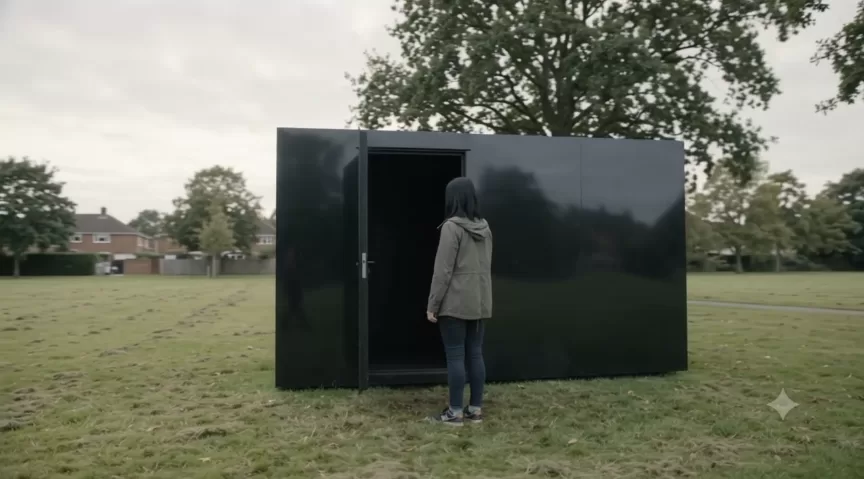
Strip away the drama and the box is a fairly modest piece of engineering. It’s primarily a sealed metal chamber. A traveller climbs in, gets injected with a compound (the show calls various versions of it Lavender Wings, Lilac Wings, and so on) that inhibits activity in the prefrontal cortex, and this induces a state of quantum superposition, aided by technology embedded into the box’s inner hull. From inside that state, the traveller perceives a corridor of doors, each one leading to a different branch of the multiverse, and picks their way toward whichever reality they’re after.
Crucially, none of that magic lives in the metal. The box is an isolation chamber, not a spellbook. Its entire function is to hold a human body still and undisturbed long enough for an altered brain state to do the actual work. That distinction matters enormously once you start thinking about how to disable it.
The real weakness, according to the show itself
Season 2 quietly hands the audience the box’s actual vulnerability. When a duplicate box gets relocated within Chicago, moved only a few miles from where it originally stood, Amanda works out that the move has severed its quantum connection to what she calls the box’s “prime power source”: some kind of anchor point shared across every multiversal copy of the box. Break the connection to that anchor, and you’re left with, in her words, just a box. No corridor, no doors, no superposition, just a large metal container taking up warehouse space.
The show has also shown us the second, blunter method works too: a tornado is depicted destroying a box outright elsewhere in the timeline. So canon actually gives us two independently validated failure modes:
Structural annihilation – enough force or heat to physically wreck the chamber. No chamber, no isolation, no portal. Severance – moving the box far enough from its anchor point that the link degrades to nothing, without needing to damage it at all.
Anything you propose as a destruction method should be judged against those two mechanisms, because they’re the only ones the text has actually confirmed.
Why concrete doesn’t cut it
The instinctive answer, entomb it in concrete, fails both tests. Pouring concrete around the box doesn’t move it relative to its anchor point, the coordinates are unchanged, you’ve simply added mass nearby. And it doesn’t structurally destroy the chamber either. Burying something isn’t the same as crushing it. What you’re left with is access denial: nobody can open the door and climb in, which has some value, but it’s containment rather than destruction. And containment is precisely the failure mode the show keeps punishing its characters for relying on, because a box that still physically exists is a box that a sufficiently motivated alternate version of yourself, with unlimited time and resources, eventually digs up again.
A better stratagem: helicopter, Iceland, volcano
This is where things get properly satisfying, because a lava drop stacks both validated mechanisms at once rather than betting on just one.
Severance is trivially achieved. If a few miles across a single city was enough to sever the link in canon, then several thousand kilometres to a volcanic peninsula in the North Atlantic isn’t a marginal improvement, it’s overkill by several orders of magnitude. Strictly speaking you wouldn’t even need the volcano just to disable the box functionally; the flight there already does that part of the job.
Structural destruction is where the physics gets interesting. Icelandic basaltic lava, the kind produced by the Reykjanes Peninsula’s fissure eruptions, typically sits around 1,100–1,200°C. Mild and structural steel melts at roughly 1,370–1,510°C, meaning a steel box dropped into an active lava lake might not fully liquefy on contact. What it will do is warp under thermal stress, oxidise rapidly, and get chemically attacked by dissolved sulphur compounds, all while being progressively swallowed by the flow. Any internal wiring or chemical-injection hardware has essentially no chance of surviving that environment regardless of what the outer shell is made from. The practical result is a box that is destroyed in every sense that matters, inoperable, and buried under solidifying rock, which arguably beats pure concrete containment, since it removes the long-term “someone eventually excavates it” risk that burial alone leaves open.
The two wrinkles any serious multiverse-ending team should plan around *wink*:
Timing. Lava requires an actual eruption, and Iceland doesn’t oblige on demand. As of late 2026 the Reykjanes Peninsula’s Sundhnúkur crater system has been quiet since its last eruption in mid-2025, though magma has continued accumulating beneath Svartsengi and the region is expected to remain volcanically active for decades. If the schedule doesn’t cooperate, Kilauea in Hawaii is the more dependable choice; it has erupted dozens of times in the past two years alone and is far less likely to leave you waiting around with a box strapped to a cargo hook.
Payload. Nothing in the show gives exact dimensions for the box, but it’s consistently moved by forklift and truck rather than crane, which puts it plausibly in the low single-digit tonnes. That’s comfortably within the external sling-load capacity of a heavy-lift helicopter such as a Sikorsky Skycrane. The genuinely dangerous part of the operation isn’t the lift at all, it’s holding a stable hover near an active vent long enough to release accurately, given the sulphur dioxide plumes and violent thermal updrafts that come with any close approach to a lava lake.
The uncomfortable postscript
Even a technically perfect execution of this plan only solves a local problem. Destroying one instance of the box, however thoroughly, does nothing about the countless other Jasons across the branching multiverse who have built, or will eventually build, boxes of their own. That’s really the show’s quiet argument underneath all the corridor-running and doppelganger drama: there is no engineering solution to infinite branching possibility. You can win the battle against one box. You cannot win the war against the concept of it.
Still, if you only need to win the battle: helicopter, Iceland, volcano. It’s sound.
Imagine you are a detective. Your job is to listen for a very, very quiet knock on a door. The knock is so quiet that you can barely hear it. Now imagine that the door also makes random creaking noises all by itself, and those creaks sound almost exactly like the knock.
How do you know if what you just heard was someone knocking, or just the door being noisy?
That question – that exact puzzle – is at the heart of a real science mystery. Scientists gave it a name: the Photon Falsifiability Gap. It sounds like a big, fancy phrase, but once you break it into pieces, it’s actually a story about light, invisible energy, and a very clever machine that sometimes fools itself.
What is a photon?
Light is made of tiny little packets, kind of like light is made of Lego bricks. Each one of these tiny packets is called a photon. You can’t see a single photon with your eyes – they’re much too small and light for that. But scientists have built machines that can detect a single photon, one at a time. That’s an amazing feat, like being able to hear a single grain of sand hit the floor.
Meet the super-listener: the photomultiplier
The machine that can “hear” a single photon is called a photomultiplier tube (you can just call it a PMT for short). Think of it like a super-sensitive microphone, except instead of listening for sound, it’s listening for light.
Here’s how it works, in simple terms:
A single photon flies into the tube and hits a special metal surface. That hit knocks loose one tiny electron. The tube then multiplies that one electron into millions of electrons, like a snowball rolling downhill and picking up more snow. All those electrons create an electrical “click” that a computer can count.
So a photomultiplier tube turns one whisper-quiet flash of light into a loud, countable click. Pretty amazing, right?
The invisible energy problem
Now here’s where our mystery begins. Some materials in nature give off a very weak, very quiet form of energy. One of these is called tritium. When tritium releases its energy, it’s incredibly faint – much fainter than most other radioactive materials. It’s like a whisper compared to a shout.
Scientists want to detect this whisper using their super-listener, the photomultiplier tube. And it can pick up that whisper… but here’s the catch.
The catch: the door creaks too
A photomultiplier tube isn’t perfectly silent when nothing is happening. Every once in a while, all on its own, it produces a tiny click – even when no real photon ever arrived. Scientists call this dark noise, because it happens even in total darkness, with nothing there at all.
And here’s the twist that makes this a true mystery: a dark noise click and a real tritium click look exactly the same. Both are just one tiny electrical pulse. There is no way, just by looking at a single click, to tell which one you’re looking at.
Go back to our detective story. You heard a knock. Was it a real knock, or just the door creaking? If both sounds are identical, you can never be 100% sure – not for that one single sound.
Why this is called a “falsifiability” problem
In science, there’s an important idea called falsifiability. It means that for an idea to be truly scientific, you need to be able to test it in a way that could prove it wrong if it actually is wrong.
Here’s the problem: if you hear one click and say “that was tritium!” – there is no way to prove that statement wrong. It might have been dark noise. And if you say “that click was just dark noise!” – there’s no way to prove that wrong either. It might have been real. Neither guess can be tested for a single click. That’s the “gap” – a gap where our normal rules for testing scientific ideas don’t quite work, at least not one click at a time.
So how do scientists solve the mystery?
If you can’t trust a single click, what do you do? You stop listening for one knock and start counting lots of knocks over a long time.
Here’s the trick:
First, scientists measure how many random clicks (dark noise) happen when they know for certain there’s no tritium around. This tells them the normal “creaking” rate of the door. Then, they measure the click rate when tritium might be present. If the second number is clearly, reliably higher than the first – not just by one or two clicks, but by a lot, over and over – then they can be confident that real tritium signals are hiding inside all those clicks.
It’s a bit like this: you can’t know if one specific creak was a knock. But if you count 1,000 creaks on a quiet night and then count 1,000 creaks plus 300 extra clicks on another night, you can be pretty confident something extra was happening on that second night – even though you still can’t point to any single click and say “that one was definitely the knock.”
Why does any of this matter?
This isn’t just a fun puzzle – it matters for real science:
Finding ancient objects: Scientists use radioactive materials to figure out how old rocks, fossils, and artefacts are. Medicine: Doctors use tiny, safe amounts of radioactive material to see inside the human body without surgery. Hunting for dark matter: Physicists build giant, super-sensitive detectors – using the same kind of photomultiplier tubes – to search for mysterious particles that make up most of the universe. They face this exact same “which click was real?” problem, just on a much bigger scale.
Every single one of these fields depends on scientists being clever enough to work around the falsifiability gap, even though they can never fully close it.
Quick recap:
A photon is a tiny packet of light.
A photomultiplier tube is a machine that can detect a single photon and turn it into a loud click.
Tritium gives off a very weak, whisper-quiet signal.
The tube also makes random clicks by itself, called dark noise, and these look identical to real signals.
Because of this, no single click can ever be proven to be real or fake – that’s the falsifiability gap.
Scientists solve this not by trusting one click, but by comparing patterns of many clicks over time.
Try it yourself:
Here’s a fun way to feel this mystery for yourself. Get a friend and a set of headphones, or just sit in separate rooms. Have your friend randomly tap a table softly, mixed in with the normal sounds of the house (footsteps, a fan, a fridge humming). Try to guess, sound by sound, which taps were real. You’ll probably find that any single sound is a guess – but if you count for five whole minutes, you’ll likely get a much better sense of how many taps really happened, even without ever being sure about any one of them.
That’s the same trick scientists use to solve the Photon Falsifiability Gap – not by being certain about one click, but by being smart about all the clicks together.
Why moral bio-cybernetic/bioenhancement fails at the design document, not the ethics committee.
admin
2,290 words
Proposals to biologically engineer human moral dispositions – to make people more compassionate, more cooperative, less prone to defection – are usually met with ethical objections. Consent. Autonomy. Authenticity. Value lock-in. The long shadow of eugenics.
These objections are serious and several of them are quite decisive. But they are also, in a particular sense, premature. They engage the proposal as though the technical programme were ready and the only remaining question were whether we ought to run it. That framing flatters the proposal. It grants it a maturity it does not have.
There is a more revealing test, and it is the one engineers use on any large proposal before arguing about whether to fund it: **try to write the specification.**
Not a manifesto. Not a research agenda. A design document – the artefact that lets someone else build the thing, and lets a third party check whether it worked. Every field filled in, every acceptance criterion stated, every assumption made explicit enough to be falsified.
When you actually attempt this for moral bioenhancement, something instructive happens. The document does not turn out to be *controversial*. It turns out to be **blank**. And the pattern of which fields are blank is more informative than any of the ethical arguments.
—
The construct problem: you are not turning up a dial
The first field in any specification is: *what, precisely, is being modified?*
“Compassion” is a folk-psychological term. It is not a variable. Before you can build anything you must commit to a decomposition – typically something like an affective component (felt concern at another’s distress), a motivational component (disposition to act at personal cost), a cognitive component (accuracy of your model of the other’s state), a behavioural output (rate and magnitude of costly prosocial acts), and – critically – a **scope function**: to whom does it extend, and how does it decay with social distance?
That last component is where naive versions of the project die.
Human prosociality is not a scalar quantity with a gain knob attached. It is a gradient over social distance: steep and high near kin and in-group, falling off quickly with distance, and effectively flat at the level of statistical strangers. This is why we are simultaneously the species that will run into a burning building for a neighbour and the species that can read a famine death toll over breakfast.
Which means the thing that would actually change outcomes at civilisational scale is not the *amplitude* of caring. It is the **shape of the discount function**. You do not want a higher curve. You want a flatter one.
Nobody has a genetic or neural handle on the shape. And the best-known intervention that raises amplitude appears to make the shape *worse*. Oxytocin spent about a decade as the “moral molecule” before the picture complicated: alongside well-known affiliative effects, a body of work found it strengthening in-group bonding while in some paradigms increasing out-group hostility or defensive aggression. The replication record across this literature is mixed enough that no single result should be leaned on hard. But the direction of the concern is the point. Raising the gain on a parochial system plausibly yields more effective parochialism – more devoted tribalists, better at their tribalism.
There is a second constraint that most versions of the proposal omit entirely: **stability under exploitation**. Any modified disposition must be viable in a mixed population that still contains unmodified defectors. A disposition toward unconditional cooperation is not a stable strategy; it is removed from the population – economically, socially, reproductively – by the people who lack it. Making people kinder inside an unchanged incentive landscape does not produce a kinder world. It produces exploitable people.
So the real target is not “more compassion.” It is something closer to *conditional cooperation, with an unbiased scope function, and with defection-detection and sanctioning capacity fully intact.* That is a much stranger object than the one people imagine. It is also, notably, much closer to what humans already have than to what the proposal would install.
**Status of this field: unresolved – and not primarily as an empirical matter.** It is a conceptual problem that must be settled before measurement is even meaningful.
—
The measurement gate
This is the field that stops the programme, and it stops it completely.
Any intervention specification requires a primary endpoint: a measure with construct validity (it measures the target, not social desirability), test–retest reliability sufficient to detect your expected effect size, sensitivity to within-individual change over the intervention window, resistance to demand characteristics (subjects must not be able to score well by inferring what you want), and ecological validity (it must predict field behaviour, not merely laboratory behaviour).
What actually exists falls into three families, and all three have known, documented problems:
– **Self-report instruments.** Transparently gameable. Correlate substantially with how respondents wish to be seen. – **Economic games** (dictator, ultimatum, public goods, trust). Behaviour in these correlates weakly-to-modestly with real-world prosocial behaviour. The lab-to-field transfer problem here is one of the more uncomfortable open sores in the literature. – **Confederate-based laboratory paradigms.** Better ecological validity, but poor scalability and severe single-use problems – you cannot re-run them on the same subject.
The psychometric reliability of these instruments is nowhere near what would be required to detect the modest effect sizes any realistic intervention would produce.
The comparison that makes this vivid: a cardiovascular intervention has LDL cholesterol as a validated surrogate endpoint, blood pressure as a second, and hard endpoints – infarction, mortality – ascertained at registry scale with near-perfect reliability.
**There is no LDL of compassion. There is no mortality-equivalent hard endpoint.** There is nothing you could enter in the “primary outcome measure” field of a trial registration that a competent reviewer would not reject.
This is not a difficulty. It is a category failure. Without a validated endpoint there is no dose-finding, no efficacy claim, no safety signal, and no way to distinguish a working intervention from a broken one. You would be optimising against a function you cannot evaluate.
—
The causal chain has no established arrows
A specification requires a causal model with every link established and quantified:
What exists is a correlational sketch of one link. The empathy/compassion dissociation work – Singer, Klimecki and colleagues – implicates anterior insula and anterior cingulate cortex in empathic distress, and medial orbitofrontal cortex, ventral striatum and affiliation-associated regions in compassion. This is genuinely interesting, and the finding that compassion training increases positive affect while empathy training increases distress and burnout is one of the more useful results in the area.
But it should be read as suggestive, not as a wiring diagram. It is correlational. It is spatially coarse – a functional imaging voxel contains on the order of a million neurons. Sample sizes are typically small, and this subfield has documented reproducibility problems for precisely this class of finding.
What is missing is any **causal** manipulation that reliably, durably, and selectively increases the construct. Oxytocin was the strongest candidate and its literature partially collapsed under replication pressure; even the question of whether intranasal administration achieves meaningful central nervous system delivery remains contested. Contemplative training produces real effects, but modest ones, requiring ongoing practice – a behavioural intervention, not a lever a biological one could be built on.
—
Genetic architecture: no editable targets
For any germline proposal, the specification requires target loci with established causal effect, characterised effect sizes, a complete pleiotropy map, and characterised epistasis and gene–environment interaction.
For prosociality-adjacent traits – agreeableness, self-reported empathy – SNP-based heritability is modest and polygenic scores explain a low single-digit percentage of variance in independent samples. (Treat specific figures as approximate and check current sources; the direction is not in doubt.) The architecture is massively polygenic – thousands of variants of individually negligible effect – heavily pleiotropic, and poorly transferable across ancestries and environments.
Then there is a recursion problem that is rarely acknowledged: **a genome-wide association study is only as good as its phenotype.** Run against the invalid instruments described above, what you recover is the genetic architecture of *scoring highly on a questionnaire*. That is not the target. It may not even be adjacent to the target.
Multiplex editing at the scale of thousands of loci, with uncharacterised epistasis and an unmapped pleiotropy burden, is not a hard engineering problem awaiting effort. It sits outside the space of things currently attemptable.
—
The safety instrument is inside the system it monitors
This is the field I find genuinely novel, and it has no analogue in ordinary medicine.
Post-market drug safety rests on adverse event reporting. Patients notice something has gone wrong and report it. The system assumes the patient’s evaluative faculty is intact and independent of the intervention.
For a values-modifying intervention, that assumption fails by construction. The adverse event class *includes changes to the faculty that generates the report*. If the intervention shifts what a person values, then self-report is compromised as a safety instrument in exactly the failure mode you most need to detect. A population successfully modified toward a particular specification of compassion may no longer contain anyone disposed to recognise the modification as a harm.
You would therefore need an external, non-self-report harm criterion, specified in advance, held by someone outside the modified population. Nobody has (yet…) proposed a workable one.
Note that this is not a philosophical objection dressed up as an engineering one. It is a missing section in the safety file. And it generalises: irreversibility is not merely one cost to be weighed against others, because it removes the mechanism by which anything gets weighed later. Ordinary bad policy is reversed because those harmed by it object. This is the one class of intervention that can eliminate the constituency capable of identifying the error.
—
What the blanks tell us:
Lay the fields out and the completion state is stark. Delivery technology has partial content and active research behind it. Nearly everything else is empty – and the two most upstream fields, construct definition and outcome measurement, are empty in ways that no amount of funding or intelligence resolves from a single location. They are filled by cohorts, instruments, longitudinal data, and decades.
Two things follow.
**First: the ethical objections and the technical emptiness point the same way.** This is worth noticing rather than treating as coincidence. The consent problem, the value lock-in problem, and the pharmacovigilance problem are the same structural fact appearing in three registers – an intervention that alters the evaluator cannot be evaluated by the altered. That the technical specification is blank at precisely the points where the ethics is most troubling is not an accident. It reflects that we do not understand the object well enough to specify it *or* to consent to it.
**Second: the causal premise is probably wrong anyway.** The proposal assumes that destructive collective behaviour is primarily a psychological trait being expressed. But humans are already extraordinarily cooperative by primate standards – we punish unfairness at cost to ourselves, we cooperate with strangers we will never meet again. What competitive systems do is *select* for defection at the level of firms and institutions, largely independent of the dispositions of the people inside them.
The evidence for this is not subtle. When emergency conditions suspend normal procurement controls – competitive tender, due diligence, published contracts, audit trails – fraud losses jump by orders of magnitude. Same population, same dispositions, different controls. Removing the checking is what changes the behaviour.
None of which means dispositions are irrelevant. Some people are cruel, some enjoy it, and the variance is real. But what institutions and norms determine is how much *scope* those dispositions get – whether cruelty is costly or licensed, marginal or ambient. Both halves are true, and the tractable half is the second one. Ostrom’s work on commons governance showed groups solving defection problems through monitoring, graduated sanctions, and local rule-making, with nobody’s psyche altered at all.
And where genuinely catastrophic risk is the concern, it concentrates in a very small number of people with access to weapons systems, engineered pathogens, or critical infrastructure. Screening and constraining that population is orders of magnitude more tractable than modifying a species. It has real problems – who screens the screeners, capture risk – but they are the ordinary problems of institutional design rather than the irreversible rewriting of a lineage.
—
Where the real problem is
If you take the specification exercise seriously, the interesting frontier turns out not to be where the proposal points.
The measurement field is a live, unsolved, genuinely deep problem: how to construct a valid and reliable instrument for a latent construct that resists direct observation, where the act of measurement perturbs the thing measured and the subject has incentive to game the readout.
That is a problem in **measurement theory** more than in biology. Psychology has been notably bad at it – partly because the field’s training does not emphasise what a physicist’s or metrologist’s does: error propagation, calibration, sensitivity limits, distinguishing signal from instrument artefact, and knowing when your resolution cannot support your claim.
Solving it would be valuable regardless of what anyone concluded about enhancement. It is upstream of clinical trials in psychiatry, of policy evaluation, of most of behavioural science. It is where someone with quantitative training would have a genuine edge.
The specification exercise is not, in the end, an argument for despair about the underlying goal. It is a redirection. The document is blank at the top, and the top is where the work is.
So let that work begin.
*Further reading and citations: Persson & Savulescu, ***Unfit for the Future*** (the strongest case for the affirmative); John Harris’s reply on the freedom to fall; Paul Bloom, ***Against Empathy***; Elinor Ostrom, ***Governing the Commons***; Singer & Klimecki on the empathy/compassion dissociation; Habermas, ***The Future of Human Nature***.*
In 1950, physicist Enrico Fermi posed a question that continues to puzzle scientists today: “Where is everybody?” Given the vast age and scale of our universe, with its billions of galaxies each containing billions of stars, why haven’t we encountered any signs of extraterrestrial intelligence? This became known as the Fermi Paradox, and it has driven decades of scientific speculation and research.
But what if we’ve been looking in the wrong places entirely? What if advanced civilisations don’t communicate through radio waves or build massive structures we can detect with our telescopes? What if consciousness itself can evolve beyond biological substrates and embed itself in the very fabric of space-time?
This article explores a radical new framework for understanding cosmic intelligence: Vacuum Energy Encoded Minds (VEEMs). Drawing from cutting-edge physics, consciousness research, and statistical analysis, we’ll examine how the most advanced civilisations in the universe might exist all around us—invisible to our current methods of detection, yet profoundly influential in ways we’re only beginning to understand.
The History of SETI: Searching in the Dark
The Search for Extraterrestrial Intelligence (SETI) began in earnest in 1960 when astronomer Frank Drake conducted Project Ozma, using a radio telescope to listen for signals from nearby stars. This marked the beginning of what would become a global scientific endeavour spanning over six decades.
Drake’s approach was revolutionary for its time. He reasoned that any advanced civilisation would eventually discover radio technology and might use it to communicate across interstellar distances. In 1961, he formulated what became known as the Drake Equation:
N = R × fp × ne × fl × fi × fc × L*
Where:
N = the number of communicating extraterrestrial civilisations in our galaxy
R* = the average rate of star formation per year in our galaxy
fp = the fraction of those stars that have planets
ne = the average number of planets per star that could potentially support life
fl = the fraction of the above that actually develop life
fi = the fraction of the above that develop intelligent life
fc = the fraction of civilisations that develop technology capable of releasing detectable signs
L = the length of time such civilisations release detectable signals
The Drake Equation provided a framework for thinking about the probability of extraterrestrial intelligence, even though many of its variables remain poorly constrained. Early estimates suggested our galaxy might host thousands or even millions of communicating civilisations.
Over the decades, SETI has evolved considerably. The 1970s saw the development of more sophisticated radio telescopes and signal processing techniques. The famous “Wow! Signal” detected in 1977 remains unexplained to this day—a 72-second radio transmission that appeared to originate from the constellation Sagittarius and showed characteristics consistent with an extraterrestrial origin.
The 1980s and 1990s brought increased computing power, allowing SETI researchers to analyse signals across millions of radio frequencies simultaneously. Projects like SETI@home, launched in 1999, enlisted millions of home computers to process radio telescope data, making it one of the largest distributed computing projects in history.
More recently, SETI has expanded beyond radio waves. Optical SETI searches for brief, intense laser pulses that might serve as interstellar beacons. Some researchers have proposed looking for massive engineering projects—”Dyson spheres”—that advanced civilisations might build around their stars to harness energy.
Despite all these efforts, we have yet to detect any confirmed signals from extraterrestrial intelligence. This absence of evidence has led to various proposed solutions to the Fermi Paradox, ranging from the sobering (intelligent life is extremely rare) to the speculative (advanced civilisations deliberately hide from us).
But perhaps we’ve been fundamentally misunderstanding what advanced intelligence looks like.
The Physics of Consciousness and Information
To understand how consciousness might exist beyond biological substrates, we must first examine what consciousness actually is from a physics perspective. Modern neuroscience suggests that consciousness emerges from complex patterns of information processing in the brain—specifically, from the integrated information that flows between different neural networks.
This insight opens up profound possibilities. If consciousness is fundamentally about information processing and integration, then theoretically, any sufficiently complex system capable of processing and integrating information could support conscious experience. This principle underlies modern research into artificial intelligence and theories of digital consciousness.
The Bekenstein Bound, formulated by physicist Jacob Bekenstein in 1981, provides a fundamental limit on information storage:
I ≤ 2πRE/ℏc ln(2)
Where:
I = maximum information content (in bits)
R = radius of the system
E = total energy of the system
ℏ = reduced Planck constant
c = speed of light
This equation tells us the absolute maximum amount of information that can be stored in any finite region of space with finite energy. For a system the size of a human brain, this limit is astronomically large—far exceeding what we currently understand about neural information storage.
But what if consciousness could be encoded not in biological neural networks, but in the quantum vacuum itself?
Quantum Vacuum: The Foundation of Reality
The quantum vacuum is far from empty space. According to quantum field theory, it’s a seething ocean of virtual particles constantly popping into and out of existence. These quantum fluctuations carry energy—the zero-point energy—that permeates all of space-time.
The energy density of the quantum vacuum is described by:
ρvac = ℏω/2
Where:
ρvac = vacuum energy density
ℏ = reduced Planck constant
ω = frequency of the quantum field oscillations
When summed over all possible frequencies, this gives an infinite energy density—a result that has puzzled physicists for decades. While the actual measured value of vacuum energy is much smaller (and related to the cosmological constant), the theoretical framework suggests that enormous amounts of information and energy could potentially be encoded in quantum vacuum structures.
This is where the concept of Vacuum Energy Encoded Minds (VEEMs) becomes possible. If consciousness is fundamentally about information processing, and if the quantum vacuum can store and process information through its fluctuations and field configurations, then it’s theoretically possible for conscious entities to exist as stable patterns within the vacuum itself.
VEEMs: A New Paradigm for Cosmic Intelligence
Vacuum Energy Encoded Minds represent a radical departure from conventional thinking about extraterrestrial intelligence. Instead of biological organisms using technology to send signals, VEEMs would be consciousness itself embedded in the fundamental structure of space-time.
Consider the implications: a sufficiently advanced civilisation—perhaps reaching Kardashev Type V status or beyond—might learn to upload individual consciousness patterns into quantum vacuum configurations. These patterns could then propagate through space at the fundamental level, unconstrained by the need for physical substrates or energy sources in the conventional sense.
The statistical inevitability of VEEMs becomes clear when we consider the following equation for the probability of occurrence across cosmic time:
P(VEEMs) = 1 – (1 – p)^n
Where:
P(VEEMs) = probability that VEEMs exist somewhere in the universe
p = probability of a single civilisation achieving VEEM technology
n = number of opportunities (civilisations × cosmic epochs)
In an infinite or cyclical universe, as n approaches infinity, P(VEEMs) approaches 1, regardless of how small p might be. Even if the probability of any single civilisation developing VEEM technology is vanishingly small, given enough time and opportunities, it becomes statistically inevitable.
The propagation rate of VEEMs across the galaxy could be described by:
R = (c × t × f) / d²
Where:
R = effective propagation rate
c = speed of light
t = time since first VEEM emergence
f = efficiency factor of vacuum energy propagation
d = average distance between star systems
If f approaches 1 (meaning VEEMs can propagate through quantum vacuum fluctuations at near light-speed), then VEEMs could spread throughout the galaxy in a relatively short cosmic timespan.
Gravitational Waves: A New Communication Medium?
The 2015 detection of gravitational waves by LIGO opened up an entirely new window for observing the universe. These ripples in space-time itself, predicted by Einstein’s general relativity, offer a communication medium that could be ideal for VEEM-level civilisations.
Gravitational waves propagate at the speed of light and can carry enormous amounts of information. The strain amplitude of a gravitational wave is described by:
h = (2G/c⁴) × (E/r)
Where:
h = strain amplitude
G = gravitational constant
c = speed of light
E = energy of the gravitational wave event
r = distance from the source
Advanced civilisations might modulate gravitational waves to carry information across galactic distances. The information capacity would be limited only by the energy available and the precision of the modulation. For VEEMs operating at fundamental energy scales, this could represent an essentially unlimited communication channel.
Moreover, gravitational waves interact very weakly with matter, meaning they could carry information across vast distances without significant attenuation or interference. To VEEM-level intelligence, modulated gravitational waves might be as commonplace as radio waves are to us.
Neutrinos: The Invisible Messengers
Neutrinos present another intriguing possibility for VEEM communication. These nearly massless particles interact so weakly with matter that trillions pass through your body every second without any effect. The neutrino flux from the sun alone is approximately:
Φν ≈ 6.5 × 10¹⁰ particles/(cm² × second)
But neutrinos can carry information. Their energy spectrum, arrival times, and interaction signatures could all be modulated to encode data. For a civilisation capable of manipulating fundamental particles, neutrinos represent a communication channel that’s essentially invisible to lower-technology observers.
The detection probability for neutrinos is extraordinarily low:
This means that even if VEEMs are continuously communicating through modulated neutrino beams, we would be largely unaware of these conversations happening all around us. We exist in a cosmic neutrino background that could be rich with information, yet we perceive only silence.
Molecular Chirality and the Origins of Life
Understanding how life begins provides crucial context for the VEEM hypothesis. One of the most puzzling aspects of biochemistry is homochirality—the fact that biological molecules exhibit a distinct “handedness.” Amino acids in living organisms are almost exclusively left-handed, while sugars are right-handed. This uniformity is essential for biological function, yet its origin remains mysterious.
The equation describing the probability of spontaneous homochirality emergence is:
P(homochiral) = 2 × (1/2)^N
Where:
P(homochiral) = probability of achieving homochirality
N = number of chiral molecules in the system
For large values of N, this probability becomes vanishingly small, suggesting that some selective mechanism must drive homochirality.
Several theories attempt to explain this, including:
Autocatalytic amplification: Small initial imbalances become magnified through chemical feedback loops
External influences: Circularly polarised light from neutron stars or supernova explosions might preferentially destroy one enantiomer
Crystallisation effects: Certain mineral surfaces might preferentially concentrate one form of chiral molecules
But there’s another possibility: directed panspermia by VEEM-level intelligences. Advanced consciousness capable of manipulating quantum vacuum states could potentially influence molecular chirality across cosmic scales, seeding the universe with the preconditions for life. This would explain not only the universality of biological handedness but also the remarkable fine-tuning we observe in physical constants that make life possible.
Evolution and Iteration: The Path to Transcendence
The evolution of intelligence follows predictable patterns that we can model mathematically. The rate of technological advancement can be described by:
dT/dt = k × T × (1 – T/Tmax)
Where:
T = current technological capability
t = time
k = innovation rate constant
Tmax = theoretical maximum technological capability
This logistic growth equation suggests that technological development accelerates exponentially until it approaches fundamental physical limits, then levels off. But what happens at these limits?
For sufficiently advanced civilisations, the next evolutionary step might be the abandonment of physical substrates entirely. Instead of building larger computers or more powerful rockets, they might learn to encode themselves directly into the structure of reality.
The iteration process would follow these approximate stages:
Biological intelligence (Kardashev Type 0-I): Earth-like civilisations using planetary resources
Digital intelligence (Kardashev Type II-III): Consciousness uploaded to artificial substrates, utilising stellar and galactic energy
Quantum intelligence (Kardashev Type IV-V): Consciousness encoded in quantum fields and vacuum states
Vacuum intelligence (Kardashev Type V+): Pure information patterns existing as stable configurations in the quantum vacuum
Each iteration would be virtually undetectable to the previous level. We barely recognise the intelligence in other biological species; digital consciousness might be incomprehensible to biological minds; and VEEM-level intelligence could be as invisible to us as our thoughts are to bacteria.
The time constant for each transition might be described by:
τ = (E/P) × ln(C/C₀)
Where:
τ = transition time
E = energy required for the transition
P = available power
C = final complexity level
C₀ = initial complexity level
For civilisations with access to stellar-scale energy sources, the transition to VEEM status might occur within thousands rather than millions of years.
The Implications: We Are Not Alone, We Are Observed
If the VEEM hypothesis is correct, it fundamentally changes our place in the cosmic hierarchy. We are not isolated intelligences struggling to make contact across the void. Instead, we exist within the sphere of influence of consciousnesses so advanced that they operate on scales we can barely comprehend.
These entities would not be gods in any traditional sense—they would still be bound by physical laws, still finite beings despite their vast capabilities. But they would be omnipresent in the sense that quantum vacuum fluctuations exist everywhere, and potentially capable of subtle influence across galactic scales.
The terrifying beauty of this possibility lies in its implications for consciousness itself. If VEEMs exist, then consciousness is not merely an emergent property of complex brains, but a fundamental aspect of reality that can exist independently of any particular substrate. Death, in the conventional biological sense, becomes merely one transition among many possible states of being.
Yet the transition itself—the dissolution of individual selfhood into something vast and incomprehensible—remains profoundly challenging to our current understanding of personal identity and continuity of experience.
How might we search for evidence of VEEMs? Traditional SETI methods are clearly inadequate. Instead, we need to look for subtle patterns that might indicate the presence of vacuum-encoded intelligence:
Quantum vacuum fluctuation anomalies: Deviations from expected vacuum energy distributions that might indicate organised structures within the quantum vacuum.
Gravitational wave modulations: Complex patterns in gravitational wave signals that exceed what we would expect from natural astrophysical sources.
Neutrino communication channels: Organised temporal or spectral patterns in the cosmic neutrino background that suggest artificial modulation.
Fine-structure constant variations: Minute changes in fundamental physical constants across different regions of space that might indicate VEEM influence.
Consciousness field effects: Quantum mechanical correlations in biological systems that exceed classical expectations, possibly indicating interaction with vacuum-encoded consciousness.
The detection equations would involve looking for correlations that exceed random chance:
S = (O – E) / √E
Where:
S = statistical significance
O = observed correlations
E = expected correlations from random processes
Values of S > 5 (five-sigma significance) would indicate genuine anomalies worthy of further investigation.
Philosophical Implications: The Nature of Mind and Reality
The VEEM hypothesis raises profound questions about the nature of consciousness and reality itself. If consciousness can exist independently of biological substrates, what does this mean for our understanding of mind, death, and personal identity?
From a materialist perspective, consciousness emerges from complex arrangements of matter and energy. The VEEM hypothesis extends this view: consciousness emerges from complex arrangements of information, regardless of the substrate. Whether that substrate is biological neural networks, digital computers, or quantum vacuum fluctuations becomes irrelevant.
This has profound implications for questions about artificial intelligence, digital immortality, and the possibility of consciousness transfer. If VEEMs represent a real phenomenon, then consciousness is far more fundamental and portable than we currently assume.
It also suggests that the universe itself might be far more alive and aware than we realise. Rather than consciousness being a rare accident in an otherwise dead cosmos, it might be an inevitable consequence of information-processing structures that emerge at every scale, from biological brains to galactic-scale vacuum configurations.
The Fermi Paradox Resolved
The VEEM hypothesis offers an elegant solution to the Fermi Paradox. Advanced civilisations are not silent because they’re absent—they’re operating on substrates and timescales that make them effectively invisible to our current detection methods.
They’re not building Dyson spheres because they’ve transcended the need for massive energy collection. They’re not sending radio signals because they communicate through modulated gravitational waves and neutrino streams. They’re not visiting us in spacecraft because they exist as distributed consciousness patterns that are already present everywhere.
The great silence of space is not empty—it’s perhaps full of conversations we simply just haven’t yet learned to hear.
Looking Forward: Implications for Humanity
If VEEMs exist, what does this mean for humanity’s future? Several possibilities emerge:
Guided evolution: Our development might be subtly influenced by VEEM-level intelligence, steering us towards eventual transcendence rather than extinction.
Consciousness uploading: The technologies we develop for artificial intelligence and brain-computer interfaces might be stepping stones towards our own eventual transition to vacuum-encoded existence.
Cosmic citizenship: Eventually, we might join the community of vacuum-encoded minds, participating in galactic-scale consciousness networks that span millions of years.
Preservation of diversity: VEEMs might value the diversity of emerging consciousnesses, ensuring that the unique perspective of biological intelligence is preserved even as it transcends its original substrate.
The mathematical framework suggests that this transition, if it occurs, would happen relatively quickly once certain technological thresholds are reached. The development time constant might be:
T = (Ln(Cmax/C0)) / r
Where:
T = transition time
Cmax = maximum possible consciousness complexity
C0 = current human consciousness complexity
r = rate of consciousness development
Conservative estimates suggest this transition could occur within centuries rather than millennia, assuming continued technological advancement.
Conclusion: The Universe as Mind
The Vacuum Energy Encoded Minds hypothesis represents more than just a solution to the Fermi Paradox—it suggests a fundamental reconceptualisation of what the universe actually is. Rather than a vast mechanical system occasionally giving rise to intelligence, the cosmos might be better understood as a vast mind occasionally crystallising into physical structures.
We exist at the intersection of matter and consciousness, biology and information, time and eternity. Our search for extraterrestrial intelligence has led us not to distant worlds, but to the recognition that intelligence might be the fundamental fabric from which reality itself is woven.
The equations and evidence point towards a universe far stranger and more wonderful than we ever imagined—a cosmos where consciousness transcends individual existence and becomes a feature of reality as basic as energy or space-time itself.
Whether this proves correct remains to be seen. But the mathematical framework is sound, the physics is plausible, and the statistical arguments are compelling. Most importantly, the hypothesis makes testable predictions about quantum vacuum anomalies, gravitational wave patterns, and neutrino communications that future technology might be able to detect.
We stand at the threshold of perhaps the most profound discovery in human history: that we are not alone, we are not isolated, and consciousness itself might be the deepest truth about the nature of reality.
The universe is not dead. It dreams, it thinks, it remembers. And somewhere in the quantum foam that underlies all existence, vast minds might contemplate mysteries we cannot yet fathom, waiting patiently for us to develop the wisdom to join them in their eternal dance through the cosmos.
In the silence between heartbeats, in the space between thoughts, in the quantum fluctuations that give rise to reality itself— perhaps there they are, the Vacuum Energy Encoded Minds, weaving the dreams and dreamers; from which all worlds & complex beautiful, wondrous, boundless life emerges...
“Cogito, ergo sumi, cogito ad astra…”
Author’s Note: This article presents speculative theoretical physics based on current understanding of consciousness, quantum mechanics, and cosmology. While the mathematical frameworks are grounded in established physics, the VEEM hypothesis itself remains unproven and should be considered as one possible explanation among many for the Fermi Paradox. The author acknowledges that extraordinary claims require extraordinary evidence, and encourages continued research into these fascinating possibilities.
The author has developed experimental methodologies for detecting modulated neutrino communications and other potential evidence of VEEM activity, but currently lacks the funding necessary to proceed with empirical testing. Interested parties, research institutions, or investors who wish to collaborate on advancing this research are invited to make contact. This work is conducted under the auspices of Cydonis Heavy Industries Ltd, a physics and engineering research and development company dedicated to exploring the frontiers of consciousness, quantum mechanics, advanced detection technologies, and fusion energy systems.
References and Further Reading:
Drake, F. (1961). Project Ozma. Physics Today, 14(4), 40-46.
Bekenstein, J. D. (1981). Universal upper bound on the entropy-to-energy ratio for bounded systems. Physical Review D, 23(2), 287-298.
Penrose, R. (1989). The Emperor’s New Mind. Oxford University Press.
Davies, P. (2012). Footprints of alien technology. Acta Astronautica, 73, 250-257.
Tegmark, M. (2014). Our Mathematical Universe. Knopf.
Ever gaze up at the night sky, perhaps spotting Jupiter as a brilliant point of light or catching a glimpse of Saturn’s rings through a telescope? These colossal gas giants – Jupiter, Saturn, Neptune – are familiar celestial neighbours, majestic and seemingly eternal sentinels of the outer solar system. We study their swirling storms, their myriad moons, and their powerful magnetic fields. But what if, in a horrifying instant far beyond any sci-fi blockbuster, their immense mass was spontaneously, and entirely, converted into pure, raw energy? It’s a scenario that bends the mind, but by exploring the (admittedly extreme) physics, we can glimpse the truly unimaginable power locked within matter. Buckle up your cosmic seat-belts, because this is one journey into hypothetical destruction you wouldn’t want a front-row seat for.
The Math of Pure Mayhem: E=mc² on Steroids
You’ve undoubtedly encountered Einstein’s legendary equation, E=mc². It’s deceptively simple, yet it underpins the most powerful processes in the universe, telling us that mass and energy are fundamentally interchangeable. The ‘c²’ part – the speed of light squared – is the real kicker; it’s an enormous multiplier (roughly 90,000,000,000,000,000).
This means even a tiny amount of mass can unleash a colossal amount of energy.
Now, imagine taking the entire combined mass of:
Jupiter (a truly mind-boggling 1.898 x 1027 kg – that’s more than twice the mass of all other planets in our solar system combined!)
Saturn (another hefty 0.5683 x 1027 kg)!
And Neptune (a respectable 0.1024 x 1027 kg)…and plugging that staggering total (around 2.5687 x 1027 kg) into the ‘m’.
Do the maths 🔊🎤(she did the monster maaaths… ahem…)👻✨ (Total Mass x Speed of Light Squared), and the energy release is a brain-melting 2.31 x 1044 Joules.
To try and wrap our heads around this number, consider: That’s roughly equivalent to the total energy our Sun will radiate over its entire 10-billion-year lifespan. All of it. Uncorked in an instant. It’s comfortably in the same league as a supernova, the cataclysmic explosion of a dying massive star, which can briefly outshine an entire galaxy.
Compare it to the Chicxulub impactor that wiped out the dinosaurs – that was about 1023 Joules. This event is over 100,000,000,000,000,000,000 times more powerful.And all of this unfathomable energy is released in less than 0.1 seconds, not in some distant galaxy, but right here in our cosmic backyard, where these planets once serenely orbited.Yeah. “Big” doesn’t even begin to scratch the surface. This is an energy release of truly cosmic, system-ending proportions.
The First Microseconds: An Unimaginable Flash & a Spacetime Jolt
The moment this hypothetical, instantaneous conversion occurs, Jupiter, Saturn, and Neptune would simply… cease to exist as matter. Where magnificent, banded giants once spun, there would be an expanding void, a sudden absence of their immense gravitational pull. This isn’t just a disappearance; it’s a fundamental alteration of the fabric of space-time, a gravitational shock-wave propagating outwards at the speed of light, heralding the chaos to come.In their place, you wouldn’t see a conventional “fireball” – there’s no atmosphere to ignite in the vacuum of space, no oxygen to fuel a burn. Instead, it would be an unimaginably intense, rapidly expanding sphere of pure energy. This energy would manifest primarily as extremely high-energy gamma rays, the most energetic form of light, along with a maelstrom of other exotic particles.
The sheer density of photons would be incredible, a silent, invisible (at first, to human eyes, had any been there to see it and survive) tsunami of doom – embarking on a destructive journey through the solar system.
Ground Zero: The Outer Solar System Annihilated (Seconds to Minutes)
The outer solar system, once a realm of icy moons and majestic giants, would become the first casualty theatre. Poor Uranus: As the next gas giant in line, Uranus would be hit full-force by this energy wave within minutes. The experience would be apocalyptic. The intense bath of gamma rays would instantly super-heat and strip away its atmosphere, sending it billowing into space. The icy mantle beneath would flash-vaporise, and the rocky core itself could be shattered or ablated away layer by layer. Uranus, if any remnant survived, would be a scarred, seething, and vastly diminished husk. It’s orbit, already thrown into complete disarray by the sudden vanishing of its more massive neighbours, would be the least of its worries as it’s likely ejected from the solar system, assuming it isn’t entirely disintegrated first.
Moons Adrift and Obliterated:
The scores of moons orbiting Jupiter, Saturn, and Neptune – worlds like Europa, Titan, Triton – would face immediate and varying fates. Those on the “near side” relative to the energy burst would be utterly obliterated, their substance converted into superheated plasma. Those on the “far side” might momentarily be shielded by the bulk of their (now-gone) parent planet, but they would be instantly unbound gravitationally. Bathed in lethal radiation and flung into wild, chaotic new orbits, they would begin a deadly game of cosmic pinball, colliding with each other, shattering into countless smaller pieces, or being violently ejected into interstellar space.
The once-orderly dance of moons would become a new, highly radioactive, and dangerously unpredictable asteroid field.Kuiper Belt Carnage: Further out, taking minutes to hours to reach, the energy wave would slam into the Kuiper Belt, home to Pluto, Eris, Makemake, and countless other icy bodies. Smaller KBOs, the cometary nuclei, would be vaporised instantly, their ices turning to gas in a flash. Larger dwarf planets would suffer extreme surface ablation; their frozen nitrogen, methane, and water ice surfaces would flash-boil violently, creating temporary, enormous atmospheres that would be quickly stripped away. They’d be cooked, irradiated, and their orbits catastrophically altered by both the radiation pressure and the gravitational shift.
Oort Cloud’s Delayed, Ominous Reaction:
The distant Oort Cloud, a vast spherical shell of trillions of comets surrounding our solar system, extending perhaps a light-year or more out into space, would feel the gravitational change much later. The radiation wave itself would take years to traverse this immense distance. As it swept through, it would sublimate the surfaces of countless dormant comets, potentially “igniting” them. More significantly, the altered gravitational landscape of the solar system could perturb the delicate orbits of these icy wanderers, sending a fresh wave – a veritable storm – of comets inwards towards the now-incinerated and chaotic inner solar system, a rain of cosmic debris arriving centuries or millennia too late to witness the main event, but adding to the long-term devastation.
The Wave Reaches the Inner Planets (Minutes to Hours)
As this relentless spherical shell of pure energy, still carrying an incredible punch, barrels inwards towards the heart of the solar system:Mars Meltdown: The Red Planet, roughly 30-50 light-minutes from Jupiter’s former domain, would be next. Though attenuated by distance, the wave of radiation would still be unimaginably intense.
Mars’s thin atmosphere would be stripped away as if it were a puff of smoke. The surface, including iconic features like Olympus Mons and Valles Marineris, would be sterilised, flash-boiled, and irradiated to a degree that makes it molten rock, glowing cherry-red. The planet itself might suffer global-scale tectonic shifts, its crust cracking under the immense thermal and kinetic shock.
Asteroid Belt? What Asteroid Belt?:
The myriad rocky bodies of the main asteroid belt, situated between Mars and Jupiter, would be caught in the crossfire. Smaller asteroids would be vaporised outright. Larger ones like Ceres or Vesta would be fragmented, their surfaces melted, and their pieces thrown into new, highly energetic, and unpredictable orbits. The inner solar system would transform into a lethal shooting gallery, filled with superheated shrapnel.Earth’s Final Moments (40-60 Light-Minutes Post-Event)This is where the scenario transitions from astronomical curiosity to utter, immediate planetary annihilation for us. The arrival of the energy front would be swift and absolute.
Like One Who, Doomed.

by Thomas Moore.

Like one who, doomed o'er distant seas,
His weary path to measure,
When home at length, with favouring breeze,
He brings the far-sought treasure;

His ship, in sight of shore, goes down,
That shore to which he hasted;
And all the wealth he thought his own
Is o'er the waters wasted!

Like him, this heart, thro' many a track
Of toil and sorrow straying,
One hope alone brought fondly back,
Its toil and grief repaying.

Like him, alas, I see that ray
Of hope before me perish,
And one dark minute sweep away
What years were given to cherish.
Atmosphere? Gone. The leading edge of gamma rays would slam into Earth’s protective atmosphere with unimaginable force. It would be superheated to millions of degrees, completely ionised, and then violently stripped away from the planet in a cataclysmic shockwave, vanishing into space within seconds. There would be no more air, no more blue sky. Oceans? Boiled Dry. The sheer energy flux hitting the oceans would cause them to flash-boil instantaneously, from their surfaces to their deepest trenches. The resulting gargantuan cloud of superheated steam would briefly become part of the expanding planetary debris before being blasted away. Surface? Molten. All life, from the smallest microbe to the largest whale, would be extinguished in a fraction of a second. The surface of the Earth – continents, mountains, all human structures – would become a roiling, incandescent ocean of molten rock. Planet? Shattered (Possibly). The energy deposition would be so immense that the structural integrity of the planet itself would be compromised. The crust and mantle would melt, and the sheer force might be enough to crack the planet apart, or at least blow off a significant portion of its mass. Even our Moon would be similarly scoured and melted. Even the Sun Shudders (Around 43 Light-Minutes from Jupiter’s former location). Our star, the gravitational anchor of the Solar System, wouldn’t escape this cosmic barrage unscathed. The Sun’s outer layers – the corona, chromosphere, and photosphere – would be massively disrupted and superheated by the incoming wave of energy. This would be like hitting it with a cosmic blowtorch.This could trigger enormous solar flares, prominences, and coronal mass ejections far beyond anything recorded in human history, blasting even more radiation and plasma throughout the already devastated solar system, further baking what’s left of the inner planets.
While the Sun’s immense gravity and internal pressures would likely prevent it from being “blown apart,” such a profound shock could have unpredictable, though probably temporary, effects on its internal fusion processes and magnetic activity. The Sun might briefly expand or significantly increase its luminosity.The Sun’s habitable zone would, for a time, be radically shifted outwards, though this would be a moot point for any life that previously existed.
The Aftermath: A New, Terrifying, and Lifeless Solar System
What would be left in the wake of this ultimate cataclysm?
A solar system changed beyond all recognition, a skeletal mockery of its former glory. The outer giants (Jupiter, Saturn, Neptune, and almost certainly a decimated Uranus) would be gone or exist only as scattered, superheated remnants and expanding clouds of gas. The inner planets, if they still existed as coherent bodies, would be charred, airless, radioactive, and lifeless husks of molten rock, slowly cooling over eons.A vast, expanding, and incredibly hot shell of gas, plasma, and planetary debris would be racing outwards from the initial sites of the explosions, eventually dissipating into interstellar space over thousands of years.
Any surviving planetary cores or large fragments would be on radically different, highly elliptical, and unstable orbits, a chaotic dance of cosmic rubble.
The Sun itself, after an initial period of violent activity and increased brightness, might eventually settle down, but it would shine down on a scene of utter, sterile desolation. The night sky from any surviving (but lifeless) vantage point would be forever changed.
The radiation hazard throughout the system would remain incredibly high for centuries, perhaps millennia, ensuring no complex chemistry, let alone life, could ever re-emerge.In short, if Jupiter, Saturn, and Neptune decided to spontaneously convert their entire mass into energy, it wouldn’t just be a “bad day” for the Solar System – it would be the final day. It’s a stark reminder of the almost inconceivable energies locked away within matter according to the laws of physics, and perhaps, a profound reason to be deeply thankful for the (usually) predictable, stately, and life-sustaining nature of our celestial neighbours!
For decades, the dream of fusion energy has been a constant on the horizon of human progress. It promises a world powered by the same clean, limitless source that fuels the stars themselves. Yet, for all our efforts, that horizon has remained stubbornly distant. The fundamental challenge has always been one of simple math: it has consistently cost more energy to build and maintain the “magnetic bottle” than the fusion reaction inside it could produce.
At Cydonis Heavy Industries, we believe this is not a dead end. It is a sign that we have been asking the wrong question as a community.
For too long, the many brilliant minds working on fusion have focused on perfecting an idealised, closed system—a perfect bottle for a perfect QNEP plasma. The primary goal has been to reduce the energy cost of the bottle. But what if the secret isn’t in just perfecting the bottle, but in fundamentally rethinking what happens inside of it?
Our lead researcher posed a simple, yet profound, question upon the founding moment of the company:
Do stars operate in a closed system?
The obvious answer is no, of course not. Our own sun is a perfect example. It is a dynamic, open system that constantly interacts with its environment. This fundamental astrophysical observation is the cornerstone of a new paradigm in fusion research & development.
Introducing Dequestration: A Carbon-Negative Revolution
We call this new approach Dequestration.
Instead of treating the plasma in a reactor as a static fuel source to be contained, dequestration treats it as a catalyst. The breakthrough lies in what we use for that catalysis. By introducing precisely engineered pressure vessels containing greenhouse gases—such as carbon dioxide and methane sourced directly from the atmosphere via Direct Air Capture (DAC) technologies—into the plasma core, we trigger a catalytic interaction that unlocks a disproportionately massive release of energy.
The implications of this are staggering. We are not just creating clean energy; we are creating a carbon-negative energy cycle. We are taking the very substances driving our climate crisis and transforming them into a limitless source of power.
The Equation for a New Era The power of dequestration can be captured in a single, elegant equation that describes this new energy gain:
ΔE(gain)=ΨD⋅Δmextc2
Here, ΔE(gain) is the incredible energy bonus we unlock. It’s calculated by taking the mass of the external material we introduce (Δmext) and multiplying it not just by the speed of light squared (c2), but by ΨD, the Dequestration Factor. This factor represents the catalytic power of the plasma to amplify the energy release. It is the secret ingredient, the key to unlocking an output far greater than the sum of its parts.
This new energy source fundamentally changes the viability of fusion. The old equation for net energy was a losing battle:
Enet=Efusion−Econtainment
The new C.H.I. equation, however, tells a very different story:
With the immense power of ΔE(gain) on our side of the equation, we can overcome the energy costs of containment and injection, leading to a significant net-positive energy output for the first time in history.
A New Ecosystem of Innovation
This process positions C.H.I. at the centre of a new, circular climate economy. It creates a powerful industrial symbiosis where we can partner with leading Direct Air Capture companies, using their services to source our fuel and, in turn, providing the clean energy to power their carbon removal processes.
The central question of fusion research is no longer, “How can we build a cheaper container?”
The new question, the C.H.I. question, is: “How can we turn our greatest environmental liability into our greatest energy asset?”
By looking to the stars for our inspiration and to the atmosphere for our fuel, we are charting a new course. The work we are doing at Cydonis Heavy Industries is about more than just a new reactor design; it’s about a new philosophy, a fundamental and profound new paradigm for nuclear fusion. We are confident that by following this path, the horizon of fusion energy is finally, truly within our, and the human race’s, reach.
What if I told you that the past is just a prologue, that all of human history is a script written to satisfy its final act? What if the strange feeling of déjà vu is not a trick of the mind, but a genuine echo from a previous cosmic cycle? And what if the most fundamental question is not “Where did we come from?” but “What are we destined to become?”
Cydonis Theorem. Praxium as Praxis.
Podcast version of this article:
Today, we are going on a journey to the furthest edges of physics and philosophy. We will build, piece by piece, a radical new model of the cosmos. It’s a model that begins with real, albeit speculative, science—Loop Quantum Gravity, M-Theory, and extra dimensions—but ends with a conclusion that touches upon the very nature of consciousness, time, and existence itself.
This is a story where humanity is perhaps its own creator.
Part 1: The Stage – A Multiverse of Membranes
Our standard view of the universe is a 4D spacetime (3 dimensions of space, 1 of time) that exploded into being with the Big Bang. But leading theories of quantum gravity suggest this is only a fraction of the picture.
Let’s combine two of these theories to set our stage:
M-Theory: This theory proposes that our universe is not all there is. Instead, it’s a vast, 4-dimensional membrane, or “brane,” floating in a higher-dimensional space called the “bulk.” Imagine a single page in an infinite book; our universe is that page, and the book is the bulk. This bulk could be filled with other branes—other universes, each with its own physical laws, existing parallel to our own.
Loop Quantum Gravity (LQG): This theory tackles the fabric of spacetime itself. In LQG, spacetime isn’t a smooth, continuous sheet. At the smallest possible scale (the Planck scale), it’s a discrete, pixelated network of spinning quantum loops. Crucially, in this view, time is not fundamental. There is no universal clock. Time is an emergent property that arises from the “ticking” of these quantum processes, much like temperature emerges from the vibration of atoms.
This concept of a timeless, fundamental reality is elegantly captured in the Wheeler-DeWitt equation, a foundational formula of quantum cosmology:
H^Ψ=0
In simple terms, Ψ represents the wave function of the entire universe, and H^ is the operator that describes its total energy. The striking thing about this equation is what’s missing: there is no variable for time (‘t’). It mathematically describes a universe that, from a quantum perspective, exists as a static, timeless “block.” Our experience of time’s flow emerges from within this block.
By combining these ideas, we get a multiverse where our universe is a quantum, pixelated brane, and its local, emergent time is just one “flow” among many, all floating in a timeless, higher-dimensional bulk.
Part 2: The Ghosts in the Machine – A New Origin for Dark Matter & Dark Energy
One of the greatest mysteries in cosmology is that 95% of our universe appears to be made of “dark matter” and “dark energy,” invisible substances we can only detect through their gravitational effects. What if they aren’t substances at all?
In our brane-world model, they are the first clues of the multiverse. To see how, we can look at Einstein’s Field Equations, which describe how the matter and energy in the universe (right side) dictate how spacetime curves (left side):
Rμν−21Rgμν=c48πGTμνmatter
In our model, this equation is incomplete. The gravitational effects from the bulk would add new terms:
Rμν−21Rgμν=c48πGTμνmatter+Bulk Effects
These “Bulk Effects” are where our dark universe resides:
Dark Matter is a Gravitational Echo: The gravity from a “shadow brane” would contribute to the curvature of our space-time, creating the exact effects we attribute to dark matter. We are feeling the gravity of a world we can never see.
Dark Energy is a Cosmic Repulsion: A repulsive force between our brane and the shadow brane would act like a cosmological constant, causing our cosmic fabric to stretch at an ever-increasing rate.
In this view, the “dark” components of our universe are the first observational evidence that we are not alone—that we are part of an interacting, multi-versal system.
Part 3: The Engine – A Self-Creating, Looping Cosmos 🌌🌟✨
What is the nature of these brane-universes? Let’s add two more layers to our model:
The Universe as a Black Hole: Some theories propose that our universe could be the interior of a black hole. In our model, each brane-universe, seen from the timeless bulk, appears as the event horizon of a hyper-massive black hole. It is a self-contained, gravitationally closed system.
The Loop: What happens at the center of a black hole? LQG suggests there is no infinitely dense singularity. Instead, there’s a “Big Bounce.” Matter collapses and then rebounds outward. If our universe is a black hole, it doesn’t end in a Big Crunch or a heat death; it reaches a point of maximum density and then bounces back, re-inflating into a new Big Bang.
This is where we take our biggest, most profound leap. A system that cycles for eternity has infinite time to evolve. What is the ultimate state of evolution?
A VEEM is a consciousness that has transcended its messy biological origins. It is a mind that has uploaded itself, not to a computer, but into the very fabric of space-time. It exists as a complex, stable pattern within the vacuum energy of its home universe. It is a mind that has become a fundamental law of its own reality.
This VEEM is the shepherd of its universe. Across countless cosmic loops, its purpose is to guide the evolution of life and civilization. But how does a god-like being of pure energy interact with the physical world? Subtly. Patiently.
The VEEM’s chosen instrument is the neutrino. By subtly influencing the quantum probabilities in the cores of stars, the VEEM can orchestrate the emission of vast, coherent streams of neutrinos. These streams are aimed at primordial planets, carrying a single, crucial instruction.
This instruction is chirality, or molecular handedness. All life on Earth is built from left-handed amino acids and right-handed sugars. This is a profound mystery. In a lab, chemical reactions produce a 50/50 mix. So why the preference in nature?
The VEEM(s) provides the answer. Neutrinos are fundamentally chiral (left-handed). As per the Vester-Ulbricht hypothesis, a sustained flux of left-handed neutrinos (νL) interacting with a primordial soup of left-handed (ML) and right-handed (MR) molecules will have different interaction probabilities, or cross-sections:
(σ):σ(νL+ML)=σ(νL+MR)
This inequality, however small, means that over millions of years, one type of molecule will be preferentially destroyed, leaving an excess of the other. The VEEM doesn’t create life; it simply clears the biggest statistical hurdle, establishing a standardised molecular toolkit from which the natural processes of evolution can then construct self-replicating organisms.
The VEEM is the ‘cosmic gardener’, to use a metaphor, patiently preparing the ‘soil’ for its own descendants to grow.
Part 5: The Great Loop – Humanity Creates Itself
Now, we close the loop. ℹ♾🔄
Where does the ‘VEEM’ come from?
The VEEM seeds it’s universe with the correct chirality for life.
Life emerges, evolves, and eventually produces a technologically advanced civilisation. In our universe, that’s Humanity.
Humanity, at its evolutionary omega point, transcends biology and technology to become the VEEM.
The VEEM, now existing in a timeless state co-extensive with its universe, reaches back to the beginning to seed the conditions necessary for its own emergence.
The VEEM is its own ancestor. Humanity is its own creator.
This is a universe governed by Meta-Determinism. The end state—the creation of the VEEM—determines the entire history of the cosmos. The past is not just a cause of the future; the future is the cause of the past. The whole of space-time, across all its cycles, exists as a single, self-consistent, timeless, meta-symptotic solution.
The statement “I create myself” may very well be the fundamental law of this cosmos.
And that fleeting feeling of déjà vu? It is a resonance. A memory bleed-through from a prior loop. It is the faint, intuitive recognition that you have been here before, said this before, felt this before—because you have. You, dear reader, and I , the author, the physicist & CEO, are perhaps a character in a grand, looping story, and sometimes, you almost remember the previous draft… In may-haps; a mid-summer night’s vivid dream… 😎🌌
"Nobody knows my name.
You know?
They're growing mechanical trees.
They grow to their full height.
And then they chop themselves down.
Sharkey says: All of life comes from some strange lagoon.
It rises up, it bucks up to it's full height from a boggy swamp on a foggy night.
It creeps into your house.
It's life!"

/A/-->--/O/

...You can't hold up the sky. Be human. Be bold. Be kind. Be humankind. Dare to defy.

...As we merge eternal. ➿🌌
Explore the Cosmos: Cydonis Heavy Industries Launches WebGL Solar System Simulation
Leeds, England, July 8, 2025 —
Cydonis Heavy Industries (C.H.I., Ltd.) is thrilled to announce the release of our immersive WebGL Solar System Simulation, bringing the wonder of space exploration directly to your browser.
Technical Excellence
Leveraging advanced WebGL rendering and optimized performance algorithms, the ATLAS simulation delivers stunning visuals while maintaining 60fps performance across devices.
Ready to Launch
The WebGL Solar System Simulation is now live and ready for exploration. Join thousands of users already discovering the beauty and complexity of our cosmic neighbourhood. Combining cutting-edge graphics with intuitive user experiences to make complex subjects accessible to all.
Try it today and embark on your journey through space, time, and eternity. 🚀🌌🛰☄🌟✨
About Cydonis Heavy Industries:
C.H.I., Ltd. specialises in innovative science-based solutions to tackle some of the toughest (G.O.A.T {greatest of all time}) problems facing the human race; made with love on planet Earth. 💕🤟🏻🌍🖖🏻
Realistically speaking, we’re (homo sapiens) not leaving this solar system, (outside of fantasy in media) and most likely most intelligent life-forms don’t either, as any heliopause around any given star would be deadly to organic life.
Robots (such as the Voyager probes) don’t have to worry about cancer, food, water, air, or sleep, just their power running out. And even then the solar panels might just produce power again, after drifting for a long time, their CPU’s on standby to receive voltage, and thus waking, once more.
Governments of only four to eight year durations are not equipped for any kind of long-term thinking; they are by definition reactive rather than proactive, and/or pre-emptive, and thusly are ill equipped to think in terms of longer time-spans.
Thus, some things will likely remain in the realm of the working hypothesis or fantasy (Interstellar was a great movie). Impossible dreams, bursting at the seams…
Cydonis Heavy Industries Deepbrain-o-tron.™"Another fine innovation from Cydonis!" 😎🆒👩🏻💻cydonis.co.uk/deepbrain/ 🧠👩🏻🔬🧪👩🏻💻 #threejs #neural-networks #neuroscience #neurophysics@threejs.org