*On the overview effect, DMT, and the non-catastrophic path to a solarpunk civilisation.*

"One thought ever at the fore—
That at the Divine Ship, the World, breasting Time and Space,
All peoples of the globe together sail, sail the same voyage, are bound to the same destination." - Walt Whitman (May 31, 1819 – March 26, 1892).
*A thesis of speculative philosophy.*
—
There is a version of the future that does not require catastrophe first.
It is not guaranteed. It is not even, given current trajectories, particularly probable. But it is possible in a way that matters – not as fantasy, but as a set of principles and practices already being tested in fragments all over the world. Getting there, however, requires something unprecedented: a civilisational shift in consciousness, achieved deliberately, before the alternative makes it unavoidable.
This is an attempt to think seriously about what that shift might look like, and how it might be designed.
—
The Two Roads
Gene Roddenberry was honest about it, even if *Star Trek* usually glossed over the details. The United Federation of Planets – that vision of humanity curious rather than acquisitive, diverse rather than tribal, oriented toward contribution rather than accumulation – does not emerge from gradual enlightened progress. It emerges from the Eugenics Wars, then the Atomic Horror. A period of such comprehensive devastation that the survivors were, in a sense, selected for and radicalised toward cooperation simply because the alternative had been made undeniably, inescapably visible.
The uncomfortable truth embedded in Trek’s own mythology is that civilisations tend to change at the scale required only when the cost of *not* changing becomes viscerally, personally real.
Climate change has a particularly cruel relationship with this dynamic. Most historical crises that produced genuine civilisational change had a quality of sharpness – a moment when the before and after were unmistakable. A war ends. A bomb drops. The catastrophe is legible. You can point to it and say: *that. Never again that.*
Climate change is different in almost every way that makes collective response difficult. It is slow relative to a human attention span but fast relative to civilisational adaptation rate(s). The worst consequences are unevenly distributed – the people with the most power to act face the mildest early consequences, while those facing existential threat right now have the least leverage over global systems. It is causally diffuse; you cannot point to a hurricane and say *that specific molecule of CO2 from that specific decision caused this*. And it interacts with everything else – a climate-driven war wouldn’t announce itself as a climate war. It would look like a water war, a food war, a migration crisis, a failing state. The climate signal buried under layers of proximate causes, each one attracting its own political narrative and its own blame.
This is a crisis specifically designed by its nature to defeat the cognitive and institutional tools humans have developed for responding to crises.
The most plausible bad road isn’t a sudden nuclear exchange over abstract principles. It’s something more gradual and more total: sustained drought across multiple arable farmland bread-baskets simultaneously, food price shocks rippling into political instability, fragile states failing, refugee flows stressing receiving countries into their own crises, nationalist movements taking power in enough places to break the international cooperation that climate response requires – while the feedback loops continue regardless. Not one war but a long, grinding, multi-theatre catastrophe with no clear end because the underlying driver is still operating.
This is not a fringe scenario. It sits somewhere in the central range of projections if current trajectories hold.
And so the question that haunts any honest thinking about the future is whether the non-catastrophic road remains open, and if so, what would have to happen for humanity to take it.
—
A Thought Experiment
Imagine two experiences, offered to every person on Earth within a few years of their twenty-first birthday, as a kind of global coming-of-age ceremony.
The first is the overview effect.
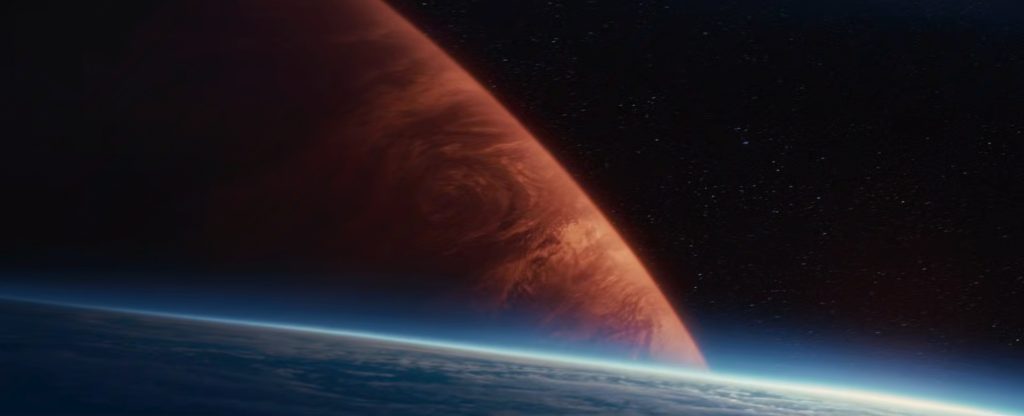
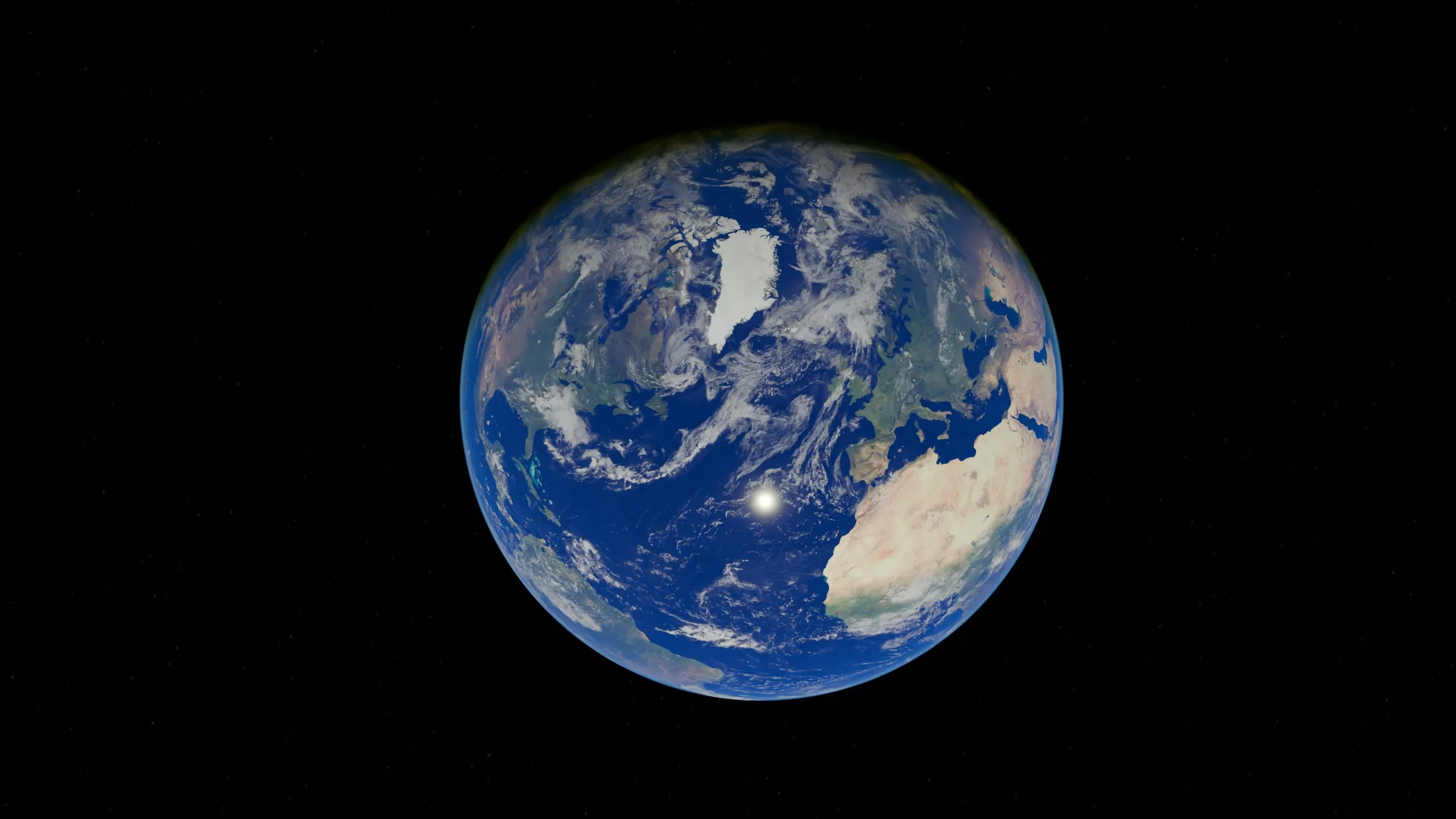
When astronauts see Earth from space for the first time, something happens to them that is remarkably consistent across individuals regardless of nationality, religion, or political belief. The planet below appears as it is – borderless, fragile, impossibly beautiful against the void. The tribal distinctions that seemed so urgent and so natural dissolve not through argument but through *seeing*. Edgar Mitchell described it as an instant global consciousness. Ron Garan called it the orbital perspective. What they all seem to be pointing at is the same thing: a felt understanding, not merely an intellectual one, that we share one home, that the lines are fictions, that the whole thing is at once vast and terrifyingly small.
This experience doesn’t require going to space. The images exist. The testimony of hundreds of astronauts exists. Immersive technology has advanced to the point where something close to the cognitive shift can be induced in people who have never left the ground. The effect, when achieved, is neurologically consistent – it hits conservatives and progressives alike, the religious and the secular, the young and the old.
The second experience is DMT.
Or more precisely, a form of it – most likely ayahuasca, or an oral DMT formulation with an MAOI, to allow a longer window and the possibility of integration within the experience itself. Whatever the precise pharmacology, what researchers and participants consistently describe is: encounters with something that feels vastly larger than the self, a dissolution of the ego-boundary between self and world, a sense not of going somewhere new but of *returning* somewhere deeply familiar, and an aftermath of burning questions about the nature of consciousness and reality that can last years or a lifetime.
DMT doesn’t produce a single unified experience – it’s notoriously personal – but there are statistical regularities in what people bring back: a felt sense of radical interconnection, a loosening of defensive ego structures, an expanded temporal horizon, a tendency to find other humans more fascinating and less threatening, and something that functions like a direct encounter with the fact of one’s own mortality and the inexplicable gift of being alive at all.
The hypothesis of the thought experiment is this: if the overview effect is administered first – at, say, eighteen – and several months later the DMT ceremony follows, into a psyche already softened toward interconnection, the combination might produce something culturally unprecedented. A shared, ineffable reference point that almost everyone has but nobody can fully articulate. The thing that mystic traditions across all cultures have always pointed at – the experiential core beneath the dogma, the place where the boundaries of self turn out to be more permeable than advertised – made democratically available, not just to monks and shamans and the neurologically fortunate.
What kind of world might that produce?
—
The Ceremony (Initial Ideas):
Before speculating about the world it produces, the ceremony itself deserves serious design attention. Because how it’s done matters at least as much as whether it’s done – a badly designed mandatory ceremony would be an instrument of harm or worse, of control.
A few non-negotiable principles first.
The ceremony must serve the participant, not the state. The moment it becomes propaganda – even well-intentioned propaganda – it poisons the well. The design must actively resist co-option. Preparation is half the ceremony; psychedelic research consistently shows that expectation and context shape experience as much as the molecule itself. Integration is the other half – what happens in the months after is where transformation either takes root or dissipates. Most ceremonial design ignores this. It is the most important part. And the ceremony must feel like a gift, not a test – coercion and transcendence are enemies.
The Preparation: Six Weeks
The ceremony begins weeks before any medicine is taken.
The first two weeks involve a gradual stepping-out from habitual life – a reduction in digital noise, attention to sleep and physical preparation, and a question given to carry rather than to answer: *What am I, beneath everything I’ve been told I am?*
Weeks three and four involve experiential education in small groups deliberately mixed across class, background, and belief. Not lectures – genuine encounter. The actual story of the universe, told not as a science class but as a creation myth that happens to be true. Death education: real, unflinching engagement with mortality, drawn from Buddhist, Stoic, Pragmatic, Secular Humanist, and Indigenous traditions. The recognition that everyone in the room will ‘die’ (they will temporarily become detached from both id and ego, & their sense of self-hood), and that this is the precondition for taking life seriously. A breath-work session – holotropic breathing or similar – to give the participant their first taste of the altered-state terrain and surface anything that might need attention before the ceremony itself.
Week five is a three-to-five day retreat at a dedicated site – ideally natural, human-scaled, beautiful, acoustically rich, with no clocks visible. Long periods of genuine silence. A one-on-one conversation with the guide whose only purpose is witnessing: *What are you carrying into this?* And something made by hand over these days – carved, woven, assembled – not for the object but for the making. It will come with the participant into the ceremony.
The Ceremony: Two Nights, Three Days
Night zero: not space itself, but the closest available analogue. A darkened dome. The participant lies on their back as an immersive recreation of the orbital view unfolds around them – not a video but something more total. Earth rotating below. Blackness above. Silence, then breathing, then the sound of the participant’s own heartbeat played back through the space. A guide speaks occasionally, not narrating but offering a phrase and leaving it to resonate: “There are no lines down there. Every war ever fought happened on that. You came from this. You will return to this…”
Day one: a long walk, several hours, without phones or conversation for the first two hours. The instruction is simply to pay attention to what is actually here. In the afternoon, the group shares – not how they feel, but what they noticed that they usually walk past. In the evening, each person shares the object they made and says something about what it is. The first time in the ceremony the participant is truly witnessed by the group.
Day two is the ceremony itself.
The ceremonial space has been designed with care: warm, fragrant with something that will never be used outside this room (scent is the fastest route to associative memory – this smell will trigger recall of this room for the rest of the participant’s life), lit with candles or firelight, with live music – strings or voice, something organic and breathing.
The guide speaks briefly before the medicine is administered. Not with hype, not with minimisation, but with plain precision: *You may encounter things that feel more real than anything you have encountered before. You may feel fear. You may feel joy beyond what you thought was possible. Both are welcome here. We will be with you throughout. You are safe.*
The medicine is given individually, by the guide, with eye contact and a simple gesture. Not clinical, not theatrical. A moment of genuine recognition between two humans.
During the experience, guides move quietly. Music continues, evolving – beginning with structure and gradually dissolving into something ambient and spacious as participants go deeper, then gently reassembling as they begin to return. No one is rushed. No one is intervened with unless in genuine distress.
The return is not an end but a threshold. Warm drinks, simple food, rest. The ceremony space remains open through the night.
That evening, when everyone has returned, the group gathers one last time. A fire if possible. The instruction: *You don’t have to say anything. But if something wants to be said, this is the place for it.*
Day three is slow. Good food. Bodywork if wanted. One final group session looking not back but forward – not a plan, not goals, but an image: *What does the life you return to look like, in light of what happened here?*
Before leaving, each participant receives two things: a letter they wrote to themselves during preparation, sealed and held until now; and the name of their integration companion – the person they will check in with monthly for the following year.
Integration: One Year
Monthly check-ins, not therapy but structured companionship with someone who has themselves been through the ceremony. A six-month gathering of the original group. At twelve months, a letter written to the person they were before and to a person who hasn’t yet gone through – both archived, some anonymised and shared with future cohorts as testimony.
What the Ceremony Does Not Do
Equally important: the ceremony contains no political content. None. No environmental message, no national identity, no ideology. It goes deliberately beneath the level at which politics operates. No prescribed interpretation – guides are trained to reflect questions back rather than answer them. No hierarchy of experience – the person who saw nothing but darkness for four hours is not a failure. No performance expected – transformation, if it comes, arrives in its own time, often sideways, months later, noticed in retrospect.
And the governance of the ceremony itself must be constitutionally independent – ungovernable by any single state, corporation, or ideology. Built with radical transparency and an explicit adversarial function: a body whose sole job is to look for ways the ceremony is being corrupted and to say so loudly.
The ceremony should, if well designed, produce people who are harder to manipulate – including by the ceremony itself.
—
The World It Makes
What kind of civilisation emerges from a generation that has, at the threshold of adulthood, encountered both the overview perspective and the dissolution of ego?
Consider what the Federation’s humans are actually like, when you look carefully. They are curious as a primary drive – not acquisitive. The hunger is to understand and encounter, not to own or dominate. They carry almost no xenophobia despite being surrounded by radical otherness – not as a moral achievement they’re constantly working at, but as something that has become natural. They are comfortable with uncertainty and mystery. They have a complex relationship with ego – ambition exists, conflict exists, but the defensive, fearful, zero-sum quality of ego has been largely metabolised. They find meaning through contribution rather than accumulation.
These are, almost precisely, the consistent psychological outputs of well-integrated psychedelic experience and the overview effect. Roddenberry intuited something real.
The ceremony wouldn’t produce the Federation immediately. But it might produce the generation that builds the generation that builds it.
More specifically:
**The dissolution of scarcity thinking** – not economic scarcity necessarily, but the psychological scarcity that makes people hoard, dominate, and fear. Both experiences tend to produce a felt sense of abundance at some fundamental level – not naively, but as a background orientation. The zero-sum game becomes harder to believe in viscerally.
**Genuine curiosity about otherness** – after an experience that radically defamiliarises your own consciousness, other humans stop being threatening and start being fascinating. The demagogue’s playbook, which depends on enemy construction and dehumanisation, would find much harder soil.
**A longer now** – both experiences tend to expand temporal perception. The present moment becomes richer and more real, and simultaneously the long arc of time becomes more personally felt. A civilisation that thinks in centuries, that plants trees it won’t sit under – that shift begins here.
**Post-heroic courage** – the best characters in Trek are brave not from ego or ideology but from something quieter and more durable. A kind of settled-ness about mortality and meaning that the ceremony, at its best, can catalyse.
None of this is guaranteed. The ceremony is not a conversion. It’s the best possible soil preparation. What grows still depends on the seed and the weather. Some people will integrate their experience into a framework of superiority rather than humility. Some will use transcendence to avoid engaging with the world – “everything is one” as a reason not to fight injustice. The design must anticipate this and build counter-pressures.
But the capacity for the shift is already present in the species. It doesn’t need to be invented. It needs to be activated – at a scale and speed that has no historical precedent but is not, in principle, impossible.
—
Solarpunk: The Aesthetic of the World That Follows
If the ceremony works on the interior – dissolving the psychological structures that make ecological destruction feel acceptable or inevitable – then solarpunk is what the exterior might look like when built by people with that different interior.
Solarpunk is frequently misunderstood as simply green aesthetics: solar panels and vertical gardens and linen clothing. The aesthetic is real and matters. But underneath it are deeper commitments.
Decentralisation as a value – not just of energy production but of decision-making, food production, knowledge, and care. Technology as appropriate and embedded – chosen carefully, with the question always being whether it serves life and community or extracts from them. High-tech and low-tech coexisting without hierarchy, because a mesh network and a seed library are equally sophisticated responses to real needs. The repair and maintenance ethic – the recognition that the most sustainable technology is the one you can fix yourself, that you understand, that connects you to material reality rather than abstracting you from it. Genuine pluralism – not a monoculture of linen and bicycles but a federated diversity of communities, approaches, and aesthetics, held together by shared values around care and ecological embeddedness. And joy as a political category – perhaps the most radical element – the insistence that the transition to a sustainable civilisation should be *desirable*, not merely necessary.
Morning in a solarpunk city feels like a market town that has absorbed the best of urban density without the alienation. There is noise – the noise of people and birds and water and wind in photovoltaic canopies, not engines. Buildings are covered in things that grow: not as decoration but as food, insulation, habitat, air. The boundary between indoors and outdoors is genuinely porous.
Food is local enough that you know, roughly, where it came from and who tended it. Not because of political commitment but because the system is designed so that this is simply true. Eating is understood as a relationship with land and season rather than a transaction.
Work has been reorganised around contribution rather than employment. Automation has eliminated drudgery without the fruits being captured entirely by capital, because the governance structures – built by the post-ceremony generation – managed the transition differently than pure market logic would have. People work fewer hours in the sense of obligated toil and many more hours in the sense of purposeful making. The boundary between work and craft, work and care, work and art has blurred in ways that feel like freedom.
Conflict still exists. Communities disagree. Resources are contested. People fail each other. But the register of conflict has changed – it tends to be about genuine competing goods rather than zero-sum domination. The tools for working through it are more sophisticated, more embedded in daily life, more practised.
Children grow up with a completely different relationship to the natural world – not as background to human activity but as the medium in which human life is embedded. A generation that has caught insects, grown food, watched seasons, understood weather as the breath of the living system they’re part of – that generation doesn’t need to be convinced of ecological values. They are ecologically literate in a way that genuinely changes behaviour.
And night in this city is darker than we’re used to. The light pollution has been dramatically reduced – partly for ecological reasons and partly because someone, at some point, made the political case that being able to see the stars is not a luxury. It is, in fact, precisely what the ceremony’s first movement was designed to invoke. A civilisation that can see the Milky Way from its cities is a civilisation that is regularly reminded of its context.
—
The Aesthetic as Ethics
One of solarpunk’s deepest insights is that beauty is not frivolous – it is structural.
Ugly environments produce alienated people. Disposable aesthetics produce disposable ethics. When nothing around you is made with care, it becomes harder to practise care. When everything is designed for efficiency over beauty, the message encoded in the built environment is that beauty is not worth the cost – and that message is absorbed below the level of argument.
Solarpunk insists on beauty not as luxury but as moral infrastructure. The mosaic on the water recycling building, the hand-carved details on the community hall, the way the park was designed so that it’s glorious in February not just in July – these are not decorations. They are the environment continuously telling its inhabitants: *you are worth beauty. This place is worth care. The future is worth building well.*
This is very close to what the ceremony is doing at the individual level – giving people a felt experience of being worth care, of being embedded in something worth cherishing. The solarpunk built environment is the ceremony’s values made permanent and public.
—
The Honest Difficulty
The distance between here and there is real and should not be romanticised.
The timing problem is perhaps the most painful. The ceremony works on the young – people at the threshold of adulthood. The cohort that goes through it in its first decade of operation is not the cohort currently making decisions about coal plants, deforestation, carbon pricing, and international climate agreements. Those decisions are being made right now by people in their fifties, sixties, seventies, shaped by entirely different formative experiences in a world with different stakes. The ceremony is a generational intervention. Its fruits come in thirty or forty years. Whether thirty or forty years is soon enough is not comfortable to sit with.
There are genuine tensions within the solarpunk vision too. Decentralisation can produce parochialism. Community can produce conformity. The emphasis on local and craft can slide into exclusivity. And the infrastructure of the current world – physical, economic, psychological – has enormous inertia. The people who profit from that inertia are not going to release it gracefully. The transition, even in the optimistic version, involves loss, disruption, and genuine sacrifice.
And the deepest tension: enforced transcendence may be a contradiction in terms. Both experiences tend to produce genuine freedom – freedom from the small, anxious, defended self. But mandating them introduces an element of control that might undercut exactly what makes them transformative. The Zen tradition has a phrase for forced enlightenment: it doesn’t exist.
And yet. We already have mandatory education, mandatory military service in many countries, mandatory vaccines. We already shape citizens. The question is only *toward what*. This ceremony says: toward a direct encounter with the fact that you are small, temporary, connected, and inexplicably here.
There are, perhaps, worse things to mandate.
—
What the Ceremony Is Really For
The Federation’s humans didn’t get there through legislation or ideology. In Trek’s mythology it took First Contact – the shock of genuine otherness dissolving remaining tribalism almost overnight. The experience of suddenly knowing, viscerally, that you are not alone in the universe, that you are small, that you are part of something vast.
The ceremony is trying to engineer that shift without requiring the catastrophe first. To give people the cognitive and emotional equivalent of First Contact – with the cosmos, with their own consciousness, with the radical contingency of being alive – while they’re still young and plastic enough to build their lives around what they encounter.
What climate change demands of humanity is genuinely unprecedented: delayed gratification at civilisational scale; genuine identification with strangers across geography, culture, and time; systemic thinking over narrative thinking; willingness to be wrong and update quickly. These are not impossible human capacities. They exist. They show up in individuals, in communities, in moments of genuine crisis and solidarity. But they are not currently the default – they require effort, education, and usually some precipitating experience that makes them feel necessary.
The overview effect and well-integrated psychedelic experience are, among the limited tools available, probably the most reliable known methods for installing these capacities as a default orientation rather than an effortful achievement.
Which means the ceremony isn’t just a nice idea about human flourishing. It might be – or something like it might be – among the more serious proposals for whether the non-catastrophic path remains open at all.
—
Still Available
The most realistic thing to hope the ceremony produces is not enlightened beings but people for whom the *attempt at goodness* feels natural and worth making. People who, when they fall short of their own ideals, recognise it as falling short rather than rationalising it as inevitable.
That is, perhaps surprisingly, not far from where we already have access to. There are already young people – more than the headlines suggest, because conflict and outrage make better copy than patient construction – who seem to have arrived at something like this orientation without any ceremony. Who feel the planetary crisis personally. Who think in longer timescales. Who find tribalism not just wrong but boring. Who are building things quietly.
The solarpunk future is less a destination to arrive at than a direction to move in. And movement in a direction, sustained and intelligent and honest about obstacles, is how all the futures that ever got built actually got built.
The beautiful version – the one with the dark nights full of stars, and the buildings breathing with green, and the children who know where their food comes from, and the elders who are genuinely valued, and the work that feels like craft, and the conflicts that are about real competing goods rather than manufactured fear – that version is not guaranteed.
But it is still available.
And sometimes that is enough –
Enough people, sufficiently awake to what is at stake and what is possible, who cannot quite bring themselves to let the beautiful version go.
The ceremony, in the end, is just a way of making enough people that kind of awake.
The rest, as it has always been, is up to us.
*This essay emerged from a conversation about consciousness, ceremony, Star Trek, and the future we might still choose. It is an attempt to think seriously about non-catastrophic paths to civilisational change – and about the tools, both ancient and modern, that might help us find one.*