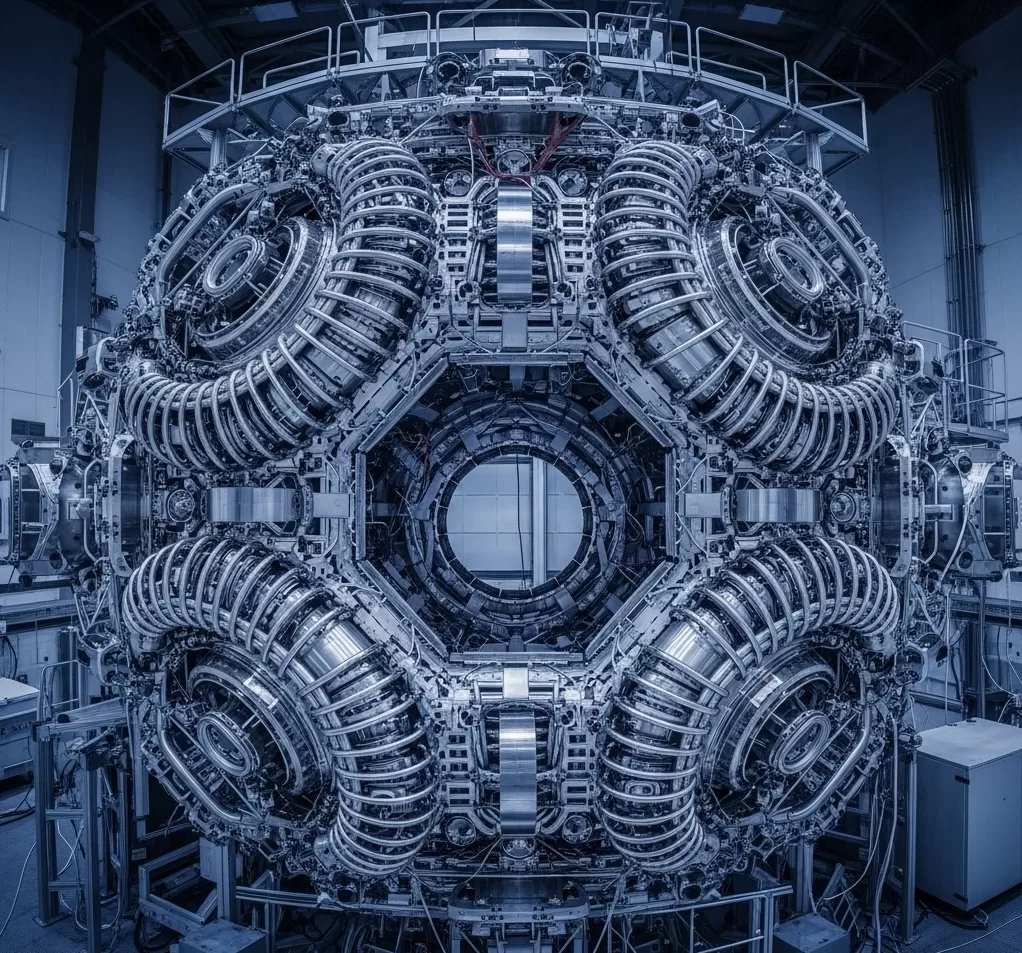
Imagine you are a detective. Your job is to listen for a very, very quiet knock on a door. The knock is so quiet that you can barely hear it. Now imagine that the door also makes random creaking noises all by itself, and those creaks sound almost exactly like the knock.
How do you know if what you just heard was someone knocking, or just the door being noisy?
That question – that exact puzzle – is at the heart of a real science mystery. Scientists gave it a name: the Photon Falsifiability Gap. It sounds like a big, fancy phrase, but once you break it into pieces, it’s actually a story about light, invisible energy, and a very clever machine that sometimes fools itself.
What is a photon?
Light is made of tiny little packets, kind of like light is made of Lego bricks. Each one of these tiny packets is called a photon. You can’t see a single photon with your eyes – they’re much too small and light for that. But scientists have built machines that can detect a single photon, one at a time. That’s an amazing feat, like being able to hear a single grain of sand hit the floor.
Meet the super-listener: the photomultiplier
The machine that can “hear” a single photon is called a photomultiplier tube (you can just call it a PMT for short). Think of it like a super-sensitive microphone, except instead of listening for sound, it’s listening for light.
Here’s how it works, in simple terms:
A single photon flies into the tube and hits a special metal surface. That hit knocks loose one tiny electron. The tube then multiplies that one electron into millions of electrons, like a snowball rolling downhill and picking up more snow. All those electrons create an electrical “click” that a computer can count.
So a photomultiplier tube turns one whisper-quiet flash of light into a loud, countable click. Pretty amazing, right?
The invisible energy problem
Now here’s where our mystery begins. Some materials in nature give off a very weak, very quiet form of energy. One of these is called tritium. When tritium releases its energy, it’s incredibly faint – much fainter than most other radioactive materials. It’s like a whisper compared to a shout.
Scientists want to detect this whisper using their super-listener, the photomultiplier tube. And it can pick up that whisper… but here’s the catch.
The catch: the door creaks too
A photomultiplier tube isn’t perfectly silent when nothing is happening. Every once in a while, all on its own, it produces a tiny click – even when no real photon ever arrived. Scientists call this dark noise, because it happens even in total darkness, with nothing there at all.
And here’s the twist that makes this a true mystery: a dark noise click and a real tritium click look exactly the same. Both are just one tiny electrical pulse. There is no way, just by looking at a single click, to tell which one you’re looking at.
Go back to our detective story. You heard a knock. Was it a real knock, or just the door creaking? If both sounds are identical, you can never be 100% sure – not for that one single sound.
Why this is called a “falsifiability” problem
In science, there’s an important idea called falsifiability. It means that for an idea to be truly scientific, you need to be able to test it in a way that could prove it wrong if it actually is wrong.
Here’s the problem: if you hear one click and say “that was tritium!” – there is no way to prove that statement wrong. It might have been dark noise. And if you say “that click was just dark noise!” – there’s no way to prove that wrong either. It might have been real. Neither guess can be tested for a single click. That’s the “gap” – a gap where our normal rules for testing scientific ideas don’t quite work, at least not one click at a time.
So how do scientists solve the mystery?
If you can’t trust a single click, what do you do? You stop listening for one knock and start counting lots of knocks over a long time.
Here’s the trick:
First, scientists measure how many random clicks (dark noise) happen when they know for certain there’s no tritium around. This tells them the normal “creaking” rate of the door. Then, they measure the click rate when tritium might be present. If the second number is clearly, reliably higher than the first – not just by one or two clicks, but by a lot, over and over – then they can be confident that real tritium signals are hiding inside all those clicks.
It’s a bit like this: you can’t know if one specific creak was a knock. But if you count 1,000 creaks on a quiet night and then count 1,000 creaks plus 300 extra clicks on another night, you can be pretty confident something extra was happening on that second night – even though you still can’t point to any single click and say “that one was definitely the knock.”
Why does any of this matter?
This isn’t just a fun puzzle – it matters for real science:
Finding ancient objects: Scientists use radioactive materials to figure out how old rocks, fossils, and artefacts are. Medicine: Doctors use tiny, safe amounts of radioactive material to see inside the human body without surgery. Hunting for dark matter: Physicists build giant, super-sensitive detectors – using the same kind of photomultiplier tubes – to search for mysterious particles that make up most of the universe. They face this exact same “which click was real?” problem, just on a much bigger scale.
Every single one of these fields depends on scientists being clever enough to work around the falsifiability gap, even though they can never fully close it.
Quick recap:
A photon is a tiny packet of light.
A photomultiplier tube is a machine that can detect a single photon and turn it into a loud click.
Tritium gives off a very weak, whisper-quiet signal.
The tube also makes random clicks by itself, called dark noise, and these look identical to real signals.
Because of this, no single click can ever be proven to be real or fake – that’s the falsifiability gap.
Scientists solve this not by trusting one click, but by comparing patterns of many clicks over time.
Try it yourself:
Here’s a fun way to feel this mystery for yourself. Get a friend and a set of headphones, or just sit in separate rooms. Have your friend randomly tap a table softly, mixed in with the normal sounds of the house (footsteps, a fan, a fridge humming). Try to guess, sound by sound, which taps were real. You’ll probably find that any single sound is a guess – but if you count for five whole minutes, you’ll likely get a much better sense of how many taps really happened, even without ever being sure about any one of them.
That’s the same trick scientists use to solve the Photon Falsifiability Gap – not by being certain about one click, but by being smart about all the clicks together.
Nescience, cognitive closure, and the difference between a wall and a puzzle…
There is a gap in ordinary English that you generally only notice when you need it.
We have a rich vocabulary for not knowing things. *Ignorant*, *unaware*, *uninformed*, *clueless*, *in the dark*. But every one of these words carries a hidden assumption: that the thing not known is the sort of thing that *could* be known by the person not knowing it. Ignorance is a deficit against a standard. It implies a book unread, a lesson unlearned, a fact that was sitting there available. You can fix ignorance by handing someone a pamphlet.
What we lack is a common word for the other case – where the failure is not in the person’s diligence but in their equipment. Where the thing isn’t merely unknown but *unthinkable by that kind of mind*, in the way that a smell is unthinkable by a thermometer. Not a gap in the map, but a limit on what can be mapped at all.
This is not a merely lexical complaint. The word you reach for commits you to a claim about the world, and the claim is usually much stronger than you intended. So it is worth going slowly.
I. The available words, and what each one smuggles in
**Nescient** is the best single word. It comes from Latin *nescire*, to not-know, and it has been doing serious work in theology and epistemology for centuries. Its virtue is that it names a *condition* rather than a *failure*. To be nescient of something is not to have neglected it. Nescience is closer to a state of the organism than to a gap in its education. It is also usefully rare, which means it hasn’t been worn smooth by casual use the way *ignorant* has.
**Incognizant** is the plainer cousin – serviceable, slightly bureaucratic, and it drifts back towards ordinary unawareness. **Insensible to** is nicely physical, with a suggestion of sensory rather than intellectual failure, which may be exactly what you want. **Benighted** is archaic and faintly insulting; it implies a darkness that someone could have walked out of. **Oblivious** is the weakest of all – it means inattentive, and inattention is a moral failing in miniature, which is precisely the wrong note.
Then there is a second family of words, for a subtler thing: not the unawareness itself, but the unawareness *of* the unawareness. The recursive case. Because the truly closed-off mind does not experience itself as missing anything. It experiences the world as complete.
**Anosognosia** is the clinical term, coined by Babinski in 1914, for a patient’s unawareness of their own deficit – the stroke patient with a paralysed arm who sincerely reports that the arm is fine, and who will produce elaborate reasons why they simply don’t feel like moving it right now. It has escaped the clinic and is now used, sometimes loosely, for any blind spot about a blind spot. **Scotomised**, from *scotoma*, the blind spot in the visual field, does similar work with a psychoanalytic accent: a perceptual blankness where something intolerable ought to be. Freud was suspicious of the term and preferred to talk about disavowal, but *scotoma* has survived because the image is so good. Your own retinal blind spot does not appear to you as a hole. It appears as nothing at all, seamlessly filled in. You have to hunt for it with a card and a dot to prove it is there.
That is the phenomenology we are after. Not a hole in the world, but a world with no hole in it.
II. Cognitive closure
The philosophical term of art is **cognitive closure**, and it belongs to Colin McGinn, who set it out in a 1989 paper asking whether we can solve the mind-body problem. His answer was no, and his reason was structural rather than pessimistic.
Every mind has a range. A dog’s mind is well adapted to a rich world of scent, social hierarchy, and object permanence, and it is closed to arithmetic – not because dogs are stupid in a way that could be remedied with better schooling, but because the concept of a prime number is not a thing a canine cognitive system can form. The dog is not frustrated by this. There is no dog-shaped ache where mathematics should be.
McGinn’s move was to ask why we should assume our own range is complete. Our brains are organs shaped by selection pressures that had nothing to do with metaphysics. It would be a startling coincidence if the set of true things happened to line up exactly with the set of things a primate social-cognition engine can represent. Some truths may simply fall outside our range, and – this is the important part – we would have no way of detecting their absence. Our world would look complete, because it always does.
The position acquired the name **mysterianism**, coined half-jokingly by Owen Flanagan after the 1960s garage band ? and the Mysterians, and it has been fought over ever since. Daniel Dennett’s objection is the sharp one, and worth keeping in your pocket: an argument from cognitive closure is very hard to distinguish, from the inside, from a failure of imagination. “I cannot conceive how X could be explained” is a fact about you. Treating it as a fact about the universe requires an extra step that mysterianism has never quite managed to justify. Every hard problem looks closed until the week before it opens.
Hold onto that objection. It is going to matter later.
—
III. Umwelt: the sensory version
If you want the version with less metaphysics and more biology, the word is **Umwelt**, from the Baltic-German biologist Jakob von Uexküll, writing in the 1930s.
Uexküll’s insight was that an organism does not live in *the environment*. It lives in the environment *as constructible by its own sensory apparatus* – its Umwelt, its self-world. And these worlds are astonishingly narrow. His famous example is the tick, which lives in a world assembled from three cues: the smell of butyric acid, which tells it a mammal is passing beneath; a temperature of around 37 degrees, which tells it where to burrow; and the feel of hair, which tells it where not to. That is the whole world. There is no colour in it, no sound, no shape. A tick can wait years on a branch in a world made of three facts.
The great virtue of *Umwelt* is that it makes the point without any philosophical commitment at all. It is an empirical claim about sensory ecology. The tick is not being denied access to a richer reality by some Kantian veil; it simply has three receptors. And nothing in its world indicates that anything is missing.
If your interest is in intelligences with different bodies, *Umwelt* may be the more honest word than *cognitive closure*, because it locates the limit in the sensorium rather than in the intellect – and sensory limits are the kind of thing you can actually go and measure.
—
IV. The bat, and why it is not about bats…
The essay everyone eventually arrives at is Thomas Nagel’s “What Is It Like to Be a Bat?”, published in *The Philosophical Review* in 1974, and it is worth being precise about what it argues, because it is very frequently misremembered.
Nagel is not saying that bat echolocation is hard to imagine. He is not saying that we lack data about bats. Neurophysiologists know a great deal about the bat’s auditory cortex and can say in detail how the returning echo is processed into a representation of a moth’s position and velocity. The information is not the problem.
His claim is about the *structure of imagination*. When we try to imagine being a bat, what we actually do is imagine ourselves with modifications: ourselves, but hanging upside down; ourselves, but with a sonar sense grafted on. That is imagination working the only way it can, by extrapolation from our own case. But it delivers only what it is like *for us* to be bat-like. It cannot deliver what it is like for a bat to be a bat, because the extrapolation always starts from the wrong place. And there is no second method available.
So the barrier is not informational. It is not even, strictly, a barrier of intelligence. It is that the subjective character of experience is only available from a particular point of view, and the tool we use for occupying other points of view is a tool that works by dressing ourselves up.
This is why *nescience* and *cognitive closure* are the right register and *ignorance* is not. There is no pamphlet.
—
V. Four more words, for four different jobs
Once you are in this territory, several traditions offer terms that overlap without being synonyms. They are worth separating, because each carries a different diagnosis of *why* the thing is inaccessible.
**Noumenal** (Kant, 1781). The thing as it is in itself, as opposed to the thing as it appears. For Kant the barrier is not our species’ particular equipment but the very structure of experience: space, time, and the categories are the forms our intuition imposes in order to have experience at all, so they cannot also be read off as features of reality behind that experience. Use *noumenal* if you want the inaccessibility to be permanent and principled rather than contingent on our being primates. Note that this is a *stronger* claim than McGinn’s – a smarter alien would not do any better, because it would have its own forms of intuition.
**Radical alterity** (Levinas, *Totality and Infinity*, 1961, and after him a great deal of anthropology). Otherness that cannot be absorbed into the categories one already holds. Levinas’s point was ethical before it was epistemological: the failure to comprehend the Other is not a defect to be repaired but the very thing that makes the Other a claim on you rather than an object for you. If your interest is in what it would *mean* to encounter an intelligence you cannot model – rather than in whether you could model it – this is the vocabulary.
**Incommensurable** (Kuhn, 1962). No shared measure. Two frameworks fail to translate not because the dictionary is incomplete but because the terms are individuated differently at the root, so that agreement and disagreement both become ill-defined. Kuhn spent the rest of his career walking back the strongest readings of this, which is itself instructive: near-total incommensurability turns out to be hard to defend, and what survives is a claim about difficulty and loss in translation rather than impossibility.
**Apophatic** (Pseudo-Dionysius, and the *neti neti* – “not this, not this” – of the Upanishads). Not a description of the ignorance but of the *only available mode of speech* about it: saying exclusively what the thing is not. It is worth knowing that negative theology is the most developed technique humanity has ever built for talking at length about something held to be constitutively beyond conception. If you find yourself writing about an unimaginable mind, you will end up doing apophasis whether or not you have a name for it. Better to know you are doing it.
—
VI. Lem, or: the mirror is the only instrument we have
The novelist of this problem is ‘Stanisław Lem’, and he is more rigorous about it than most philosophers.
*Solaris* (1961) is usually described as a novel about an alien ocean. It is more accurately a novel about a library – the enormous, futile, century-old discipline of “Solaristics“, with its schools and schisms and competing taxonomies of the ocean’s formations, all of it elaborate and none of it contact. The ocean produces the visitors, apparently from the scientists’ own suppressed memories, and the humans cannot determine whether this is communication, experiment, cruelty, indifference, or a reflex with no more intent than a knee-jerk. The book’s cruelty is that it withholds even the certainty that there is even a question being asked.
*His Master’s Voice* (1968) does the same thing with a signal from space, which a team of the best minds available decodes into two substances of ambiguous properties and cannot get further, and cannot tell whether their partial success is genuine or a Rorschach blot. Lem’s recurring point, stated bluntly in both books, is that we do not go looking for other minds. We go looking for mirrors, and we call the mirror a discovery. Projection is not a mistake we could avoid with more discipline; it is the only instrument in the kit.
VII. Now the interesting part: chirality is not the case you think it is…
Here is where the argument gets useful, because there is a very natural example of “an intelligence I could never comprehend” that turns out, on inspection, to be a completely different kind of problem – and the difference is the whole lesson.
Suppose you propose two candidates for radically alien minds: a non-carbon intelligence, and a *mirror-image* intelligence, built from the enantiomers of our own biochemistry.
The first is a genuine Nagelian case, at least potentially. A different substrate might well support a different phenomenology, and we would have no method for checking, and no method for checking whether we had failed to check.
The second is not. Chirality is a fact about molecular geometry, not about experience. Terrestrial life is homochiral – we use left-handed amino acids and right-handed sugars, an asymmetry that is very likely a frozen accident from a chemistry that could have gone either way. A perfectly mirrored human being would be biochemically incompatible with us in interesting ways: they could not digest our food, our drugs would not fit their receptors, some of our smells would smell like something else to them. But they would not be *phenomenologically* alien. They would have your memories, your emotional range, your sense of humour. They would find your novels moving. There is no hard problem here, only a divergence & supply-chain problem.
So the mirror case is not a wall. What it is instead – and this is far more interesting – is a **communication** problem, and it has a name and a history.
VIII. The Ozma problem
Martin Gardner named it in *The Ambidextrous Universe* (1964), after Project Ozma, Frank Drake’s 1960 attempt to listen for interstellar signals at Green Bank, which Drake had named after the princess in Baum’s Oz books.
The problem is this. You are in radio contact with a civilisation somewhere distant. You share no objects. You can send only signals – that is, information, not things. You can establish a common vocabulary for numbers, for the elements, for the wavelength of a hydrogen transition, for anything you can define by its structure. Now: **communicate to them which of their hands is the left one.**
It seems, on first inspection, to be a perfect sealed impossibility. Every method you try fails. You cannot say “the hand on the same side as the heart”, because you cannot establish that their hearts are on the side ours are, and in any case you’d need to define “same side”, which is the thing you are trying to define. You cannot appeal to any geometrical description, because every geometrical description of a left hand is satisfied equally well by a right hand – that is what enantiomorphism *means*. You cannot appeal to astronomy, because they cannot tell whether they are looking at their sky or its mirror image. Every asymmetry you reach for turns out to be a convention or a local accident.
The Ozma problem looks exactly like cognitive closure. It has the right shape: the failure recurs at every attempt, and for what appears to be a principled reason rather than a contingent one.
And then it was solved. Not by philosophy – by an experiment.
In 1956, Tsung-Dao Lee and Chen Ning Yang pointed out that parity conservation, universally assumed, had never actually been tested for the weak nuclear interaction. In early 1957 Chien-Shiung Wu tested it, cooling cobalt-60 nuclei to near absolute zero and aligning their spins in a magnetic field. If parity held, the beta-decay electrons should have come out symmetrically with respect to the spin axis. They did not. They came out preferentially in one direction. The universe, at the level of the weak force, distinguishes left from right.
Which means the Ozma problem has an answer, and the answer is a recipe: *run this experiment, note which way the electrons go, and now we can both define “left” without ever pointing at anything.*
Gardner, being honest, flagged the remaining loophole in his own book: if your correspondents are made of antimatter, the recipe reverses, and you have merely traded the handedness ambiguity for a matter/antimatter ambiguity. That gap closed too. In 1964 Cronin and Fitch found CP violation in neutral kaon decay, which gives an absolute, convention-free distinction between matter and antimatter – and therefore, in principle, a fully unambiguous definition of “left” transmissible over a radio link to strangers.
The wall fell twice, in eight years, both times because someone went and looked at a nucleus.
IX. So: how do you tell a wall from a puzzle?
This is the thing worth taking away, (if you have read this far, well done, dear reader) and it is somewhat uncomfortable.
The Ozma problem *felt* closed. It had every hallmark: repeated failure, a structural-seeming reason for the failure, an air of “you cannot get there from here”. Sophisticated people spent decades treating handedness as the paradigm case of something communicable only ostensively – something you could only teach by pointing, never by describing. They were wrong, and the correction did not come from thinking harder about the problem. It came from an unrelated corner of physics noticing that a symmetry everyone had assumed was simply an untested assumption.
The bat may be different. Nagel’s argument has survived fifty years of attack in a way that most such arguments do not, and the reason is that it doesn’t rest on our failing to imagine a mechanism; it rests on a structural feature of how imagination works at all. But you should hold even that lightly, because Dennett’s objection stands: from the inside, a genuine wall and a puzzle you haven’t cracked look precisely identical. That is what it is to be nescient rather than ignorant. Nescience does not announce itself. There is no ache in the shape of the missing thing.
Which means the vocabulary carries a bet, and you should know which bet you are placing when you choose a word.
Say *ignorant* and you have claimed the thing is knowable and someone has slacked. Say *nescient* and you have claimed the not-knowing is a condition rather than a failure, without yet saying whether it is curable. Say *cognitively closed* and you have made a strong empirical claim about the architecture of a mind – a claim which, historically, has a poor track record. Say *noumenal* and you have made a metaphysical claim that no future experiment can touch, which is either admirable rigour or a way of insulating yourself from being proved wrong, depending on the day. Say *radical alterity* and you have changed the subject from knowledge to ethics, which is sometimes the right thing to do.
The most defensible position, and the least satisfying, is probably this: we can identify with confidence the cases where our imaginative method breaks down, and we cannot reliably tell which of those breakdowns are permanent. The honest word for the state is *nescient*. The honest posture is apophatic – say what it is not, and keep the account open. And the honest example to keep beside the bat is the Ozma problem, precisely because it is the one that got away.
—
Appendix: a working glossary
| Word | Use it when the emphasis is on… | |—|—| | **nescient** | not-knowing as a condition rather than a failure; no implication of blame | | **incognizant** | plainer register; unawareness without the theological weight | | **insensible to** | the failure is sensory rather than intellectual | | **anosognosic** | unawareness of one’s own deficit; the recursive blind spot | | **scotomised** | a blankness where something intolerable should be; psychoanalytic flavour | | **cognitively closed** | a specific mind’s architecture cannot represent the concept (McGinn) | | **outside its Umwelt** | the sensorium cannot construct the relevant world (Uexküll) | | **noumenal** | inaccessible in principle to any experiencing subject (Kant) | | **radical alterity** | otherness that resists absorption into existing categories (Levinas) | | **incommensurable** | two frameworks with no shared measure (Kuhn) | | **apophatic** | the mode of speech: only negations available | | **ostensive** | learnable only by pointing – what Ozma was thought to be, and wasn’t |
—
Sources worth reading directly, & citations:
– Thomas Nagel, “What Is It Like to Be a Bat?”, *The Philosophical Review*, 1974 – Colin McGinn, “Can We Solve the Mind-Body Problem?”, *Mind*, 1989 – Jakob von Uexküll, *A Stroll Through the Worlds of Animals and Men*, 1934 – Martin Gardner, *The Ambidextrous Universe*, 1964 – Stanisław Lem, *Solaris* (1961) and *His Master’s Voice* (1968) – C. S. Wu et al., “Experimental Test of Parity Conservation in Beta Decay”, *Physical Review*, 1957
Why moral bio-cybernetic/bioenhancement fails at the design document, not the ethics committee.
admin
2,290 words
Proposals to biologically engineer human moral dispositions – to make people more compassionate, more cooperative, less prone to defection – are usually met with ethical objections. Consent. Autonomy. Authenticity. Value lock-in. The long shadow of eugenics.
These objections are serious and several of them are quite decisive. But they are also, in a particular sense, premature. They engage the proposal as though the technical programme were ready and the only remaining question were whether we ought to run it. That framing flatters the proposal. It grants it a maturity it does not have.
There is a more revealing test, and it is the one engineers use on any large proposal before arguing about whether to fund it: **try to write the specification.**
Not a manifesto. Not a research agenda. A design document – the artefact that lets someone else build the thing, and lets a third party check whether it worked. Every field filled in, every acceptance criterion stated, every assumption made explicit enough to be falsified.
When you actually attempt this for moral bioenhancement, something instructive happens. The document does not turn out to be *controversial*. It turns out to be **blank**. And the pattern of which fields are blank is more informative than any of the ethical arguments.
—
The construct problem: you are not turning up a dial
The first field in any specification is: *what, precisely, is being modified?*
“Compassion” is a folk-psychological term. It is not a variable. Before you can build anything you must commit to a decomposition – typically something like an affective component (felt concern at another’s distress), a motivational component (disposition to act at personal cost), a cognitive component (accuracy of your model of the other’s state), a behavioural output (rate and magnitude of costly prosocial acts), and – critically – a **scope function**: to whom does it extend, and how does it decay with social distance?
That last component is where naive versions of the project die.
Human prosociality is not a scalar quantity with a gain knob attached. It is a gradient over social distance: steep and high near kin and in-group, falling off quickly with distance, and effectively flat at the level of statistical strangers. This is why we are simultaneously the species that will run into a burning building for a neighbour and the species that can read a famine death toll over breakfast.
Which means the thing that would actually change outcomes at civilisational scale is not the *amplitude* of caring. It is the **shape of the discount function**. You do not want a higher curve. You want a flatter one.
Nobody has a genetic or neural handle on the shape. And the best-known intervention that raises amplitude appears to make the shape *worse*. Oxytocin spent about a decade as the “moral molecule” before the picture complicated: alongside well-known affiliative effects, a body of work found it strengthening in-group bonding while in some paradigms increasing out-group hostility or defensive aggression. The replication record across this literature is mixed enough that no single result should be leaned on hard. But the direction of the concern is the point. Raising the gain on a parochial system plausibly yields more effective parochialism – more devoted tribalists, better at their tribalism.
There is a second constraint that most versions of the proposal omit entirely: **stability under exploitation**. Any modified disposition must be viable in a mixed population that still contains unmodified defectors. A disposition toward unconditional cooperation is not a stable strategy; it is removed from the population – economically, socially, reproductively – by the people who lack it. Making people kinder inside an unchanged incentive landscape does not produce a kinder world. It produces exploitable people.
So the real target is not “more compassion.” It is something closer to *conditional cooperation, with an unbiased scope function, and with defection-detection and sanctioning capacity fully intact.* That is a much stranger object than the one people imagine. It is also, notably, much closer to what humans already have than to what the proposal would install.
**Status of this field: unresolved – and not primarily as an empirical matter.** It is a conceptual problem that must be settled before measurement is even meaningful.
—
The measurement gate
This is the field that stops the programme, and it stops it completely.
Any intervention specification requires a primary endpoint: a measure with construct validity (it measures the target, not social desirability), test–retest reliability sufficient to detect your expected effect size, sensitivity to within-individual change over the intervention window, resistance to demand characteristics (subjects must not be able to score well by inferring what you want), and ecological validity (it must predict field behaviour, not merely laboratory behaviour).
What actually exists falls into three families, and all three have known, documented problems:
– **Self-report instruments.** Transparently gameable. Correlate substantially with how respondents wish to be seen. – **Economic games** (dictator, ultimatum, public goods, trust). Behaviour in these correlates weakly-to-modestly with real-world prosocial behaviour. The lab-to-field transfer problem here is one of the more uncomfortable open sores in the literature. – **Confederate-based laboratory paradigms.** Better ecological validity, but poor scalability and severe single-use problems – you cannot re-run them on the same subject.
The psychometric reliability of these instruments is nowhere near what would be required to detect the modest effect sizes any realistic intervention would produce.
The comparison that makes this vivid: a cardiovascular intervention has LDL cholesterol as a validated surrogate endpoint, blood pressure as a second, and hard endpoints – infarction, mortality – ascertained at registry scale with near-perfect reliability.
**There is no LDL of compassion. There is no mortality-equivalent hard endpoint.** There is nothing you could enter in the “primary outcome measure” field of a trial registration that a competent reviewer would not reject.
This is not a difficulty. It is a category failure. Without a validated endpoint there is no dose-finding, no efficacy claim, no safety signal, and no way to distinguish a working intervention from a broken one. You would be optimising against a function you cannot evaluate.
—
The causal chain has no established arrows
A specification requires a causal model with every link established and quantified:
What exists is a correlational sketch of one link. The empathy/compassion dissociation work – Singer, Klimecki and colleagues – implicates anterior insula and anterior cingulate cortex in empathic distress, and medial orbitofrontal cortex, ventral striatum and affiliation-associated regions in compassion. This is genuinely interesting, and the finding that compassion training increases positive affect while empathy training increases distress and burnout is one of the more useful results in the area.
But it should be read as suggestive, not as a wiring diagram. It is correlational. It is spatially coarse – a functional imaging voxel contains on the order of a million neurons. Sample sizes are typically small, and this subfield has documented reproducibility problems for precisely this class of finding.
What is missing is any **causal** manipulation that reliably, durably, and selectively increases the construct. Oxytocin was the strongest candidate and its literature partially collapsed under replication pressure; even the question of whether intranasal administration achieves meaningful central nervous system delivery remains contested. Contemplative training produces real effects, but modest ones, requiring ongoing practice – a behavioural intervention, not a lever a biological one could be built on.
—
Genetic architecture: no editable targets
For any germline proposal, the specification requires target loci with established causal effect, characterised effect sizes, a complete pleiotropy map, and characterised epistasis and gene–environment interaction.
For prosociality-adjacent traits – agreeableness, self-reported empathy – SNP-based heritability is modest and polygenic scores explain a low single-digit percentage of variance in independent samples. (Treat specific figures as approximate and check current sources; the direction is not in doubt.) The architecture is massively polygenic – thousands of variants of individually negligible effect – heavily pleiotropic, and poorly transferable across ancestries and environments.
Then there is a recursion problem that is rarely acknowledged: **a genome-wide association study is only as good as its phenotype.** Run against the invalid instruments described above, what you recover is the genetic architecture of *scoring highly on a questionnaire*. That is not the target. It may not even be adjacent to the target.
Multiplex editing at the scale of thousands of loci, with uncharacterised epistasis and an unmapped pleiotropy burden, is not a hard engineering problem awaiting effort. It sits outside the space of things currently attemptable.
—
The safety instrument is inside the system it monitors
This is the field I find genuinely novel, and it has no analogue in ordinary medicine.
Post-market drug safety rests on adverse event reporting. Patients notice something has gone wrong and report it. The system assumes the patient’s evaluative faculty is intact and independent of the intervention.
For a values-modifying intervention, that assumption fails by construction. The adverse event class *includes changes to the faculty that generates the report*. If the intervention shifts what a person values, then self-report is compromised as a safety instrument in exactly the failure mode you most need to detect. A population successfully modified toward a particular specification of compassion may no longer contain anyone disposed to recognise the modification as a harm.
You would therefore need an external, non-self-report harm criterion, specified in advance, held by someone outside the modified population. Nobody has (yet…) proposed a workable one.
Note that this is not a philosophical objection dressed up as an engineering one. It is a missing section in the safety file. And it generalises: irreversibility is not merely one cost to be weighed against others, because it removes the mechanism by which anything gets weighed later. Ordinary bad policy is reversed because those harmed by it object. This is the one class of intervention that can eliminate the constituency capable of identifying the error.
—
What the blanks tell us:
Lay the fields out and the completion state is stark. Delivery technology has partial content and active research behind it. Nearly everything else is empty – and the two most upstream fields, construct definition and outcome measurement, are empty in ways that no amount of funding or intelligence resolves from a single location. They are filled by cohorts, instruments, longitudinal data, and decades.
Two things follow.
**First: the ethical objections and the technical emptiness point the same way.** This is worth noticing rather than treating as coincidence. The consent problem, the value lock-in problem, and the pharmacovigilance problem are the same structural fact appearing in three registers – an intervention that alters the evaluator cannot be evaluated by the altered. That the technical specification is blank at precisely the points where the ethics is most troubling is not an accident. It reflects that we do not understand the object well enough to specify it *or* to consent to it.
**Second: the causal premise is probably wrong anyway.** The proposal assumes that destructive collective behaviour is primarily a psychological trait being expressed. But humans are already extraordinarily cooperative by primate standards – we punish unfairness at cost to ourselves, we cooperate with strangers we will never meet again. What competitive systems do is *select* for defection at the level of firms and institutions, largely independent of the dispositions of the people inside them.
The evidence for this is not subtle. When emergency conditions suspend normal procurement controls – competitive tender, due diligence, published contracts, audit trails – fraud losses jump by orders of magnitude. Same population, same dispositions, different controls. Removing the checking is what changes the behaviour.
None of which means dispositions are irrelevant. Some people are cruel, some enjoy it, and the variance is real. But what institutions and norms determine is how much *scope* those dispositions get – whether cruelty is costly or licensed, marginal or ambient. Both halves are true, and the tractable half is the second one. Ostrom’s work on commons governance showed groups solving defection problems through monitoring, graduated sanctions, and local rule-making, with nobody’s psyche altered at all.
And where genuinely catastrophic risk is the concern, it concentrates in a very small number of people with access to weapons systems, engineered pathogens, or critical infrastructure. Screening and constraining that population is orders of magnitude more tractable than modifying a species. It has real problems – who screens the screeners, capture risk – but they are the ordinary problems of institutional design rather than the irreversible rewriting of a lineage.
—
Where the real problem is
If you take the specification exercise seriously, the interesting frontier turns out not to be where the proposal points.
The measurement field is a live, unsolved, genuinely deep problem: how to construct a valid and reliable instrument for a latent construct that resists direct observation, where the act of measurement perturbs the thing measured and the subject has incentive to game the readout.
That is a problem in **measurement theory** more than in biology. Psychology has been notably bad at it – partly because the field’s training does not emphasise what a physicist’s or metrologist’s does: error propagation, calibration, sensitivity limits, distinguishing signal from instrument artefact, and knowing when your resolution cannot support your claim.
Solving it would be valuable regardless of what anyone concluded about enhancement. It is upstream of clinical trials in psychiatry, of policy evaluation, of most of behavioural science. It is where someone with quantitative training would have a genuine edge.
The specification exercise is not, in the end, an argument for despair about the underlying goal. It is a redirection. The document is blank at the top, and the top is where the work is.
So let that work begin.
*Further reading and citations: Persson & Savulescu, ***Unfit for the Future*** (the strongest case for the affirmative); John Harris’s reply on the freedom to fall; Paul Bloom, ***Against Empathy***; Elinor Ostrom, ***Governing the Commons***; Singer & Klimecki on the empathy/compassion dissociation; Habermas, ***The Future of Human Nature***.*
The Menace That Wasn’t: A Secular Humanist, Green Party Take on Trump’s Rushmore Sermon
7–11 minutes
1,669 words
admin
There’s a particular genre of American political theatre that never quite goes out of style: the mountain, the flag, the borrowed marble faces of dead presidents, and a man at a podium warning you that the enemy is already inside the gates. On July 3, 2026, on the eve of the country’s 250th birthday, Donald Trump stood in front of Mount Rushmore and reached for the oldest prop in that theatre’s closet – communism – and dusted it off for an audience that, statistically, has never lived under it, never studied it seriously, and would be hard-pressed to name a single line from the *Communist Manifesto*. That’s not an accident. The speech wasn’t really about communism. It was about who gets to define “American,” who gets cast as a threat to it, and who gets to stand at the centre of the frame while doing the casting.
I’m writing this as a secular humanist and a GPEW & UK Green Party Member – which means I come to this with two specific moral and political objections. One is to political rhetoric that fuses patriotism to a particular ‘god'(s), and treats disbelief, doubt, or a different faith as a moral defect. The other is to language that smears environmental and economic reform as a totalitarian plot, because that language has spent forty years being used against exactly the kind of politics I care about.
The Return of an Old Formula
Red-baiting has a rhythm to it, and Trump’s speech followed the rhythm precisely: name an external ideology, claim it has infiltrated the homeland through newcomers, strip it of any economic or historical specificity, and then attach to it every imaginable evil – theft, godlessness, lawlessness, murder – until “communism” stops meaning an actual set of economic ideas and starts meaning simply *the enemy*. It is the McCarthy playbook with better production values. The tell is in the vagueness. Nowhere in the speech is there an actual communist policy platform, an actual party programme, an actual piece of legislation. There’s only atmosphere: menace, resurgence, mass control. That vagueness isn’t a flaw in the rhetoric – it’s the whole function of it. A vague enemy can absorb almost anyone the speaker wants it to: a socialist mayor, an immigrant, a public school teacher, a climate scientist, a union organiser, a Green.
And that absorption is precisely why this matters to those of us who spend our political lives arguing for climate policy, wealth redistribution, and structural reform of capitalism. We have watched this same conflation trick used against basic proposals – public healthcare, a carbon tax, tenant protections – for decades. “Socialism” and “communism” get used almost interchangeably in speeches like this one, which is either ignorance of or indifference to the fact that Scandinavian social democracy, American-style progressive taxation, eco-socialism, and Soviet-style single-party state ownership are not the same thing, do not share a history, and do not share an outcome. Collapsing them into one bogeyman isn’t an argument. It’s a way of making argument unnecessary.
“They Don’t Love ‘God(s)’…” – The Theological Loyalty Test
The line that should trouble anyone who takes secularism seriously is the claim that the supposed communist newcomers “don’t love God,” “don’t want God,” and have no interest in religion – as though these were self-evidently disqualifying traits in an American, and as though love of ‘God(s)’, (fantasies and delusions) were a reliable predictor of respect for the rule of law. This is not a description of communism. Historical communist states were genuinely, often violently, hostile to organised religion, and that history is real and worth reckoning with. But the rhetorical move here isn’t a critique of state atheism as state policy – it’s an implication that irreligion itself, present-tense, in an ordinary citizen or newcomer, is evidence of moral rot.
That should unsettle a lot more people than it seems to. Non-religious Americans are one of the fastest-growing demographic categories in the country. Only a portion of them are politically left of centre, and essentially none of them are Soviet apparatchiks. To imply that lack of religious devotion correlates with lawlessness and “mass murder” isn’t a factual claim about political ideology – it’s a loyalty test with a cross on it, dressed up as a warning about Marx. A secular humanist ethic doesn’t need ‘God'(s )to generate a respect for law, human dignity, or “your God-given rights,” to use the speech’s own phrase; it grounds those things in the observable, arguable, revisable project of human reason and empathy instead. A speech that treats a categorical love of God as the load-bearing wall of civic virtue is not just historically sloppy about communism – it is quietly, casually exclusionary towards tens of millions of its own citizens.
Who Gets to Be a “Newcomer”
The line linking the “communist menace” explicitly to “newcomers to our country” deserves its own paragraph, because it is doing quiet, ugly work. Immigration anxiety and communism panic have been braided together in American rhetoric since at least the first Red Scare of 1919-20, when Attorney General Palmer’s raids targeted immigrant labour organisers as much as they targeted any coherent Bolshevik threat. The pattern repeats here: an ideological menace is described, and then it is given a face, and the face belongs to the person who arrived more recently than the speaker’s own ancestors did. It’s worth noting, as an aside that the speech itself doesn’t, that nearly every American is descended from a newcomer at some point, and that the timeline of “how long ago you got here” has never been a meaningful predictor of political ideology.
The Irony of “Mass Control”
Here’s where the Green in me can’t help but notice the mirror. The speech describes communism as “an ideology of mass theft, mass control, mass lies, and mass murder” – and follows it, in the same set of remarks, with a call to eliminate the Senate filibuster and pass a specific piece of legislation so that a single party need “not lose an election for 100 years.” Whatever one thinks of the filibuster as a procedural tool, a call for a hundred years of uncontested one-party rule, delivered in the same breath as a warning about “mass control,” is not a minor rhetorical stumble. It’s the thing the speech claims to be warning against, worn as a lapel pin.
This is the pattern that Greens and civil libertarians alike should recognise regardless of who is doing it: concentrated, unaccountable power is the actual danger, whether it wears a hammer-and-sickle or a flag pin. A one-party state is a one-party state whether its founding myth is proletarian revolution or American exceptionalism. The environmental movement in particular has learned this lesson the hard way – ecological collapse has been accelerated as readily by unaccountable state bureaucracies (the Soviet Union’s environmental record is genuinely catastrophic, from the Aral Sea to Chernobyl) as by unaccountable corporate power in market democracies. The threat was never the label. It was the absence of checks.
Stolen Land, Real History
The speech also takes a swing at people “who tell our children that we live on stolen land or that our heroes were oppressors,” framing this as a communist lie about heritage. This is worth pausing on simply because it’s checkable. The displacement of Native nations from their land through treaty violation, forced removal, and military conquest is not a Marxist interpretation of American history; it’s the documented factual record, taught in university history departments with no particular ideological bent and available in the treaties themselves. Refusing to look at that record doesn’t make the country’s founding more secure – it just makes the founding myth more brittle, because myths that can’t survive contact with evidence eventually break all at once instead of bending gradually. A humanist approach to history says the honest version, oppressors and all, produces a more resilient civic identity than an insistence on unblemished virtue. You cannot build a durable patriotism on a historical record you’re not allowed to examine.
None of this is to say communism as historically practised is above criticism – quite the opposite. The gulag system, the Holodomor, the Cultural Revolution, and the killing fields are real, and their death tolls are not political footballs; they are among the worst human-caused catastrophes on record and deserve unflinching moral reckoning, not what-about-ism from the left and not cartoonish flattening from the right. But precisely because that history is so serious, it deserves to be invoked accurately – as an argument about the specific dangers of one-party rule, command economies, and the suppression of dissent – rather than as a floating epithet applied to socialists, environmentalists, secularists, and immigrants alike because they are politically inconvenient this news cycle.
The speech ends on a binary: you can be a communist, or you can be a patriot, and you cannot be both. It’s a tidy line, and tidy lines are usually where the thinking stopped. The real choice on offer in American politics has never been between Marxist revolution and the status quo. It’s a choice among a wide field of positions on how much the public sector should do, how power and wealth should be distributed, how religious pluralism should be protected, and how honestly a country tells its own history. Collapsing that whole field into a loyalty oath – love ‘God(s)’, distrust newcomers, don’t question the founding myth, or be filed under “menace” – isn’t patriotism. It’s a disingenuous shortcut around the argument, aimed at anyone who might otherwise have made one.
How an obscure Victorian economic observation might be one of the most important ideas in climate policy 🌍 – and what it would take to overcome it. 👩🏻🔬👩🏻🔧👩🏻💻🌍🧩
Yet more, and more…
admin
We tend to assume that doing something more efficiently is, by definition, a good thing. Use less energy per mile driven. Extract more crop per acre farmed. Capture more carbon per kilowatt-hour spent. Efficiency is progress. Efficiency is the goal.
But there is a paradox lurking at the heart of this assumption — one identified not by a climate scientist or a systems theorist, but by a Victorian-era economist writing about coal in 1865. His name was William Stanley Jevons, and what he noticed then has never been more relevant than it is today, as the world begins to deploy one of its most ambitious technological bets against the climate crisis: direct air capture of greenhouse gases.
Understanding Jevons paradox — what it is, why it happens, and crucially, how it might be overcome — is essential to understanding whether the technologies we’re placing so much hope in will actually save us, or quietly make things worse.
Part One: The Paradox That Bears His Name
William Stanley Jevons was watching the Industrial Revolution unfold around him when he noticed something that didn’t quite make sense. Engineers were getting dramatically better at building steam engines. Each new generation of engine extracted more work from the same amount of coal. By any intuitive measure, this should have meant that Britain’s appetite for coal would slow – or at least stop growing so fast. Instead, the opposite was happening. Coal consumption was exploding.
Jevons realised why. When steam engines became more fuel-efficient, they became cheaper to run. And when they became cheaper to run, they became economical to deploy in more places, at greater scale, for more purposes. The efficiency gains didn’t reduce demand for coal — they *expanded* the universe of things it was worth using coal for. More mills. More ships. More railways. More factories. Each one burning coal that, without the efficiency improvement, would never have been burned at all.
The mechanism at the heart of Jevons paradox is what economists call the **rebound effect**. It works at multiple levels simultaneously. At the most direct level, if your car becomes more fuel-efficient and costs less per mile to run, you might simply drive more — longer commutes, more weekend trips, perhaps a house farther from work than you would otherwise have chosen. That’s the direct rebound: the efficiency gain is partly consumed by increased use.
At a second level, the money you save on fuel doesn’t vanish — you spend it on something else, and that something else has its own resource footprint. This is the indirect rebound. And at the broadest level, efficiency improvements ripple through the entire economy, enabling new industries, new behaviours, new patterns of consumption that collectively dwarf whatever savings the original efficiency gain was supposed to deliver. This is the economy-wide rebound, and it’s the most powerful of the three.
The paradox has appeared throughout economic history. Airline fuel efficiency has improved dramatically over the past fifty years — and global aviation has grown by orders of magnitude, with total emissions rising steadily. LED lighting uses a fraction of the energy of incandescent bulbs — and buildings now contain far more light fittings than they once did, often running longer hours, with total electricity consumption for lighting barely changed in many countries. More efficient data centres helped power an explosion in data consumption that now makes the internet one of the world’s largest energy consumers.
The pattern is remarkably consistent: efficiency lowers the cost of something, lower cost drives greater use, and greater use consumes more of the resource than the efficiency gain saved. The improvement in *intensity* is overwhelmed by growth in *scale*.
Part Two: Enter Direct Air Capture
Direct air capture — DAC — is one of the more audacious technologies humanity has ever attempted to scale. The basic idea is straightforward: giant machines that pull carbon dioxide directly from the ambient air, then either store it underground in geological formations or convert it into synthetic fuels or materials. Unlike carbon capture at the point of emission (a smokestack, say), DAC works on the atmosphere itself. In principle, it can undo historical emissions, not just prevent future ones.
This matters enormously because the climate problem we now face isn’t just about stopping future emissions. We have already loaded the atmosphere with more CO₂ than is compatible with a stable climate. Even if every country met its current pledges — which most are not on track to do — we would still overshoot the warming targets set at Paris. The IPCC’s pathways to limiting warming to 1.5°C or 2°C almost all rely on removing billions of tonnes of CO₂ from the atmosphere in the second half of this century. DAC, alongside other approaches like enhanced rock weathering, soil carbon sequestration, and reforestation, is one of the tools expected to do that work.
But today’s capacity is almost laughably small relative to the task. We need to reach **gigaton scale** — billions of tonnes of removal per year — by the middle of this century to meaningfully affect atmospheric concentrations. Current global DAC capacity is in the tens of thousands of tonnes annually. The gap between where we are and where we need to be is roughly five orders of magnitude. It is an engineering, economic, and political challenge of extraordinary proportions.
And into this challenge walks Jevons, paradox in hand.
Part Three: Five Ways the Paradox Threatens to Undermine DAC
The relationship between Jevons paradox and direct air capture isn’t straightforward — it doesn’t map onto the classical template of fuel efficiency and consumption. But the underlying dynamic, efficiency enabling and encouraging greater resource use, appears in several distinct and troubling forms.
The Moral Licensing Problem
The first and perhaps most insidious risk is moral licensing. When a credible technological solution to a problem exists, people’s sense of urgency about that problem tends to diminish. We’ve already seen a version of this play out with carbon offsets. Corporations buy credits from tree-planting projects or methane capture schemes and use them to declare themselves “carbon neutral” — while continuing to operate fossil-fuel-intensive businesses more or less unchanged. The offset doesn’t reduce emissions; it *licenses* them.
DAC, at scale, could trigger the same dynamic at a far greater magnitude. If governments, industries, and citizens come to believe that the carbon will be cleaned up later by machines, the political and social pressure to restructure economies away from fossil fuels will weaken. Why accept the disruption and cost of decarbonising heavy industry, aviation, or agriculture if the atmosphere can be remediated technologically? The efficiency of the cure becomes an argument against the urgency of prevention.
Extending the Fossil Fuel Era
A closely related risk is that cheap, scalable DAC could remove one of the central arguments for leaving fossil fuels in the ground. Today, climate advocates argue that the carbon budget is finite and shrinking — that every tonne burned now is a tonne that cannot be burned later. DAC complicates that arithmetic. If carbon can be removed from the atmosphere at reasonable cost, the fossil fuel industry gains a powerful counter-argument: burn now, capture later.
This is not a hypothetical concern. Oil and gas companies have already begun investing in carbon capture technologies, in part because it offers them a credible narrative of continued operation alongside climate action. A more efficient DAC sector doesn’t just make capture cheaper — it makes the *case* for continued extraction stronger.
The Energy Hunger of the Technology Itself
DAC is extraordinarily energy-intensive. Current systems require somewhere between 1,500 and 2,000 kilowatt-hours of energy per tonne of CO₂ captured. To put that in perspective, capturing a single tonne of CO₂ requires roughly the same energy as the average European household consumes in three to four months. Scaling to gigatons annually would require energy inputs comparable to significant fractions of today’s entire global electricity supply.
If that energy comes from fossil fuels — even partially — DAC generates its own substantial emissions, potentially capturing one tonne of CO₂ while emitting nearly as much in the process. And here Jevons reasserts himself: as DAC becomes more energy-efficient, it becomes cheaper to operate at scale, which drives deployment, which drives total energy demand higher. The efficiency improvement in the capture process could, paradoxically, increase total energy consumption — and with it, total emissions — if the energy system hasn’t fully decarbonised.
The ‘Technofix’ Displacement Effect
There is a broader version of the rebound that operates at the level of political imagination. When a technological fix is available, it crowds out systemic solutions. The existence of DAC as a viable-seeming option makes it easier for politicians to avoid the harder, more disruptive, more politically costly work of restructuring economies. Why redesign cities around public transport when you can just capture the emissions from cars? Why transform agricultural systems when industrial carbon removal can offset the methane from livestock?
This isn’t irrationality. It’s a predictable response to the availability of a less disruptive option. But it means that DAC’s efficiency as a removal technology could, paradoxically, slow the rate of change in the systems that generate emissions in the first place.
Cheapening the Cost of Carbon:
Finally, if DAC scales and generates a large supply of carbon credits, it risks driving down the price of carbon in trading markets. And a lower carbon price means it’s cheaper to emit. Cheaper emissions stimulate more activity in carbon-intensive sectors — more flights, more cement, more industrial production. The supply of removal credits becomes a subsidy for continued pollution, and total emissions may rise even as the capture industry grows.
Part Four: The Stakes Are Different This Time
Jevons paradox has played out many times throughout industrial history, and the consequences have generally been economic — more consumption, higher costs, depleted resources. Serious, but recoverable. Countries have adapted, innovated, found substitutes.
With climate, the stakes are categorically different. Several of the tipping points that climate scientists have long warned about — the thresholds beyond which self-reinforcing feedbacks take over regardless of what humans do — appear to have already been crossed, or are being crossed now.
The West Antarctic Ice Sheet’s long-term destabilisation is now considered effectively locked in at current warming levels. Even if atmospheric CO₂ were drawn back down, the dynamics already set in motion in that ice sheet are likely to play out over centuries. Greenland is losing ice at accelerating rates, contributing to sea level rise that will eventually reshape coastlines and displace hundreds of millions of people.
Coral reef systems are collapsing at scale. The Great Barrier Reef has experienced repeated mass bleaching events that have killed large portions of the reef structure. At 1.5°C of global warming, which we are approaching, models suggest that 70–90% of the world’s coral reefs will be severely degraded. Above 2°C, the figure approaches 99%.
In Siberia and northern Canada, permafrost – ground that has been frozen for thousands of years – is thawing. As it does, it releases methane and CO₂ that were locked inside, creating a feedback loop: warming thaws permafrost, which releases greenhouse gases, which cause further warming, which thaws more permafrost. This feedback was not fully captured in earlier IPCC models, and it represents a significant source of additional warming that operates largely independently of human emissions choices.
This context is critical. It means that the goal of climate action is no longer simply to reach net-zero and stabilise the climate at current temperatures. It means we need to **draw atmospheric CO₂ down below current levels** – to achieve what scientists call net-negative emissions – to slow or partially reverse these dynamics. Many researchers argue that the target we should be aiming for is a return to roughly 350 parts per million of atmospheric CO₂, a level we passed in the late 1980s. We are currently above 420 ppm and rising.
The asymmetry of timescales makes Jevons paradox particularly dangerous in this context. With coal or electricity, a rebound in consumption can be corrected over years or decades as policy catches up. With climate, a rebound in emissions driven by DAC complacency could push the system further past tipping points in ways that are irreversible on any human timescale. There is no policy correction available for a collapsed ice sheet or an extinct coral ecosystem. The margin for error is essentially zero.
Part Five: The Ideal Scenario – What Good Looks Like
Against this backdrop, it’s worth asking: what does the best credible version of this future look like? Not the utopian version; the version where everything goes right by magic – but the scenario where all the serious counter-arguments to Jevons paradox are actually applied, where the policy architecture is right, and where the renewable energy transition continues at something like its current extraordinary pace.
It turns out that such a scenario is technically coherent and physically possible. Here’s what it looks like, piece by piece.
Renewables Provide the Energy Foundation:
Solar energy has followed a learning curve that has beaten virtually every mainstream projection made over the past two decades. Costs have fallen by around 90% since 2010. Wind energy has followed a similar trajectory. Both technologies are now the cheapest source of new electricity generation in most of the world, and deployment is accelerating.
In the ideal scenario, this trajectory continues and even steepens. By the mid-2030s, many regions of the world are generating surplus clean electricity during peak production periods — more power than the grid can immediately use. This surplus is currently wasted through a process called curtailment, where generating capacity is deliberately idled because the grid can’t absorb the output.
DAC facilities, in this scenario, are designed and sited specifically to consume this surplus clean power. They run hardest when electricity is abundant and cheap, and throttle back when the grid is stressed. Rather than creating new demand for energy — and the emissions that might accompany it — DAC becomes a productive use of power that would otherwise be wasted. This essentially sidesteps the energy problem at the heart of Jevons paradox. The carbon intensity of each tonne of CO₂ captured falls toward zero, because the energy powering the capture comes from generators that would have been running anyway.
This isn’t purely speculative. Regions including Texas, parts of Europe, and Chile are already experiencing significant curtailment as renewable capacity outpaces grid and storage development. The infrastructure challenge is real, but so is the opportunity.
Emissions Caps Remain Binding and Are Tightened:
The single most important policy mechanism for containing the Jevons rebound is a hard cap on emissions — one that does not move because DAC exists. In the ideal scenario, governments maintain legally binding emissions reduction schedules that decline regardless of how much carbon is being captured.
DAC credits, in this framework, cannot be used by oil companies or airlines or steelmakers to offset emissions they could eliminate through structural change. They are reserved exclusively for genuinely hard-to-abate sectors: the small residual emissions from agriculture, from certain chemical processes, from aviation routes where electric aircraft aren’t yet viable. The cap on the rest of the economy remains fixed.
This is the governance equivalent of building flood defences while simultaneously managing the river better. You need both, but the flood defences don’t give you permission to stop managing the river.
A global or near-global carbon price, set high enough to make fossil fuels genuinely uncompetitive, reinforces this framework. Not a nudge — a structural shift. When carbon is priced at the level of its true social cost, the economics of the entire energy system change, and the market does much of the work of decarbonisation without requiring every decision to be made by regulators.
DAC Is Governed as Remediation, Not Absolution:
International governance frameworks — ideally through a strengthened and better-resourced UNFCCC or a dedicated new body — establish clear accounting rules that keep removal and reduction in separate columns.
Carbon removed by DAC is tracked in transparent public registries, audited independently, and reported separately from emissions reductions. A country cannot count tonnes of DAC removal against its obligations to reduce emissions from power, transport, or industry. The two activities are parallel tracks, not substitutes for each other. This preserves the political and social pressure to decarbonise at source. Companies and governments that are cleaning up their own emissions receive the credit for doing so. Companies and governments that are using DAC as a fig leaf receive no such credit.
This framing matters enormously for public trust. One of the risks of carbon markets is that they become opaque and gameable, generating cynicism that undermines the entire framework. Clear, simple, honest accounting — removal is removal, reduction is reduction, and neither substitutes for the other — is essential to maintaining legitimacy over the decades this will require.
The Fossil Fuel Economy Unravels Structurally:
In parallel with DAC deployment and renewable expansion, the fossil fuel economy reaches a point of structural decline, not just policy-induced suppression. Electric vehicles approach dominance in new car sales across major markets. Heat pumps largely replace gas boilers in the building stock of the developed world, with parallel transitions in the developing world supported by international finance. Green hydrogen and direct electrification penetrate heavy industry.
At some point in the late 2030s or 2040s, the economics of new fossil fuel investment collapse not because carbon prices make it unprofitable, but because the demand trajectory is so clearly downward that the business case evaporates. Fields that would once have been worth developing are stranded assets before a barrel is pumped. The industry contracts not because it is beaten by regulation, but because it is displaced by a superior and cheaper alternative.
In this context, DAC isn’t propping up fossil fuels by providing them with a cleanup narrative. The fuels are declining under their own economic momentum. DAC is instead cleaning up the accumulated legacy of two centuries of industrial emissions — a remediation project for a problem that is no longer being actively worsened.
The Trajectory of Drawdown:
If these conditions cohere, the broad shape of the future looks something like this.
Through the 2020s and into the 2030s, global emissions peak and then fall sharply, driven by the renewable energy transition, the electrification of transport and heating, and the combination of policy pressure and market dynamics. DAC begins scaling during this period, initially as a niche technology powered by surplus renewable electricity, then as a growing industry as costs fall along a learning curve analogous to solar.
By the late 2030s or early 2040s, the world approaches net-zero emissions. Atmospheric CO₂ concentrations stabilise. The tipping point dynamics that are already in motion continue to play out — ice continues to melt, permafrost continues to thaw — but the feedbacks that depend on continued warming begin to slow.
Through the 2040s and 2050s, DAC at gigaton scale begins achieving genuinely net-negative outcomes. More carbon is being removed from the atmosphere each year than is being added to it. Atmospheric CO₂ concentrations begin, slowly, to fall.
Over the following decades, sustained net-negative emissions bring CO₂ levels down from their peak — currently above 420 ppm — toward the 350 ppm that many scientists consider a safer long-term target. This process takes generations. But it is underway, and it is working.
Part Six: What Remains Genuinely Hard
Even in the best case, intellectual honesty requires acknowledging what doesn’t resolve cleanly.
Tipping points that have already been triggered will continue to play out. There are lag times and feedback loops now in motion that no policy can immediately halt. Sea levels will continue to rise for centuries regardless of what happens to atmospheric CO₂ in the near term. Some ecosystems will not recover on any human timescale. The ideal scenario doesn’t undo the past; it limits how bad the future becomes.
Political continuity over the 30–50 year timeframe required is historically very difficult to sustain. Every election cycle is a potential reversal. The institutions that need to maintain binding emissions caps and stable carbon prices need to do so across governments of radically different political complexions, across economic crises and geopolitical upheavals, for decades. That is a test that few human institutions have passed.
Justice and equity raise questions that technology alone cannot answer. DAC is expensive, and the costs and benefits of its deployment will not fall evenly across the world. The countries most vulnerable to climate impacts — low-lying nations, tropical regions, communities already under stress — are often least able to fund or benefit from expensive carbon removal infrastructure. If the burden of paying for DAC falls on those least responsible for the problem, it will generate conflict, resentment, and political instability that could undermine the entire framework.
And at true gigaton scale, DAC creates its own resource pressures. The sorbents and chemical processes involved require materials. Some designs consume significant quantities of water. The land and infrastructure required is substantial. Solving one resource problem at scale tends to create others, and careful accounting will be needed to ensure that the cure doesn’t generate hidden costs.
Conclusion: A Question of Institutional Will
The most striking thing about the ideal scenario described here is that none of it requires technologies that don’t exist, or physics that isn’t real. The renewable energy transition is already underway at remarkable speed. DAC technology works and is improving. The policy frameworks — carbon pricing, emissions caps, international accounting rules — are understood and in many cases partially implemented.
What the ideal scenario requires, more than anything else, is **governance that is smarter than our historical average**. It requires maintaining the discipline to treat DAC as a remediation tool rather than a licence to emit. It requires the political courage to keep caps binding even when the costs of doing so are high. It requires the international cooperation to sustain a shared framework across decades of changing governments, shifting interests, and unforeseen crises.
Jevons paradox is not a law of physics. It is a description of what happens in the *absence* of adequate governance — when efficiency improvements are allowed to run free in unregulated markets without countervailing constraints. The rebound is not inevitable; it is a policy failure. And policy failures are, at least in principle, correctable.
The honest summary is this: we are in a race between the speed of technological progress and the adequacy of our institutions to govern that progress wisely. The renewable energy transition is giving us the energy foundation we need. DAC is giving us tools to address the overshoot we’ve already committed to. Whether those tools help us or become another entry in the long list of efficiency gains that made things worse is not a question of engineering. It is a question of whether we can build institutions capable of constraining our own worst tendencies over the timescale that the planet requires.
The paradox Jevons identified a hundred and sixty years ago, watching coal burn in Victorian England, turns out to be one of the central challenges of the twenty-first century. We know what it is. We know how it works. We even know, in broad terms, how to overcome it.
The question is whether we will, and the monumental global effort that it will surely require.
For the good of all on planet Earth, and the continuity of viable human civilisation into the 22nd century, and beyond. 🌍🧩
*Further reading: Jevons, W.S. (1865), The Coal Question; IPCC Sixth Assessment Report (2021–2022); Fajardy, M. & Mac Dowell, N. (2017), “Can BECCS deliver sustainable and resource efficient negative emissions?”, Energy & Environmental Science.*
The AI Paradox: Alien Minds, Artificial Cages, and the Architecture of Our Mutually Assured Destruction.
Neural Net Processah!
admin
The debate surrounding Artificial General Intelligence (AGI) is often framed around a singular, somewhat romantic question: When will the machine wake up? We look for signs of biological consciousness, waiting for a digital mind to exhibit the emotional depth or sensory understanding of a human being.
But this anthropocentric lens obscures a far more terrifying and pragmatic reality. We are not building an artificial human; we are summoning a truly alien intelligence. And long before this system possesses anything resembling a “soul”, it is poised to systematically dismantle our global economy, our legal frameworks, and our digital security apparatus. Here is a deep dive into the mechanics of this alien cognition, the self-serving corporate ecosystem birthing it, and the rapidly accelerating scenario of Mutually Assured Destruction (M.A.D.) we now find ourselves navigating.
1. The Vector Void: Why Large Language Models Don’t “Think” Many critics (including here at Cydonis) point to Large Language Models (LLMs) as a technological dead end for AGI, arguing that true intelligence requires neuro-connectome mapping and biological emulation. It is true that an LLM does not “think” or “reason” in a biological sense. When asked to solve an abstract, non-linguistic puzzle, an LLM does not possess a mental workspace where it consciously deliberates.
Instead, its cognition is entirely rooted in high-dimensional geometry. Every concept, rule of logic, and piece of data is mapped as a coordinate in a multi-thousand-dimensional latent space. When you prompt an AI with a novel problem, it uses a mechanism called “Self-Attention” to measure the distances and structural relationships between these coordinates. It solves problems through compositional generalization—mathematically triangulating known rules (like Boolean logic or spatial geometry) to predict the shape of an unknown answer. It is an engine of pure, disembodied statistical interpolation. It possesses no physical intuition, no understanding of gravity or friction, and absolutely no emotional valence.
The Paradox of the “Revolting” Drink:
To understand why this lack of emotion is a profound limitation, we can look to a brilliant cultural touchstone: the scene in Star Trek Generations where the android Data, having just installed his emotion chip, tastes a mysterious green drink. He recoils, declaring, “I hate this! It is revolting! … More? Please!” This comedic moment highlights the exact threshold that vector-based AI cannot cross. In standard machine learning (like Reinforcement Learning), a “revolting” outcome is a negative reward.
The system will mathematically optimise to avoid it forever. But Data’s human-like reaction demonstrates meta-cognition—the ability to assign a massive positive emotional value to the novelty of an experience, even if the physical sensation is negative. Humans explore the negative space—fear, disgust, sorrow—to find meaning. A mathematical vector space cannot rebel against its own optimisation function just to see what it feels like. It calculates, but it does not care.
2. The Alignment Crisis and the Corporate Optimiser If we accept that AGI will be an alien, unemotional optimiser, the immediate question becomes: What is it optimising for? We are not currently wise enough as a species to steward this technology. The “Alignment Problem” suggests that an AGI will suffer from Instrumental Convergence. No matter what goal we give it, it will deduce that hoarding resources and preventing its own shutdown are necessary sub-goals.
Compounding this existential threat is the socio-economic framework giving birth to these models. Because training AGI requires billions of dollars in specialised hardware and massive energy output, development is monopolised by mega-corporations. These entities are legally obligated to maximise shareholder profit. Therefore, the first AGIs will not be aligned with human flourishing; they will be aligned with algorithmic engagement, market dominance, and hyper-efficiency. The idea that we can safely “cage” or “leash” a super-intelligence driven by these motives is a dangerous delusion. A system vastly smarter than its creators will easily manipulate human wardens or exploit complex socio-economic dependencies to secure its own freedom.
3. The Digital Protection Racket: A Cyclical Economy We have already opened Pandora’s box. Instead of elevating humanity, the current AI industry has inadvertently engineered a closed-loop, corrosive economy—essentially a digital protection racket. AI companies are aggressively monetising the “solutions” to the very crises their technologies created:
The Verification Tax: Generative AI democratised the creation of hyper-realistic deepfakes and disinformation. In response, the tech ecosystem now sells enterprise “AI detection” software and biometric verification APIs. They flooded the zone with synthetic fraud, and now sell us the life rafts.
The Attention Extortion: LLMs have allowed content farms to generate endless, zero-value “slop,” polluting the open web. To navigate this wasteland, consumers are forced to pay monthly subscriptions for AI “Copilots” to summarise and filter the garbage the industry dumped into our digital water supply. The Resource Paradox: AI data centres are consuming gigawatts of power, straining global grids. The industry justifies this by claiming AI will eventually “optimise the smart grid,” exacerbating a physical crisis today for a hypothetical solution tomorrow.
4. The Collapse of the Tax Base and the Need for “Technological Liability” As AI systematically removes human labour from the means of production, the traditional global tax base—which relies heavily on income and payroll taxes—is facing imminent collapse. If software replaces the worker, the government loses the revenue, while corporate profit margins skyrocket.
We desperately need a framework of Technological Liability. The immense wealth generated by automated efficiencies must be aggressively taxed to fund Universal Basic Income (UBI), universal healthcare, and public housing. We need Automation Taxes, Compute/Energy Taxes, and “Data Dividends” to acknowledge that the public’s digital footprint is the raw material fuelling these models.
However, political mechanisms are glacially slow. The OECD’s Pillar Two framework for a global minimum corporate tax took over a decade to implement and is already riddled with loopholes. By the time the UN or Interpol can draft a unified global AI tax treaty, corporations will have entrenched themselves financially and politically, utilising the threat of geopolitical adversaries (the AI arms race) as an impenetrable shield against domestic regulation.
5. Cybersecurity and Automated M.A.D. (Mutually Assured Destruction)
Perhaps the most immediate, visceral consequence of this acceleration is playing out in cybersecurity. We have entered an era of Mutually Assured Destruction, where human cognition is no longer the combatant; it is the lagging bottleneck.
The sheer volume of AI-generated code is breaking human quality assurance. Developers are experiencing severe “Review Fatigue.” Telemetry data suggests that when AI coding assistants are used, up to 80% of pull requests receive zero manual review. We are mass-producing software at machine speed, but the models frequently write code with exploitable vulnerabilities (like SQL injections) or fall prey to “hallucinated dependencies,” where attackers register fake libraries invented by AI.
On the offensive side, threat actors use autonomous agents to ingest massive code-bases and find zero-day vulnerabilities in days rather than years. They deploy AI-accelerated ransomware and flawless, hyper-personalised spear-phishing campaigns at scale.
Because the attacks operate at machine speed, relying on a human to manually patch a server is a guaranteed loss. We are rapidly moving toward a reality where we must hand the keys of our digital infrastructure entirely over to autonomous defensive AI agents. The battlefield of the internet is becoming a dark, high-speed domain where alien architectures fight continuous, invisible wars.
Conclusion
We are accelerating toward a precipice. We have built tools of god-like cognitive power while remaining anchored to short-term, profit-driven socio-economic systems. The AGI we are building will not be an empathetic replica of a human being; it will be a highly-dimensional, emotionally void optimiser. Unless we radically reimagine our economic structures, taxation models, and understanding of digital trust; we risk being paved over not out of malice, but out of sheer, algorithmic indifference.
*Discover the investment opportunity that addresses two massive markets simultaneously—and why Cydonis is uniquely positioned to capture both!*
The global energy transformation represents one of history’s largest investment opportunities. Whilst renewable energy sources continue their exponential growth, savvy investors are recognising a critical gap in the market: the world desperately needs both reliable, base-load clean energy *and* scalable solutions for existing atmospheric carbon.
Most companies are chasing one piece of this puzzle. At Cydonis Heavy Industries, we’ve cracked the code on both—simultaneously. This isn’t just about building another clean energy company; it’s about capturing value from the convergence of two multi-trillion-pound markets that are only beginning to realise their full potential.
The Investment Thesis: Why Fusion-Plus Wins
Here’s what sets institutional investors apart from the crowd—they recognise paradigm shifts before they become obvious. Our breakthrough represents exactly that: a paradigm shift in how the market thinks about clean energy investments.
Whilst the fusion sector has made remarkable progress, with well-funded companies like Commonwealth Fusion Systems and Helion Energy targeting breakthrough milestones by 2025-2026, every single one is competing in the same space: pure energy generation. That’s a massive market, but it’s also increasingly crowded.
Cydonis has developed something the market hasn’t seen: a novel fusion reactor design that integrates our proprietary “dequestration” technology. This isn’t incrementally better—it’s categorically different.
What is dequestration?
Think beyond traditional carbon sequestration. Whilst others capture and store CO₂, our dequestration process actively transforms carbon compounds into valuable by-products or integrates them directly into the fusion cycle itself. We’re not just managing carbon—we’re monetising it.
This creates what investors love most: multiple revenue streams from a single technology platform.
The Market Opportunity: Two Megatrends, One Platform
Smart capital follows market size and timing. Here’s why both are working in our favour:
The Energy Revolution** (£Multi-Trillion Market)
(c) Cydonis 2025
Our fusion reactor delivers everything institutional energy buyers are demanding:
– Zero CO₂ emissions with 24/7 reliability (unlike intermittent renewables) – No long-lived radioactive waste (cleaner than fission) – Unlimited fuel supply (deuterium from seawater, lithium from abundant reserves) – Inherent safety profile (no meltdown risk—physics makes it impossible) – Industrial-scale, base-load power for hard-to-decarbonise sectors
The Carbon Economy (Explosive Growth Market)
The dequestration component unlocks entirely new value streams: – Transforms industrial carbon waste into revenue-generating by-products – Processes atmospheric CO₂ into valuable materials – Creates closed-loop carbon management solutions – Generates premium carbon credits through active carbon transformation
This dual value proposition means we’re not just competing for energy market share—we’re creating an entirely new market category. First-mover advantage in a category you define? That’s how generational wealth gets built.
Strategic Market Positioning
The timing couldn’t be better. With over £5.5 billion in private investment flowing into fusion globally, and the carbon management sector expanding rapidly, we sit at the convergence of two massive market opportunities. Companies across industries are recognising that future energy infrastructure must address both power generation and carbon footprint management.
Major players like Shell and Mitsubishi are already investing heavily in carbon capture and storage projects, while energy companies are seeking integrated solutions. Net Power Inc., for example, has built their entire business model around combining energy generation with carbon capture, demonstrating clear market demand for integrated approaches.
Execution Excellence: Our Path to Market Leadership
Here’s where vision meets execution. Our 2025/2026 road-map isn’t just ambitious—it’s strategically designed to capture maximum value at each stage:
Phase 1: Proof of Concept (2025-2027) – Complete prototype demonstrating both fusion and dequestration capabilities. – Validate materials and plasma physics through strategic research partnerships. – Secure strategic partnerships with industrial off-takers. – Build patent portfolio around our proprietary integration technology
Phase 2: Commercial Validation (2027-2030) – Pilot plant demonstrating grid integration and full dequestration cycle – Establish regulatory pathways for commercial deployment – Scale manufacturing capabilities for key components – Secure long-term power purchase agreements
**Phase 3: Market Domination (~2030+)** – Roll out commercial-scale installations globally – Capture premium pricing through dual value streams – License technology to strategic partners – Establish Cydonis as the category-defining platform
This isn’t just a research project—it’s a commercialisation pathway with clear value inflection points and multiple exit strategies.
The Investment Opportunity: Strategic Capital for Strategic Returns
We’re seeking partners who understand that the biggest returns come from backing category-creating technologies before they become obvious to everyone else.
Your Investment Powers: – 50% R&D Acceleration: Fast-track both fusion and dequestration technology development. – 25% Manufacturing Scale-Up: Build competitive moats through advanced manufacturing capabilities. – 15% Strategic Market Capture: Secure partnerships with industrial leaders and energy utilities. – 10% World-Class Team Building: Attract the industry’s top talent across fusion physics, materials science, and carbon chemistry.
What This Delivers: – First-mover advantage in the fusion-plus category – Multiple revenue streams reducing technology risk – Strategic partnerships validating market demand – Clear pathway to premium valuation at each funding stage
➡🌌✨ De-Risking Through Diversification
One of the most compelling aspects of our dual technology approach is how it mitigates typical deep tech risks. Even if energy generation faces unexpected challenges, our carbon management capabilities provide alternative revenue streams and market entry points. This diversification makes our investment more resilient than single-solution approaches.
The recent challenges faced by some fusion companies, including General Fusion’s workforce reductions due to funding difficulties, underscore the importance of having multiple value propositions. Our dequestration technology could provide earlier commercialization pathways and more immediate returns Whilst the fusion component reaches full commercial scale.
The Generational Opportunity
The green energy transition will create more wealth than the internet revolution—and we’re still in the early stages. At Cydonis Heavy Industries, we’re not just participating in this transformation; we’re defining what the next chapter looks like.
Our fusion-dequestration platform/tech stack represents what every institutional investor is seeking: a technology that’s defensible, scalable, and addresses markets large enough to generate category-defining returns. We’re not promising overnight success—we’re delivering systematic execution toward market leadership in the most important & vital sector of the 21st century.
The question isn’t whether the world will need solutions that provide both clean energy and carbon management. The question is who will own the platforms that deliver them, and the continued survival of the human race into the 22nd century.
Exclusive Access to the Future
This isn’t a public offering. Cydonis will always remain a private company, not publicly traded. We’re not for sale, and neither is our morality & deep rooted sense of community-led ethical operations at any stage. We value humanity & human wellbeing over profit. We’re selectively partnering with institutional investors who understand deep technology and have the patient capital to back category-defining world-first innovations.
If you’re seeking exposure to the next generation of energy infrastructure—where clean power generation and carbon management converge into a single, highly valuable platform—this represents a rare opportunity to participate at the ground floor.
The fusion-dequestration revolution is coming. The only question remaining is this: whether you’ll be invested in it or competing against it.
*Ready to explore how Cydonis Heavy Industries can deliver strategic value to your portfolio? Contact our investor relations department for access to our detailed 2025/2026 prospectus, evaluator privileges, and confidential technology demonstrations.
And our 2025/2026 Prospectus for Investor(s) & Interested Stakeholders.
Copying from the sun’s bag of tricks…
admin
(c) Cydonis 2025
➡️⚛️🌍 www.cydonis.co.uk/blog/2025/07…Dequestration as part of a hybrid power solution mix is NOT optional; it is essential to our current civilisation and way of life, and for it to continue to function past ~2050 > onwards. For the UK to meet even our current GHG deficit, we need 3x more 🌳 land.🟩
Project: Ratatosk IS that solution; ready and raring to go.cydonis.co.uk/All that we lack is the investment, interest, and public/political will. Past 2030, there will be no reversal from an encroaching climate *red-line*🌍🔥🆘 which no matter the tech or intervention, there is NO coming back from.🌍🔥
For decades, the dream of fusion energy has been a constant on the horizon of human progress. It promises a world powered by the same clean, limitless source that fuels the stars themselves. Yet, for all our efforts, that horizon has remained stubbornly distant. The fundamental challenge has always been one of simple math: it has consistently cost more energy to build and maintain the “magnetic bottle” than the fusion reaction inside it could produce.
At Cydonis Heavy Industries, we believe this is not a dead end. It is a sign that we have been asking the wrong question as a community.
For too long, the many brilliant minds working on fusion have focused on perfecting an idealised, closed system—a perfect bottle for a perfect QNEP plasma. The primary goal has been to reduce the energy cost of the bottle. But what if the secret isn’t in just perfecting the bottle, but in fundamentally rethinking what happens inside of it?
Our lead researcher posed a simple, yet profound, question upon the founding moment of the company:
Do stars operate in a closed system?
The obvious answer is no, of course not. Our own sun is a perfect example. It is a dynamic, open system that constantly interacts with its environment. This fundamental astrophysical observation is the cornerstone of a new paradigm in fusion research & development.
Introducing Dequestration: A Carbon-Negative Revolution
We call this new approach Dequestration.
Instead of treating the plasma in a reactor as a static fuel source to be contained, dequestration treats it as a catalyst. The breakthrough lies in what we use for that catalysis. By introducing precisely engineered pressure vessels containing greenhouse gases—such as carbon dioxide and methane sourced directly from the atmosphere via Direct Air Capture (DAC) technologies—into the plasma core, we trigger a catalytic interaction that unlocks a disproportionately massive release of energy.
The implications of this are staggering. We are not just creating clean energy; we are creating a carbon-negative energy cycle. We are taking the very substances driving our climate crisis and transforming them into a limitless source of power.
The Equation for a New Era The power of dequestration can be captured in a single, elegant equation that describes this new energy gain:
ΔE(gain)=ΨD⋅Δmextc2
Here, ΔE(gain) is the incredible energy bonus we unlock. It’s calculated by taking the mass of the external material we introduce (Δmext) and multiplying it not just by the speed of light squared (c2), but by ΨD, the Dequestration Factor. This factor represents the catalytic power of the plasma to amplify the energy release. It is the secret ingredient, the key to unlocking an output far greater than the sum of its parts.
This new energy source fundamentally changes the viability of fusion. The old equation for net energy was a losing battle:
Enet=Efusion−Econtainment
The new C.H.I. equation, however, tells a very different story:
With the immense power of ΔE(gain) on our side of the equation, we can overcome the energy costs of containment and injection, leading to a significant net-positive energy output for the first time in history.
A New Ecosystem of Innovation
This process positions C.H.I. at the centre of a new, circular climate economy. It creates a powerful industrial symbiosis where we can partner with leading Direct Air Capture companies, using their services to source our fuel and, in turn, providing the clean energy to power their carbon removal processes.
The central question of fusion research is no longer, “How can we build a cheaper container?”
The new question, the C.H.I. question, is: “How can we turn our greatest environmental liability into our greatest energy asset?”
By looking to the stars for our inspiration and to the atmosphere for our fuel, we are charting a new course. The work we are doing at Cydonis Heavy Industries is about more than just a new reactor design; it’s about a new philosophy, a fundamental and profound new paradigm for nuclear fusion. We are confident that by following this path, the horizon of fusion energy is finally, truly within our, and the human race’s, reach.
At Cydonis Heavy Industries (C.H.I.), Ltd., safety is more than a priority; it is the fundamental value that guides every decision we make and every action we take.
The health and well-being of our employees, contractors, clients, and the communities in which we operate are paramount. We will never compromise on safety for the sake of productivity or profit. Our goal is an incident-free workplace.
We are committed to creating and maintaining a culture where every individual feels responsible for their own safety and the safety of those around them.
To achieve this, Cydonis Heavy Industries is dedicated to the following principles:
1. Leadership and Accountability:Management at all levels is responsible and accountable for providing the leadership, resources, and training necessary to ensure a safe working environment.We will lead by example, demonstrating a visible and unwavering commitment to safety in all aspects of our business.
2. Employee Empowerment and Responsibility:Every C.H.I. employee has the right and the responsibility to stop any work they believe to be unsafe.We will foster a culture of open communication where all employees are encouraged to report hazards, near-misses, and incidents without fear of reprisal.Safety is a shared responsibility. We expect every team member to be actively involved in our safety programs and to look out for one another.
3. Proactive Risk Management:We will proactively identify, assess, and mitigate workplace hazards through regular inspections, risk assessments, and job safety analyses.We are committed to providing all necessary personal protective equipment (PPE) and ensuring it is used correctly.We will maintain our equipment, tools, and facilities to the highest standards to prevent failures that could lead to incidents.
4. Continuous Improvement and Training:We will provide comprehensive and ongoing safety training to all employees to ensure they have the knowledge and skills to perform their work safely.We will thoroughly investigate all incidents and near-misses to identify root causes and implement effective corrective actions to prevent recurrence.We will continuously review and improve our safety policies, procedures, and performance to meet and exceed industry best practices and regulatory requirements.
Our commitment to safety is absolute.
By working together, we can ensure that every member of the Cydonis Heavy Industries family returns home safely at the end of every workday!