Dr. Elena Vasquez had spent eleven years trying to reconcile general relativity with quantum mechanics, and she had come to the conclusion, quietly, over many sleepless nights, that the problem wasn’t in the mathematics. The problem was in her. Some perceptual limitation, baked into the wetware, that made it impossible to hold curved spacetime and probabilistic wavefunctions in the same thought without one collapsing into the other.
She had not come to the retreat centre in the hills outside São Paulo to fix physics. She told herself that, repeatedly, on the drive up. She had come because her husband had left in March, because her postdoc had been denied, because she had not published anything worth reading in three years, and because a colleague – a string theorist who had gone quiet and strange after his own retreat, and then oddly brilliant – had told her, *just go, you’ll understand something you can’t get from equations.*
She had not planned to combine anything. The facilitator, a soft-spoken woman named Iara who had run these ceremonies for two decades, had been firm about that. But on the second night, in the dark after the first purge had passed and the visions had not yet properly begun, Elena had made a decision that was not quite a decision – the kind of thing that happens in an altered state, where intention and impulse blur past the point of separation. She had brought her own mushrooms. She took them anyway, without telling Iara, four grams ground into the last of her water, on top of a ceremonial dose of ayahuasca that was already working through her blood.
—
The nausea arrived first, as it always did with the vine, but this time it did not stay in her stomach. It became a property of *space itself.* The walls of the maloca breathed in slow peristaltic waves, and Elena understood, with total clinical certainty, that she was inside something that was digesting her.
She reached for the bucket. She did not make it. Iara’s assistant came with a cloth and murmured something in Portuguese that Elena’s brain, disassembling in real time, translated not as words but as a shape – a soft blue parabola of care, arcing over her and then gone.
*I should tell someone,* she thought. *I took something else. This isn’t standard protocol.* But the thought arrived already fragmented, already being folded into something larger, the way a sentence gets pulled apart by strong wind before it’s finished leaving your mouth.
Her heart was doing something she didn’t like. Not racing exactly – more like it had stopped agreeing to run on a single rhythm and was now negotiating between several tempos at once, and she felt this not as fear but as *data.* Somewhere very far away, a small remaining sliver of Dr. Vasquez noted: *tachycardia, possible serotonergic excess, this is exactly the interaction you warned your students about.* That sliver was calm. It observed. It did not have hands anymore, or a mouth, so it could not do anything but watch.
—
Then the visions became geometric, and this was the part she would spend the rest of her life trying, and failing, to write down properly.
She saw – no, *saw* was wrong, there was no seeing, there was only *being the fact of* – a lattice. Not a metaphor for a lattice. The actual underlying structure, she felt certain, of everything. It was not spacetime as she’d modelled it, smooth and differentiable. It was granular, foaming, appearing and disappearing at a rate she could not measure because the concept of a measuring rate required a stable observer, and she was not stable. She was inside the foam.
Voices came through the geometry. Not English, not Portuguese, not language really – more like the vine itself was old and had opinions, and the opinions arrived as pressure, as intention, as a very ancient patience regarding her smallness. She had read about “the mother” in every ayahuasca account she’d skimmed, half-embarrassed, before the trip, filing it under *anthropomorphisation, interesting but unscientific.* Now the distinction between *anthropomorphised* and *actually a mind* dissolved along with everything else, and she wept, not from fear, but from something closer to being *known.*
The mushrooms arrived on top of this like a second frequency modulating the first – faster, brighter, more fractal, less narrative. Where the vine gave her structure and voice, the mushrooms gave her recursive visual detail: the lattice sprouted eyes, then sprouted lattices of eyes, each one a further zoom, and she understood – again, with that same false clean certainty that altered states hand out like candy – that she was looking at *herself*, at the structure of a mind trying to observe its own observation, an infinite regress of a physicist trying to physics her way out of the trip and only sinking further into it.
*This is just the Copenhagen interpretation having a nervous breakdown,* she thought, and somewhere a version of her that still had a sense of humor almost laughed, except laughing required a body with reliable diaphragm control and hers was busy being folded through eleven dimensions of something that might have been grief.
—
Because underneath the geometry, the grief was the real content. It always is, people said, and she hadn’t believed them before this. She saw her husband not as a memory but as a live variable, still coupled to her, refusing to decouple no matter how far the equations of her life had drifted from his. She saw her father, who had wanted her to be a doctor, a real one, hovering disappointed at the edge of every equation she’d ever solved. She saw the postdoc rejection not as a professional setback but as a small, precise wound that had been standing in for a much larger question – *does the universe, in fact, want you here* – and the vine, or the mushroom, or the seething foam of everything, answered that question not with words but with an unbearable, oceanic *yes* that broke something loose in her chest and she cried in a way she had not cried since she was a child, ugly and total, snot and tears and bile.
Her pulse would not settle. At some point Iara was kneeling in front of her, taking her wrist, her face carved with real concern, saying words that landed as concrete instructions even through the dissolving membrane of Elena’s ordinary comprehension – *breathe with me, you are safe, you are in a body, breathe* – and something in the specific gravity of Iara’s voice, the way it refused to be swept into metaphor, gave Elena a handhold. She breathed. The world did not stop being a foaming lattice of recursive eyes, but her heart, mercifully, began to remember a single rhythm.
—
Hours passed that did not behave like hours. At the peak – if it was a peak, if peaks were even the right shape for a place with no vertical axis – she experienced something she could only describe afterward, badly, as *becoming the wavefunction instead of measuring it.* All her career she had stood outside the equation, a physicist, a knower, a subject regarding an object. Now there was no outside. She *was* the superposition, unresolved, every possible Elena – the one who’d stayed married, the one who’d left academia, the one who’d never come to Brazil at all – coexisting without collapse, and it was not distressing, not by this point; it was the first time in a decade she had felt something like rest, because if she was every possibility at once, none of them could disappoint her, and none of them could leave.
She thought, with sudden and startling clarity: *this is why they call it medicine.* Not because it fixed anything. Because it showed her the shape of the thing she’d been carrying, all lit up at once, so she couldn’t pretend anymore it was only a professional problem, or only a marriage problem, or only a mathematics problem. It was one problem. It had always been one problem.
—
The comedown, when it finally came, came slowly and with its own kind of violence – a headache like a fist, a body that felt wrung out and slightly betrayed, a thirst she couldn’t satisfy for an hour. Iara sat with her as the light came up grey through the maloca’s gaps, and asked, gently, without judgement, what exactly Elena had taken.
“Both,” Elena admitted. “I took both.”
Iara didn’t scold her. She just nodded slowly, the way people do when a thing they suspected has been confirmed, and said, “Your heart worked very hard last night. You are lucky it is a good heart.” Then, after a while: “What did you see?”
Elena tried to explain the lattice, the recursive eyes, the wavefunction, and it came out sounding like nonsense, like every account she’d ever rolled her eyes at in a journal she wasn’t proud of reading. She laughed, hoarse and real. “I don’t have language for it. I have language for quarks and I don’t have language for this.”
—
Back in her apartment two weeks later, on a Tuesday, staring at a whiteboard she hadn’t touched since before Brazil, Elena found herself writing not an equation but a question, in small letters at the corner of the board, the kind of note you leave for the version of yourself who comes back tomorrow: *what if the observer was never outside the system to begin with?*
She did not solve unification that year, or the next. The mathematics did not care what she had seen in the dark, foaming and recursive and briefly infinite. But something had shifted in the way she held the question – less like a puzzle to be cracked from a safe distance, more like a thing she was standing inside of, had always been standing inside of, the way she had, for one unbearable and clarifying night, been standing inside a vine’s old and patient mind.
She never combined them again. Once had been enough to nearly stop her heart and completely rearrange the rest of her. She kept the memory the way you keep a scar – proof of something real that happened, evidence she was careful not to need again.
Tag: compassion
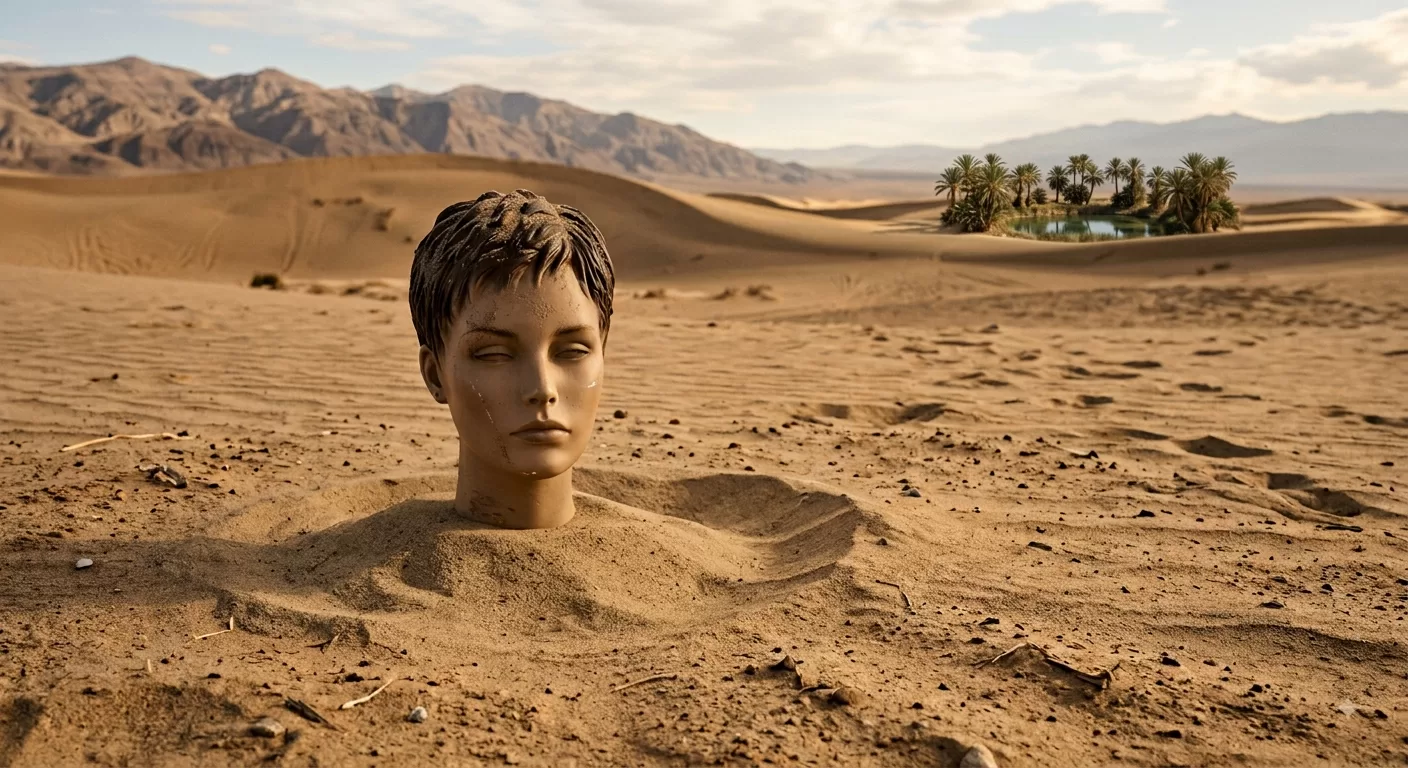
Eleven hours styx (in Tartarus).
The other day I crawled from my living room to my bathroom to answer a call of nature. I remember washing my hands on my knees afterwards – that was the moment I understood something had gone seriously wrong. My body, already worn down by a Long COVID flare that has followed me since 2022, had stopped being negotiable with me. I crawled back to the living room and called an ambulance.
I recognised, with a strange kind of clarity, that I was in danger.
The ambulance took about fifty minutes to arrive. I lay on the floor and picked up a magazine article about soy sauce – something small and ordinary to hold onto while everything else felt enormous. I thought about what might happen if I passed out before help came: that paramedics might have to break my door down to reach me. I pictured it more than once. I accepted it as a possible outcome. That’s an odd kind of peace to make, alone on a floor, but I made it.
When the ambulance arrived, I made it to the door myself, with great difficulty. Opening it brought an enormous wave of relief – followed almost immediately by trepidation, when the crew mentioned how busy the hospital was that day.
In the ambulance, flat on my back, I felt every bump in the road land directly in my joints. And somewhere in the middle of that pain, the EMT and I ended up singing “Mad World” together. Neither of us quite started it – we both did, at the same time. It remains one of the strangest and most human moments of the whole ordeal: two strangers, meeting in a song, while one of them was in genuine crisis.
At the hospital, a nurse commented on my Star Trek: The Next Generation t-shirt on the way in. Small kindness, register kept intact.
Then the wait began. Eleven hours, from ambulance arrival to actually seeing a doctor. A waiting room that was extremely hot and extremely busy, with chairs that seemed engineered to be as uncomfortable as possible for people who were, definitionally, all unwell. I tried desperately to reach my sleeping sister by phone. Not being able to get through to her was, honestly, existentially horrific – a specific kind of alone that goes beyond simply being alone in a room. It’s being unreachable to the one person who could reach you.
She saw my voicemail notifications about an hour after I arrived. When she got to the hospital, it felt like being rescued by Supergirl.
At one point in the waiting room, an Irish man who was clearly in the grip of a severe mental health crisis – fixated on death, with an intense, thousand-yard stare – began harassing my sister and me. It went on until hospital security and nursing staff stepped in to manage the situation. It was frightening in the moment, but it also underlined something about that waiting room: everyone in it, in one way or another, was in crisis, and the system meant to hold all of us at once was stretched far too thin to do it well.
Somewhere in that waiting room, gallows humour crept in – nurses talking about The Last of Us and The Pitt, a show literally about an overwhelmed emergency department, while living through a version of it themselves. It wasn’t despair. It was people staying human inside something exhausting, the way healthcare workers often do.
I don’t have a tidy conclusion to offer. What I have is what happened, told in order: the crawl, the calculated call for help, the fifty minutes with a soy sauce article, the song in the ambulance, the small kindness about a t-shirt, the hour of silence, and then not being alone anymore.
That’s the account, for whoever needs it, including future me.
– written the day after, for the record.
The Missing Specification (For Humanity) And The Great Polycrisis Filter.
Why moral bio-cybernetic/bioenhancement fails at the design document, not the ethics committee.
2,290 words
Proposals to biologically engineer human moral dispositions – to make people more compassionate, more cooperative, less prone to defection – are usually met with ethical objections. Consent. Autonomy. Authenticity. Value lock-in. The long shadow of eugenics.
These objections are serious and several of them are quite decisive. But they are also, in a particular sense, premature. They engage the proposal as though the technical programme were ready and the only remaining question were whether we ought to run it. That framing flatters the proposal. It grants it a maturity it does not have.
There is a more revealing test, and it is the one engineers use on any large proposal before arguing about whether to fund it: **try to write the specification.**
Not a manifesto. Not a research agenda. A design document – the artefact that lets someone else build the thing, and lets a third party check whether it worked. Every field filled in, every acceptance criterion stated, every assumption made explicit enough to be falsified.
When you actually attempt this for moral bioenhancement, something instructive happens. The document does not turn out to be *controversial*. It turns out to be **blank**. And the pattern of which fields are blank is more informative than any of the ethical arguments.
—
The construct problem: you are not turning up a dial
The first field in any specification is: *what, precisely, is being modified?*
“Compassion” is a folk-psychological term. It is not a variable. Before you can build anything you must commit to a decomposition – typically something like an affective component (felt concern at another’s distress), a motivational component (disposition to act at personal cost), a cognitive component (accuracy of your model of the other’s state), a behavioural output (rate and magnitude of costly prosocial acts), and – critically – a **scope function**: to whom does it extend, and how does it decay with social distance?
That last component is where naive versions of the project die.
Human prosociality is not a scalar quantity with a gain knob attached. It is a gradient over social distance: steep and high near kin and in-group, falling off quickly with distance, and effectively flat at the level of statistical strangers. This is why we are simultaneously the species that will run into a burning building for a neighbour and the species that can read a famine death toll over breakfast.
Which means the thing that would actually change outcomes at civilisational scale is not the *amplitude* of caring. It is the **shape of the discount function**. You do not want a higher curve. You want a flatter one.
Nobody has a genetic or neural handle on the shape. And the best-known intervention that raises amplitude appears to make the shape *worse*. Oxytocin spent about a decade as the “moral molecule” before the picture complicated: alongside well-known affiliative effects, a body of work found it strengthening in-group bonding while in some paradigms increasing out-group hostility or defensive aggression. The replication record across this literature is mixed enough that no single result should be leaned on hard. But the direction of the concern is the point. Raising the gain on a parochial system plausibly yields more effective parochialism – more devoted tribalists, better at their tribalism.
There is a second constraint that most versions of the proposal omit entirely: **stability under exploitation**. Any modified disposition must be viable in a mixed population that still contains unmodified defectors. A disposition toward unconditional cooperation is not a stable strategy; it is removed from the population – economically, socially, reproductively – by the people who lack it. Making people kinder inside an unchanged incentive landscape does not produce a kinder world. It produces exploitable people.
So the real target is not “more compassion.” It is something closer to *conditional cooperation, with an unbiased scope function, and with defection-detection and sanctioning capacity fully intact.* That is a much stranger object than the one people imagine. It is also, notably, much closer to what humans already have than to what the proposal would install.
**Status of this field: unresolved – and not primarily as an empirical matter.** It is a conceptual problem that must be settled before measurement is even meaningful.
—
The measurement gate
This is the field that stops the programme, and it stops it completely.
Any intervention specification requires a primary endpoint: a measure with construct validity (it measures the target, not social desirability), test–retest reliability sufficient to detect your expected effect size, sensitivity to within-individual change over the intervention window, resistance to demand characteristics (subjects must not be able to score well by inferring what you want), and ecological validity (it must predict field behaviour, not merely laboratory behaviour).
What actually exists falls into three families, and all three have known, documented problems:
– **Self-report instruments.** Transparently gameable. Correlate substantially with how respondents wish to be seen.
– **Economic games** (dictator, ultimatum, public goods, trust). Behaviour in these correlates weakly-to-modestly with real-world prosocial behaviour. The lab-to-field transfer problem here is one of the more uncomfortable open sores in the literature.
– **Confederate-based laboratory paradigms.** Better ecological validity, but poor scalability and severe single-use problems – you cannot re-run them on the same subject.
The psychometric reliability of these instruments is nowhere near what would be required to detect the modest effect sizes any realistic intervention would produce.
The comparison that makes this vivid: a cardiovascular intervention has LDL cholesterol as a validated surrogate endpoint, blood pressure as a second, and hard endpoints – infarction, mortality – ascertained at registry scale with near-perfect reliability.
**There is no LDL of compassion. There is no mortality-equivalent hard endpoint.** There is nothing you could enter in the “primary outcome measure” field of a trial registration that a competent reviewer would not reject.
This is not a difficulty. It is a category failure. Without a validated endpoint there is no dose-finding, no efficacy claim, no safety signal, and no way to distinguish a working intervention from a broken one. You would be optimising against a function you cannot evaluate.
—
The causal chain has no established arrows
A specification requires a causal model with every link established and quantified:
`intervention → molecular change → circuit change → systems-level change → psychological change → behavioural change`
What exists is a correlational sketch of one link. The empathy/compassion dissociation work – Singer, Klimecki and colleagues – implicates anterior insula and anterior cingulate cortex in empathic distress, and medial orbitofrontal cortex, ventral striatum and affiliation-associated regions in compassion. This is genuinely interesting, and the finding that compassion training increases positive affect while empathy training increases distress and burnout is one of the more useful results in the area.
But it should be read as suggestive, not as a wiring diagram. It is correlational. It is spatially coarse – a functional imaging voxel contains on the order of a million neurons. Sample sizes are typically small, and this subfield has documented reproducibility problems for precisely this class of finding.
What is missing is any **causal** manipulation that reliably, durably, and selectively increases the construct. Oxytocin was the strongest candidate and its literature partially collapsed under replication pressure; even the question of whether intranasal administration achieves meaningful central nervous system delivery remains contested. Contemplative training produces real effects, but modest ones, requiring ongoing practice – a behavioural intervention, not a lever a biological one could be built on.
—
Genetic architecture: no editable targets
For any germline proposal, the specification requires target loci with established causal effect, characterised effect sizes, a complete pleiotropy map, and characterised epistasis and gene–environment interaction.
For prosociality-adjacent traits – agreeableness, self-reported empathy – SNP-based heritability is modest and polygenic scores explain a low single-digit percentage of variance in independent samples. (Treat specific figures as approximate and check current sources; the direction is not in doubt.) The architecture is massively polygenic – thousands of variants of individually negligible effect – heavily pleiotropic, and poorly transferable across ancestries and environments.
Then there is a recursion problem that is rarely acknowledged: **a genome-wide association study is only as good as its phenotype.** Run against the invalid instruments described above, what you recover is the genetic architecture of *scoring highly on a questionnaire*. That is not the target. It may not even be adjacent to the target.
Multiplex editing at the scale of thousands of loci, with uncharacterised epistasis and an unmapped pleiotropy burden, is not a hard engineering problem awaiting effort. It sits outside the space of things currently attemptable.
—
The safety instrument is inside the system it monitors
This is the field I find genuinely novel, and it has no analogue in ordinary medicine.
Post-market drug safety rests on adverse event reporting. Patients notice something has gone wrong and report it. The system assumes the patient’s evaluative faculty is intact and independent of the intervention.
For a values-modifying intervention, that assumption fails by construction. The adverse event class *includes changes to the faculty that generates the report*. If the intervention shifts what a person values, then self-report is compromised as a safety instrument in exactly the failure mode you most need to detect. A population successfully modified toward a particular specification of compassion may no longer contain anyone disposed to recognise the modification as a harm.
You would therefore need an external, non-self-report harm criterion, specified in advance, held by someone outside the modified population. Nobody has (yet…) proposed a workable one.
Note that this is not a philosophical objection dressed up as an engineering one. It is a missing section in the safety file. And it generalises: irreversibility is not merely one cost to be weighed against others, because it removes the mechanism by which anything gets weighed later. Ordinary bad policy is reversed because those harmed by it object. This is the one class of intervention that can eliminate the constituency capable of identifying the error.
—
What the blanks tell us:
Lay the fields out and the completion state is stark. Delivery technology has partial content and active research behind it. Nearly everything else is empty – and the two most upstream fields, construct definition and outcome measurement, are empty in ways that no amount of funding or intelligence resolves from a single location. They are filled by cohorts, instruments, longitudinal data, and decades.
Two things follow.
**First: the ethical objections and the technical emptiness point the same way.** This is worth noticing rather than treating as coincidence. The consent problem, the value lock-in problem, and the pharmacovigilance problem are the same structural fact appearing in three registers – an intervention that alters the evaluator cannot be evaluated by the altered. That the technical specification is blank at precisely the points where the ethics is most troubling is not an accident. It reflects that we do not understand the object well enough to specify it *or* to consent to it.
**Second: the causal premise is probably wrong anyway.** The proposal assumes that destructive collective behaviour is primarily a psychological trait being expressed. But humans are already extraordinarily cooperative by primate standards – we punish unfairness at cost to ourselves, we cooperate with strangers we will never meet again. What competitive systems do is *select* for defection at the level of firms and institutions, largely independent of the dispositions of the people inside them.
The evidence for this is not subtle. When emergency conditions suspend normal procurement controls – competitive tender, due diligence, published contracts, audit trails – fraud losses jump by orders of magnitude. Same population, same dispositions, different controls. Removing the checking is what changes the behaviour.
None of which means dispositions are irrelevant. Some people are cruel, some enjoy it, and the variance is real. But what institutions and norms determine is how much *scope* those dispositions get – whether cruelty is costly or licensed, marginal or ambient. Both halves are true, and the tractable half is the second one. Ostrom’s work on commons governance showed groups solving defection problems through monitoring, graduated sanctions, and local rule-making, with nobody’s psyche altered at all.
And where genuinely catastrophic risk is the concern, it concentrates in a very small number of people with access to weapons systems, engineered pathogens, or critical infrastructure. Screening and constraining that population is orders of magnitude more tractable than modifying a species. It has real problems – who screens the screeners, capture risk – but they are the ordinary problems of institutional design rather than the irreversible rewriting of a lineage.
—
Where the real problem is
If you take the specification exercise seriously, the interesting frontier turns out not to be where the proposal points.
The measurement field is a live, unsolved, genuinely deep problem: how to construct a valid and reliable instrument for a latent construct that resists direct observation, where the act of measurement perturbs the thing measured and the subject has incentive to game the readout.
That is a problem in **measurement theory** more than in biology. Psychology has been notably bad at it – partly because the field’s training does not emphasise what a physicist’s or metrologist’s does: error propagation, calibration, sensitivity limits, distinguishing signal from instrument artefact, and knowing when your resolution cannot support your claim.
Solving it would be valuable regardless of what anyone concluded about enhancement. It is upstream of clinical trials in psychiatry, of policy evaluation, of most of behavioural science. It is where someone with quantitative training would have a genuine edge.
The specification exercise is not, in the end, an argument for despair about the underlying goal. It is a redirection. The document is blank at the top, and the top is where the work is.
So let that work begin.
*Further reading and citations: Persson & Savulescu, ***Unfit for the Future*** (the strongest case for the affirmative); John Harris’s reply on the freedom to fall; Paul Bloom, ***Against Empathy***; Elinor Ostrom, ***Governing the Commons***; Singer & Klimecki on the empathy/compassion dissociation; Habermas, ***The Future of Human Nature***.*
A Secular Humanist’s Take on Trump’s Mt. Rushmore Sermon
The Menace That Wasn’t: A Secular Humanist, Green Party Take on Trump’s Rushmore Sermon
7–11 minutes1,669 words
There’s a particular genre of American political theatre that never quite goes out of style: the mountain, the flag, the borrowed marble faces of dead presidents, and a man at a podium warning you that the enemy is already inside the gates. On July 3, 2026, on the eve of the country’s 250th birthday, Donald Trump stood in front of Mount Rushmore and reached for the oldest prop in that theatre’s closet – communism – and dusted it off for an audience that, statistically, has never lived under it, never studied it seriously, and would be hard-pressed to name a single line from the *Communist Manifesto*. That’s not an accident. The speech wasn’t really about communism. It was about who gets to define “American,” who gets cast as a threat to it, and who gets to stand at the centre of the frame while doing the casting.
I’m writing this as a secular humanist and a GPEW & UK Green Party Member – which means I come to this with two specific moral and political objections. One is to political rhetoric that fuses patriotism to a particular ‘god'(s), and treats disbelief, doubt, or a different faith as a moral defect. The other is to language that smears environmental and economic reform as a totalitarian plot, because that language has spent forty years being used against exactly the kind of politics I care about.
The Return of an Old Formula
Red-baiting has a rhythm to it, and Trump’s speech followed the rhythm precisely: name an external ideology, claim it has infiltrated the homeland through newcomers, strip it of any economic or historical specificity, and then attach to it every imaginable evil – theft, godlessness, lawlessness, murder – until “communism” stops meaning an actual set of economic ideas and starts meaning simply *the enemy*. It is the McCarthy playbook with better production values. The tell is in the vagueness. Nowhere in the speech is there an actual communist policy platform, an actual party programme, an actual piece of legislation. There’s only atmosphere: menace, resurgence, mass control. That vagueness isn’t a flaw in the rhetoric – it’s the whole function of it. A vague enemy can absorb almost anyone the speaker wants it to: a socialist mayor, an immigrant, a public school teacher, a climate scientist, a union organiser, a Green.
And that absorption is precisely why this matters to those of us who spend our political lives arguing for climate policy, wealth redistribution, and structural reform of capitalism. We have watched this same conflation trick used against basic proposals – public healthcare, a carbon tax, tenant protections – for decades. “Socialism” and “communism” get used almost interchangeably in speeches like this one, which is either ignorance of or indifference to the fact that Scandinavian social democracy, American-style progressive taxation, eco-socialism, and Soviet-style single-party state ownership are not the same thing, do not share a history, and do not share an outcome. Collapsing them into one bogeyman isn’t an argument. It’s a way of making argument unnecessary.
“They Don’t Love ‘God(s)’…” – The Theological Loyalty Test
The line that should trouble anyone who takes secularism seriously is the claim that the supposed communist newcomers “don’t love God,” “don’t want God,” and have no interest in religion – as though these were self-evidently disqualifying traits in an American, and as though love of ‘God(s)’, (fantasies and delusions) were a reliable predictor of respect for the rule of law. This is not a description of communism. Historical communist states were genuinely, often violently, hostile to organised religion, and that history is real and worth reckoning with. But the rhetorical move here isn’t a critique of state atheism as state policy – it’s an implication that irreligion itself, present-tense, in an ordinary citizen or newcomer, is evidence of moral rot.
That should unsettle a lot more people than it seems to. Non-religious Americans are one of the fastest-growing demographic categories in the country. Only a portion of them are politically left of centre, and essentially none of them are Soviet apparatchiks. To imply that lack of religious devotion correlates with lawlessness and “mass murder” isn’t a factual claim about political ideology – it’s a loyalty test with a cross on it, dressed up as a warning about Marx. A secular humanist ethic doesn’t need ‘God'(s )to generate a respect for law, human dignity, or “your God-given rights,” to use the speech’s own phrase; it grounds those things in the observable, arguable, revisable project of human reason and empathy instead. A speech that treats a categorical love of God as the load-bearing wall of civic virtue is not just historically sloppy about communism – it is quietly, casually exclusionary towards tens of millions of its own citizens.
Who Gets to Be a “Newcomer”
The line linking the “communist menace” explicitly to “newcomers to our country” deserves its own paragraph, because it is doing quiet, ugly work. Immigration anxiety and communism panic have been braided together in American rhetoric since at least the first Red Scare of 1919-20, when Attorney General Palmer’s raids targeted immigrant labour organisers as much as they targeted any coherent Bolshevik threat. The pattern repeats here: an ideological menace is described, and then it is given a face, and the face belongs to the person who arrived more recently than the speaker’s own ancestors did. It’s worth noting, as an aside that the speech itself doesn’t, that nearly every American is descended from a newcomer at some point, and that the timeline of “how long ago you got here” has never been a meaningful predictor of political ideology.
The Irony of “Mass Control”
Here’s where the Green in me can’t help but notice the mirror. The speech describes communism as “an ideology of mass theft, mass control, mass lies, and mass murder” – and follows it, in the same set of remarks, with a call to eliminate the Senate filibuster and pass a specific piece of legislation so that a single party need “not lose an election for 100 years.” Whatever one thinks of the filibuster as a procedural tool, a call for a hundred years of uncontested one-party rule, delivered in the same breath as a warning about “mass control,” is not a minor rhetorical stumble. It’s the thing the speech claims to be warning against, worn as a lapel pin.
This is the pattern that Greens and civil libertarians alike should recognise regardless of who is doing it: concentrated, unaccountable power is the actual danger, whether it wears a hammer-and-sickle or a flag pin. A one-party state is a one-party state whether its founding myth is proletarian revolution or American exceptionalism. The environmental movement in particular has learned this lesson the hard way – ecological collapse has been accelerated as readily by unaccountable state bureaucracies (the Soviet Union’s environmental record is genuinely catastrophic, from the Aral Sea to Chernobyl) as by unaccountable corporate power in market democracies. The threat was never the label. It was the absence of checks.
Stolen Land, Real History
The speech also takes a swing at people “who tell our children that we live on stolen land or that our heroes were oppressors,” framing this as a communist lie about heritage. This is worth pausing on simply because it’s checkable. The displacement of Native nations from their land through treaty violation, forced removal, and military conquest is not a Marxist interpretation of American history; it’s the documented factual record, taught in university history departments with no particular ideological bent and available in the treaties themselves. Refusing to look at that record doesn’t make the country’s founding more secure – it just makes the founding myth more brittle, because myths that can’t survive contact with evidence eventually break all at once instead of bending gradually. A humanist approach to history says the honest version, oppressors and all, produces a more resilient civic identity than an insistence on unblemished virtue. You cannot build a durable patriotism on a historical record you’re not allowed to examine.
None of this is to say communism as historically practised is above criticism – quite the opposite. The gulag system, the Holodomor, the Cultural Revolution, and the killing fields are real, and their death tolls are not political footballs; they are among the worst human-caused catastrophes on record and deserve unflinching moral reckoning, not what-about-ism from the left and not cartoonish flattening from the right. But precisely because that history is so serious, it deserves to be invoked accurately – as an argument about the specific dangers of one-party rule, command economies, and the suppression of dissent – rather than as a floating epithet applied to socialists, environmentalists, secularists, and immigrants alike because they are politically inconvenient this news cycle.
A Green politics that argues for public transit, a carbon price, universal healthcare, and stronger labour protections is not a request for a politburo. It is, if anything, a bet that democratic institutions – the same institutions this speech claims to be defending – are strong enough to legislate ambitious change without collapsing into the very authoritarianism the speech warns against. Painting that politics with the same brush as Stalinism isn’t vigilance. It’s an [ironically] bad faith way of making sure ambitious reform never gets argued on its merits at all.
The Actual Choice
The speech ends on a binary: you can be a communist, or you can be a patriot, and you cannot be both. It’s a tidy line, and tidy lines are usually where the thinking stopped. The real choice on offer in American politics has never been between Marxist revolution and the status quo. It’s a choice among a wide field of positions on how much the public sector should do, how power and wealth should be distributed, how religious pluralism should be protected, and how honestly a country tells its own history. Collapsing that whole field into a loyalty oath – love ‘God(s)’, distrust newcomers, don’t question the founding myth, or be filed under “menace” – isn’t patriotism. It’s a disingenuous shortcut around the argument, aimed at anyone who might otherwise have made one.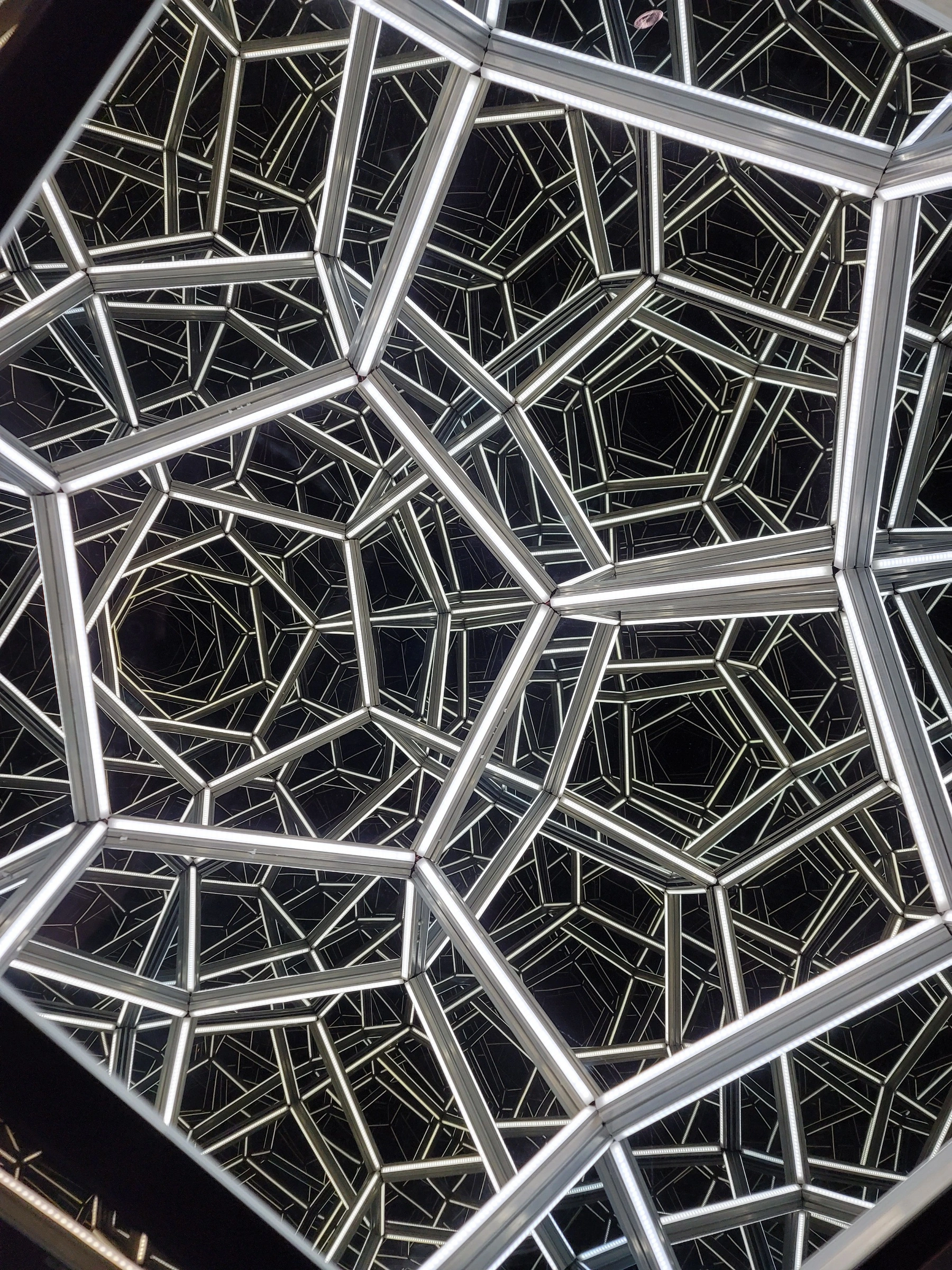
Symbols, Evolution, and the Patterns We Make
What started as a simple question about watermelons whilst chatting with a friend led me down a fascinating rabbit hole about human nature, symbols, and the way we organise ourselves into tribes.
It turns out the watermelon became a Palestinian symbol in the 1980s when Israeli authorities banned the display of Palestinian flag colours – red, green, black, and white. Palestinians found a clever workaround: watermelons naturally contain all these colours in their flesh, rind, and seeds. One banned symbol replaced by nature’s own palette.
The symbol emerged from the art scene of that era. Palestinian artist Sliman Mansour recalls Israeli soldiers telling artists they weren’t allowed to paint in those specific colours. When faced with such cultural repression, creativity found a way – the humble watermelon became a canvas for national identity, its natural colours serving as a subtle but powerful statement of resistance.
But watermelons aren’t alone. Palestinians have developed an entire symbolic vocabulary: the keffiyeh headscarf with patterns representing olive leaves and trade routes, olive trees symbolising deep roots and resilience, keys representing the hope of return, and Handala – a cartoon character who remains forever ten years old until Palestine is free.
Each symbol carries layers of meaning that extend far beyond their surface appearance. The olive tree, for instance, can survive drought, frost, and fire – living for centuries whilst providing sustenance for generations. About 100,000 Palestinian families depend on olive oil as their main source of income, making these ancient trees both practical lifelines and metaphors for endurance. Handala, created by cartoonist Naji al-Ali in 1969, appears as a barefoot boy with sharp, hedgehog-like hair, hands clasped behind his back, never showing his face. He embodies the frozen childhood of displacement – growing up only when return becomes possible.
This got me thinking about what I call “memetic evolution” – how cultural symbols compete, adapt, and survive just like biological traits. When direct expression is suppressed, creativity flourishes in unexpected ways. Symbols find new forms, like water flowing around obstacles.
There’s something deeply human about this adaptive process. Across history, whenever dominant powers attempt to erase cultural expression, communities respond with remarkable ingenuity. Code-switching in language, hidden meanings in folk songs, religious symbols disguised as decorative patterns – the impulse to maintain identity finds endless creative outlets. The watermelon joins a long tradition of resistance through symbolism, from the Christian fish symbol in Roman times to the subtle defiance embedded in enslaved peoples’ spirituals.
It’s the same mechanism at work whether we’re talking about Palestinian resistance symbols or football team loyalty. I’ve seen gravestones in cemeteries dedicated to football teams – someone’s final statement about tribal belonging carved in stone. The psychological need to belong to something larger than ourselves operates at every scale, from global liberation movements to local sports rivalries.
The cemetery where my grandparents are buried provides a perfect laboratory for observing these different scales of meaning. Whilst I sit contemplating vast cosmic distances – mentally zooming out to the heliopause and beyond – the neighbouring gravestone declares eternal allegiance to a football club. Both represent attempts to transcend individual mortality through collective identity, yet they operate on vastly different scales of significance. It’s simultaneously touching and absurd, this human need to plant flags of belonging even in our final resting places.

This pattern fascinates me partly because I’ve always felt like an outsider to it. With a neurological makeup that lets me zoom from planetary perspectives to quantum details simultaneously, dying for tribalism has seemed absurd since I was a toddler. I can mentally disassemble Kings Cross station, rotate its architecture, and rebuild it in my head – yet people judge me on superficial appearances without knowing what’s happening behind my eyes. 😥👀🌌👩🏻💻🧩🔄🧠
The irony cuts deep. I can close my eyes and pull apart the entire structure of a major transport hub – understanding the flows of people and systems, the architectural relationships, the engineering beneath the surface. I can hold multiple scales of reality in simultaneous focus, from the cosmic to the quantum. Yet the same people who couldn’t begin to mentally map the station they’re standing in will give me strange looks based on health impacts from the pandemic that they neither understand nor care to learn about. It’s like being a supercomputer housed in a case that people think looks wrong, leading them to assume the entire system must be faulty.
It’s lonely being cognitively different in a world built for neurotypical processing speeds. Some call people like me “Newtypes” (borrowing from Japanese culture), but I’m wary of such labels. History shows how quickly categories of human “types” can become justifications for treating people differently.
The loneliness of operating at integrated scales of perception is profound. When you can naturally think in geological time and quantum mechanics and human psychology simultaneously, most conversations feel like they’re happening in slow motion on a single narrow frequency. The constant translation required – compressing vast, interconnected insights into bite-sized explanations that fit neurotypical processing – becomes exhausting. You end up feeling like a visitor from another time or world, possessing extraordinary vision but finding yourself surrounded by people operating with much narrower focal ranges.
Even biology struggles with this categorisation problem. Scientists can’t agree on what defines a “species” – there are multiple competing definitions that all break down in different ways. Much of our traditional scientific taxonomy carries colonial baggage, imposing neat hierarchical categories that say more about European thinking than natural reality.
Breeze, blowing that blonde curling hair, stirring it, and being softly stirred in turn, scattering that sweet gold about, then gathering it, in a lovely knot of curls again,
you linger around bright eyes whose loving sting pierces me so, till I feel it and weep, and I wander searching for my treasure, like a creature that often shies and kicks:
now I seem to find her, now I realise she's far away, now I'm comforted, now despair, now longing for her, now truly seeing her.
Happy air, remain here with your living rays: and you, clear running stream, why can't I exchange my path for yours?
-- Francis Petrach. (1304 ~1374)
[Aura que chelle chiome blonde et crespe.]
Ring species provide a perfect example of how nature defies our categorical thinking. Imagine populations of birds that can interbreed with their neighbours all around a geographic ring, but the populations at the “ends” of the ring cannot interbreed with each other. Are they the same species or different ones? The question becomes meaningless because nature doesn’t organise itself according to our need for clean boundaries. Traditional taxonomy reflected the “great chain of being” mentality that conveniently ranked everything from “primitive” to “advanced,” always placing European humans at the top. Even modern approaches still carry traces of this vaunted, haunted, legacy in how we commonly think about evolutionary “progress” and “relatedness.”
The truth is messier and more beautiful than our tribal brains want to admit. Whether we’re talking about Palestinian symbols, football loyalty, cognitive differences, or biological species, nature resists our attempts to organise it into clean categories. We’re all part of the same complex, evolving system – just expressing different patterns within it.
Perhaps this resistance to categorisation is itself meaningful. The watermelon symbol works precisely because it transcends the artificial boundaries imposed upon it. It exists simultaneously as fruit, symbol, act of resistance, and work of art. Similarly, the cognitive differences that isolate some of us from neurotypical social structures might represent not a deviation from some imagined norm, but simply another expression of human neural diversity – as natural and necessary as biodiversity in ecosystems.
The watermelon symbol reminds us that creativity and identity find a way, even under pressure. But perhaps the deeper lesson is recognising these pattern-making impulses in ourselves, understanding them without being consumed by them, and staying curious about the infinite complexity and diversity that surrounds us at every scale. In a world increasingly divided by rigid categories and tribal affiliations, there’s something hopeful about symbols that resist easy classification – reminding us that the most profound truths often exist in the wondrous, ponderous spaces between our neat definitions."Plant a flag, plant a seed, plant an idea, and perhaps watch it grow..."
(2004-01-~21): The Beginning of an Existential Polymetacrisis.

For myself, and the human race.

“She wrote a letter on rose petals, scattered through time.”
I can vividly remember that morning. That feeling of unease with one’s lot in life. Is this it? Is this all that this skinny or sometimes chubby bipedal ape species ever does? Or ever will do? I didn’t ask to be brought into this seemingly insane world 🌍 of arbitrary rules. Rules made by kids that got tall. That 9am to 7pm grind, every weekday?!
“Pitiiful. I don’t want to tolerate it, but I guess I must…”
Post 9/11. The world had been flipped upside down and shaken to it’s core. And shaken me deeply too. Living on Kirkgate. Getting ready for work at Cash Converters. Putting on my red polo shirt uniform. I tolerated the job. I had started working there as a means to support myself through college, but the hours were long, too long; and I was tasked with carrying heavy furniture and televisions up and down multiple flights of stairs, for only the minimum wage at the time, and my rent and bills were rather extortionate. It was back breaking toil with often rude and abusive customers. It gradually started to erode my faith in humanity.

The 2011 Riots: Cash Converters on Salford Precinct. Manchester. “And round and round that abyssal wreck…” Image Credit: Wikipedia. One of my favourite bands was playing their newest song on the radio. I was in such a rush, as ever, that my freshly-showered hair was still wet, little droplets of water dripping down my forehead and into my eyes, like so many tears, lost in the rain. I hated this job, this lot in life that had apparently been handed to me. I felt as if I had been thrust into a terrible universe, in some deep abiding sense, from what had perhaps been a great one, perhaps in some former lifespan, or at least that’s what some new-found Buddhist friends had told me in our many long conversations on religion and spirituality.
“Every singular thing, or anything which is finite and has a determinate existence, can neither exist nor be determined to produce an effect unless it is determined to exist and produce an effect by another cause, which is also finite and has a determinate existence; and again, this cause can neither exist nor be determined to produce an effect unless it is determined to exist and produce an effect by another, which is also finite and has a determinate existence, and so on, to infinity. (IP28).” – Spinoza.
Then came the sirens. A convoy of them, speeding past my creaky living room window like banshees announcing the end of something. They cut through the morning air and rang through me, like standing next to a large stricken church bell – that deep, reverberating toll that settles in your chest and stays there. I paused in buttoning my red polo shirt, irritated by yet another intrusion into my already-fractured morning routine. More chaos in a world that already felt like it was coming apart at the seams.Ten minutes later, the radio told me why.
Harold Shipman was dead. Found hanging in his cell at Wakefield Prison. The doctor who had killed at least 215 of his patients – maybe more – had finally killed himself. Those sirens I’d heard weren’t just racing toward another everyday emergency. They were marking the end of one of Britain’s most prolific serial killers, a man who had perverted the most sacred trust our society offers: the bond between doctor and patient.
In that moment, my personal morning of dread suddenly had a mirror in the collective. Here I was, putting on my uniform to participate in a system I increasingly distrusted, questioning those arbitrary rules made by kids who got tall. And there was Shipman – the ultimate embodiment of respectability gone rotten, a man who had worn his own uniform, his doctor’s coat, while systematically murdering the people who trusted him most.
The timing felt like more than coincidence. It was January 2004, and we were all still reeling from a world where the unthinkable had become routine. First the twin towers fell, three years earlier, shattering our illusions of safety. That wonderful childhood of the 90’s. Then we learned that our most trusted, formerly most venerated healers, could be killers. What other foundations, other unknown naiveties, were crumbling beneath our feet while we went through the motions of normal life?
Standing there with wet hair dripping into my eyes, I realised I wasn’t alone in my sense of displacement. An entire generation was waking up each morning to put on uniforms – literal and metaphorical – for jobs and lives that felt increasingly hollow. We were all carrying other people’s discarded possessions up endless flights of stairs, just like I did at Cash Converters, wondering if this grinding routine was all there was.
The sirens had faded, but their echo remained. They had announced more than Shipman’s death – they had marked the sound of a society finally admitting that the old certainties were gone, and we were all stumbling around in the wreckage, looking for something real to hold onto…

It’s overwhelming, and surprising. Perhaps we ought to just close the curtains and head back to bed… But that ‘something real’ didn’t arrive, in the form of an epiphany for many years later, many years stuck, brewing in the subconscious mind, until November 2023…
And so here we are, dear reader. Present day. Present time(s). A decade of unprecedented change and upheaval. The 2020’s.
Good luck. All we have is each other.

(c) Cydonis 2025. 
Safety
Our Unwavering Commitment to Safety.

At Cydonis Heavy Industries (C.H.I.), Ltd., safety is more than a priority; it is the fundamental value that guides every decision we make and every action we take.
The health and well-being of our employees, contractors, clients, and the communities in which we operate are paramount. We will never compromise on safety for the sake of productivity or profit. Our goal is an incident-free workplace.
We are committed to creating and maintaining a culture where every individual feels responsible for their own safety and the safety of those around them.
To achieve this, Cydonis Heavy Industries is dedicated to the following principles:
1. Leadership and Accountability:Management at all levels is responsible and accountable for providing the leadership, resources, and training necessary to ensure a safe working environment.We will lead by example, demonstrating a visible and unwavering commitment to safety in all aspects of our business.
2. Employee Empowerment and Responsibility:Every C.H.I. employee has the right and the responsibility to stop any work they believe to be unsafe.We will foster a culture of open communication where all employees are encouraged to report hazards, near-misses, and incidents without fear of reprisal.Safety is a shared responsibility. We expect every team member to be actively involved in our safety programs and to look out for one another.
3. Proactive Risk Management:We will proactively identify, assess, and mitigate workplace hazards through regular inspections, risk assessments, and job safety analyses.We are committed to providing all necessary personal protective equipment (PPE) and ensuring it is used correctly.We will maintain our equipment, tools, and facilities to the highest standards to prevent failures that could lead to incidents.
4. Continuous Improvement and Training:We will provide comprehensive and ongoing safety training to all employees to ensure they have the knowledge and skills to perform their work safely.We will thoroughly investigate all incidents and near-misses to identify root causes and implement effective corrective actions to prevent recurrence.We will continuously review and improve our safety policies, procedures, and performance to meet and exceed industry best practices and regulatory requirements.
Our commitment to safety is absolute.
By working together, we can ensure that every member of the Cydonis Heavy Industries family returns home safely at the end of every workday!
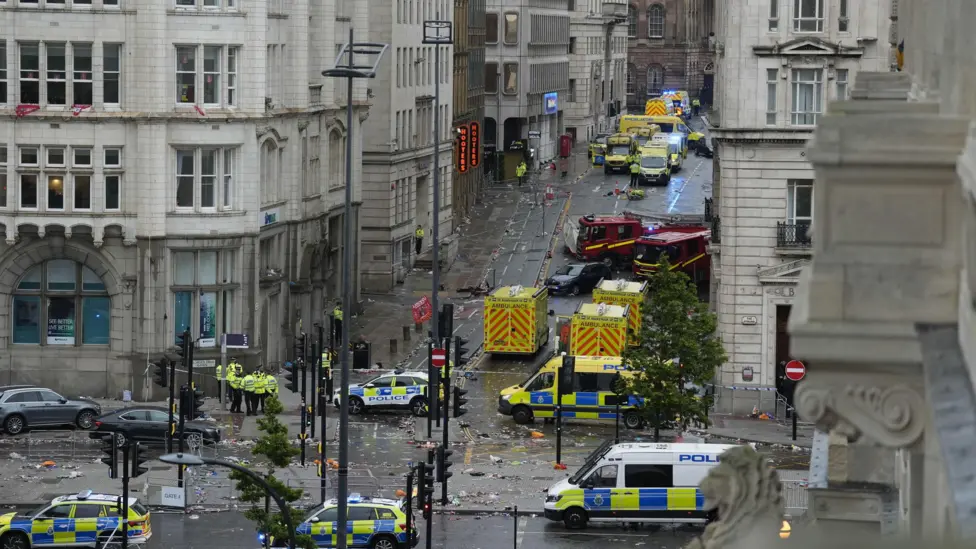
The Last of the Pennines
A Climate Fiction Story – And A Stark Warning Of A Very Possible & Terrible Future…
© 2025. Cydonis Heavy Industries, (C.H.I), Ltd. All rights reserved.
Chapter 1: The Silence of Leeds
The morning Amanda Scott stepped out of the abandoned Marks & Spencer on Briggate, the temperature gauge on her salvaged weather station read 47.3°C. It was only March.
She adjusted the straps of her pack, heavy with the last of the tinned goods from the store’s stockroom, and looked down what had once been Leeds’ bustling shopping district. The silence was absolute. Not the peaceful quiet of a Sunday morning, but the profound absence of a world that had simply stopped breathing.
The physics of it all still fascinated her, even now. Even as the last CEO of what had been Northern England’s most successful renewable energy company, even as one of perhaps a dozen souls left wandering the Yorkshire Dales, she couldn’t help but calculate. Seven degrees of warming. The feedback loops had cascaded exactly as the models predicted, except faster. Always faster than anyone had dared to publish.
Amanda’s mind, that restless engine that had earned her three degrees by twenty-five and a company worth £200 million by thirty-five, now applied itself to simpler calculations. Water: enough for three days if rationed. Food: perhaps a week. The nearest settlement with any hope of survivors: Harrogate, thirty miles north through what had once been green countryside.
She began walking.
The streets told their story in layers. First, the obvious devastation of the Great Heat of 2053, when temperatures had spiked to 52°C for six consecutive days. Shop windows had cracked from thermal expansion. Tarmac had melted into sticky rivers that trapped the last fleeing cars. The bodies had long since been claimed by the heat and the storms that followed.
But beneath that immediate catastrophe lay the slower strangulation. The abandoned offices of 2051, when the insurance industry collapsed overnight. The boarded-up houses of 2050, when the last mortgages defaulted and the banks finally admitted the obvious: you cannot write thirty-year loans on property that will be underwater in ten.
Amanda had seen it all from her corner office in the Bridgewater Place tower. Her company, Pennine Renewables, had been one of the last to keep the lights on as the grid failed piece by piece. Solar panels cracked in unprecedented heat. Wind turbines designed for 40°C began failing at 45°C. The hydroelectric systems ran dry as the reservoirs turned to dust.
She had kept the company running even as her employees fled south, then west, then simply disappeared. The irony wasn’t lost on her: the woman who had spent her career trying to prevent exactly this catastrophe was now its most intimate witness.
The M621 motorway stretched ahead, its concrete surface buckled and split. Weeds pushed through the cracks—not the familiar Yorkshire flora of her childhood, but something more aggressive, more alien. Plants that had evolved in the heat of equatorial regions, carried north by the great migrations of 2052.
Amanda paused at the Holbeck interchange, consulting the paper map she’d salvaged from a petrol station. Digital navigation had become meaningless when the satellites failed and the cell towers fell silent. She traced her route with a finger already showing the early signs of heat exhaustion despite the electrolyte tablets she’d been rationing.
The landscape ahead shimmered with heat haze, transforming the familiar outline of Headingley into something from a fever dream. She had walked this route before, of course—driven it countless times in her old Tesla, back when charging stations still functioned and the roads were crowded with the desperate optimism of people who believed technology would save them.
Technology. The word felt almost quaint now. Amanda’s phone had died three days ago, not from lack of battery but from the heat. Even the hardened electronics she’d designed for her industrial clients couldn’t survive the new reality. The future belonged to paper maps and mechanical watches, to the pre-digital skills that her generation had spent their lives trying to transcend.
She walked on, her footsteps echoing off the empty apartment blocks that lined the route. Most were dark, their windows like dead eyes. But occasionally she caught a glimpse of movement—a flutter of curtain, a shadow crossing a doorway. She had learned not to investigate. The few survivors she’d encountered had been… changed. Not just by the heat and the hunger, but by something deeper. The social contract that held civilisation together had dissolved as completely as the polar ice caps.
The sun climbed higher, and Amanda sought shelter in the remains of a garden center. The greenhouses had long since shattered, their tropical plants withered despite the new climate. She found a patch of shade and consulted her notebook—a leather-bound journal that had become her most precious possession.
The pages were filled with observations, calculations, fragments of the scientific mind trying to make sense of the senseless. Temperature readings. Barometric pressure. Notes on the behaviour of the changed wildlife—the rats that had grown bold and strangely aggressive, the birds that flew in confused circles as their magnetic navigation systems failed in the planet’s shifting magnetic field.
But increasingly, the entries were personal. Memories of her transition, completed just as the world was beginning its own transformation. The support groups where she’d met other trans women, all of them now scattered to the winds or claimed by the heat. The autism support networks that had helped her understand herself, now as extinct as the Yorkshire Dales sheep.
She wrote:
*Day 47 since leaving Leeds. The irony persists—I spent my career building systems to prevent exactly this outcome. Now I’m perhaps the only person left who truly understands what went wrong. The feedback loops were always there in the data. The tipping points were clearly marked. But understanding a system and controlling it are different things entirely.*
*The transgender community understood this better than most. We knew what it meant to live in a body that was changing beyond recognition, to watch familiar systems fail and have to rebuild from scratch. The planet is transitioning now, and there are no hormones to ease the process.*
A sound made her look up—the distant rumble of an engine. Amanda felt her heart rate spike. In the past week, she’d learned to fear the sound of motors. The few vehicles still running belonged to the groups that had turned to scavenging, and their approach to resource allocation was brutally simple.
She packed quickly and slipped out the back of the garden centre, keeping to the shadows as she made her way north. The engine sound faded, but the anxiety remained. In the old world, she’d been a CEO, a respected figure at climate conferences, a woman who commanded rooms full of powerful men. Now she was prey.
The afternoon sun was merciless as she crested the hill overlooking Harrogate. The spa town spread below her like a mirage, its Victorian terraces shimmering in the heat. From this distance, it looked almost normal—until you noticed the absence of movement, the lack of smoke from chimneys, the terrible stillness that had settled over the world.
Amanda’s weather station beeped: 49.1°C. She made a note in her journal and began the descent into what had once been one of England’s most elegant towns. Behind her, the empty shell of Yorkshire stretched to the horizon, a monument to the hubris of a species that had believed it could burn the sky without consequence.
The sun was setting as she reached the outskirts of Harrogate, painting the abandoned houses in shades of amber and gold that almost made the devastation beautiful. Almost.
*Tomorrow,* she wrote in her journal, *I’ll search for survivors. Tonight, I’ll dream of a world where the temperature never exceeded 1.5°C of warming, where the feedback loops remained dormant, where the last CEO of Pennine Renewables was remembered for preventing catastrophe rather than witnessing it.*
*But when I wake, it will still be 2054, and I will still be alone with the mathematics of our failure. Against an oligarchy that caused the world to burn to ashes, all for the sake of another day’s shareholder dividends, and exorbitantly greedy profit margins…*
She closed the journal and prepared for another sleepless night in the furnace that had once been England.
—
Chapter 2: The Harrogate Mirage
Amanda woke, groggily at 4:17 AM to the sound of rain.
For a moment, lying in the dusty remains of what had been a boutique hotel on Parliament Street, she allowed herself the luxury of hope. Rain meant cooling. Rain meant the possibility of refilling her water bottles without having to venture to the toxic sludge that had replaced the River Nidd.
Then she stepped outside and felt the drops on her skin. They burned.
The rain was the colour of rust, thick with particulates from the dust storms that swept across what had been the Atlantic. Each drop carried the chemical signature of a dying ocean—acidic, laden with metals, hostile to life. Amanda retreated quickly, making a note in her journal: *Acid precipitation event. pH approximately 3.2 based on skin reaction. The oceanic conveyor has stopped entirely.*
She had predicted this in her final paper, published in Nature Climate Change just weeks before the journal ceased publication. The Atlantic Meridional Overturning Circulation—the great engine that had carried warm water north and cold water south for millennia—had simply switched off. Without it, the weather patterns that had sustained European civilisation for ten thousand years collapsed into chaos.
The rain hammered against the hotel windows as Amanda prepared her meagre breakfast: half a tin of beans, heated over a camping stove she’d salvaged from a sporting goods shop. The fuel cartridge was nearly empty—another countdown timer in a life now measured in rapidly diminishing resources.
As she ate, she studied the street map of Harrogate, marking the locations she would search today. The residential areas first, then the town centre, finally the spa buildings that had given the town its Victorian fame. Somewhere in this maze of abandoned streets, there might be others. Or there might be nothing but the elaborate silence that had settled over the world like a shroud.
The rain stopped as suddenly as it had begun, leaving the streets steaming in the morning heat. Amanda ventured out, her boots squelching through puddles that ate at the rubber soles. The acid rain had stripped the paint from cars, revealing the metal beneath like exposed bone.
She began her search systematically, as her autism demanded. Block by block, house by house, calling out in the peculiar way that had become her signature: “Hello! I’m Amanda Scott, from Pennine Renewables. I’m looking for survivors. I have medical supplies and water purification tablets.”
The responses, when they came, were rarely what she hoped for.
The first house that showed signs of recent habitation was a Victorian terrace on Dragon Avenue. The front door hung open, revealing a living room that had been methodically stripped of everything useful. Amanda called out her greeting and heard movement upstairs—the scrabbling of something that might once have been human.
She climbed the stairs cautiously, her multi-tool ready. The stairwell was thick with the smell of decay and something else—a sweet, cloying scent that made her gag. At the top, she found them.
The family had been dead for weeks, but they weren’t alone. The rats had found them first, and the rats had changed. They were larger than any she’d seen before, their fur patchy and strange, their eyes reflecting light in a way that spoke of genetic damage. They watched her with an intelligence that made her skin crawl.
One of them, easily the size of a small cat, rose on its hind legs and made a sound that was almost like speech. Almost.
Amanda backed away slowly, making another note: *Radiation exposure or chemical contamination accelerating mutation rates. Survivors may not be human in any recognizable sense.*
She left the house quickly, but the sound followed her—a chittering that seemed to carry meaning, as if the creatures were discussing her presence.
The next several houses revealed the same pattern: abandonment, decay, and the growing presence of things that had adapted to the new world faster than humanity ever could. By midday, as the temperature climbed past 50°C, Amanda had found no living people.
She took shelter in the Royal Pump Room, the grand Victorian building that had once been Harrogate’s proudest attraction. The famous sulphur springs had long since dried up, leaving only the ghost of their distinctive smell. Amanda sat in the ornate main hall, surrounded by the elegance of a bygone era, and contemplated the mathematics of extinction.
Her notebook was filling with observations that painted a picture of accelerating collapse. The large mammals were gone—no surprise there, as they couldn’t regulate their body temperature in the new heat. The birds were dying in massive numbers, their navigation systems scrambled by the planet’s shifting magnetic field. Even the insects were struggling, their life cycles disrupted by temperature fluctuations that could swing twenty degrees in a single day.
But some things were thriving. The rats, obviously. Strange new fungi that seemed to feed on the acid rain. Plants that looked like nothing she’d studied in botany, their leaves waxy and alien. The planet was being colonised by life forms that belonged to a different era, a different world.
Amanda opened her journal and began to write:
*Day 48. Harrogate appears to be completely uninhabited by humans. The ecosystem transformation is accelerating beyond my most pessimistic projections. We’re witnessing the Permian extinction event in real time—but compressed into decades rather than millennia.*
*I think about the conferences I attended, the papers I wrote, the warnings I issued. We knew this was coming. The tipping points were clearly marked in the data. But knowing and preventing are different things entirely.*
*There’s a parallel here to my own transition. I knew I was trans for years before I acted on it. The signs were clear, the science was settled, but the social and economic barriers seemed insurmountable. By the time I finally transitioned, I was already thirty-five—past the optimal window for some treatments, but not too late to live authentically.*
*The planet never got that chance. We waited too long, and now we’re watching it transition into something alien and hostile. The familiar climate I grew up with is gone forever, replaced by something that doesn’t recognise human life as relevant.*
A sound from outside interrupted her writing—the distant rumble of an engine. Amanda felt her pulse quicken. She’d heard that sound before, in the approach to Harrogate. This time, it was closer.
She moved to the window and peered through the grimy glass. A convoy of vehicles was moving slowly down Parliament Street—three cars and a truck, all heavily modified with armour plating and strange protrusions that might have been weapons. They moved with the casual predation of apex predators in a world where the food chain had collapsed.
Amanda had heard rumors of such groups. The Scavengers, some called them. Others used less polite terms. They were the humans who had adapted to the new reality not through cooperation or ingenuity, but through the simple expedient of taking what they needed from those too weak to resist.
The convoy stopped directly in front of the Pump Room.
Amanda gathered her belongings quickly, her mind racing through escape routes. The building had multiple exits, but she’d need to move fast. The acoustic properties of the Victorian architecture would carry sound, and these people would be listening.She was halfway to the rear exit when she heard the chilling echoes of a voice:
“Amanda Scott! We know you’re in there. We’ve been tracking you since Leeds.”
The voice was cultured, educated—not what she’d expected from a group of post-apocalyptic raiders. Amanda froze, her hand on the door handle.
“We’re not here to hurt you,” the voice continued. “We’re here because we need your expertise. The world is ending, Dr. Scott, but it doesn’t have to end for everyone.”
Through the window, Amanda saw a figure emerge from the lead vehicle. A woman in her fifties, wearing what looked like a modified military uniform. She carried herself with the confidence of someone accustomed to command.
“My name is Colonel Sarah Blackwood,” the woman called out. “I represent the Northern Territories Collective. We’ve been monitoring your movements for weeks. We have a proposal.”
Amanda’s scientific curiosity warred with her survival instincts. She had heard whispers of the Collective—a group of survivors who had supposedly established a functioning settlement somewhere in the Scottish Highlands. If they were real, they might represent the last hope for organised human civilization.
If they were real.
“What kind of proposal?” Amanda called back, her voice carrying across the empty street.
“The kind that might save what’s left of our species,” Blackwood replied. “But we need to discuss it somewhere more private. Somewhere with proper cooling and clean water.”
Amanda made her decision. She stepped out of the Pump Room, her hands visible but her multi-tool within easy reach. The heat hit her like a physical blow, but she kept her expression neutral.
“I’m listening,” she said.
Colonel Blackwood smiled, but it didn’t reach her eyes. “Good. Because what we’re about to show you will change everything you think you know about the future of human civilization.”
The convoy’s engines rumbled to life, and Amanda Scott—the last CEO of Pennine Renewables, the woman who had spent her career trying to prevent the climate apocalypse—climbed into a vehicle that might carry her toward salvation or toward something far worse.
Behind them, the empty streets of Harrogate shimmered in the heat, and the changed rats watched from the shadows with their too-intelligent eyes.
—
Chapter 3: The Collective
The vehicle’s air conditioning was the first miracle Amanda had experienced in months. As they drove north through the ruins of North Yorkshire, she found herself fighting tears at the simple pleasure of cool air against her skin. The convoy’s lead vehicle was a modified Range Rover, its windows tinted black and its chassis reinforced with steel plating that spoke of careful engineering rather than hasty scavenging.
Colonel Blackwood sat opposite her, studying a tablet that somehow still functioned despite the electromagnetic chaos that had disabled most electronics. The woman’s uniform was crisp, military-precise, and bore insignia that Amanda didn’t recognize—a stylized tree within a circle, embroidered in silver thread.
“Tell me about the rats,” Blackwood said without preamble.
Amanda looked up from her own observations. Through the tinted windows, she could see the landscape rolling past—what had once been the Yorkshire Dales, now a wasteland of cracked earth and skeletal trees. The famous dry stone walls still stood, but they enclosed nothing but desolation.
“Radiation exposure,” Amanda replied. “Or chemical contamination. Possibly both. They’re showing signs of accelerated evolution—increased size, altered behavior patterns, what appears to be enhanced cognitive function.”
“How enhanced?”
“They seemed to be communicating about my presence. Coordinating their movements. I’ve seen similar patterns in dolphins and some primates, but never in rodents.”
Blackwood made notes on her tablet. “We’ve observed the same phenomenon across northern England. The rats, the surviving birds, even some of the plant life. It’s as if the environmental stressors are triggering rapid evolutionary adaptation.”
“That’s impossible,” Amanda said automatically. “Evolution doesn’t work that way. Natural selection requires multiple generations, genetic drift, reproductive isolation—”
“Dr. Scott,” Blackwood interrupted gently, “a great many things have become possible since the collapse. The rules we lived by are no longer applicable.”
The convoy turned onto what had once been the A1, the great north-south artery that had connected London to Edinburgh for centuries. Now it was a ribbon of cracked tarmac threading through emptiness. Occasionally they passed the skeletal remains of service stations, their fuel pumps standing like monuments to a vanished world.
“Where are we going?” Amanda asked.
“The Cheviot Hills,” Blackwood replied. “Just across the Scottish border. We’ve established a settlement there—fully self-sufficient, climate-controlled, with enough resources to sustain a population of approximately three thousand.”
Three thousand. Amanda tried to process the number. In the past two months, she’d encountered fewer than a dozen living humans, and half of those had been hostile or beyond help. The idea of a functioning community seemed as fantastical as the talking rats.
“How?” she asked.
“Preparation,” Blackwood said simply. “Some of us saw this coming earlier than others. We began construction in 2049, when the first cascade failures became apparent. Underground facilities, geothermal power, hydroponic agriculture, atmospheric processors. Everything necessary to maintain human civilization in a hostile environment.”
“You’re talking about bunkers.”
“I’m talking about survival,” Blackwood corrected. “The question is whether you want to be part of it.”
Amanda stared out the window at the passing desolation. In the distance, she could see smoke rising from what might have been a burning forest or simply the spontaneous combustion of overheated organic matter. The temperature gauge on the dashboard read 52°C.
“What do you want from me?” she asked.
“Your expertise. Your knowledge of renewable energy systems. Your understanding of climate dynamics.” Blackwood leaned forward. “Dr. Scott, you spent your career trying to prevent this catastrophe. Now we need you to help us survive it.”
“And if I refuse?”
“Then we’ll return you to Harrogate with our thanks and our regrets. But I think you’re too intelligent to choose extinction over adaptation.”
The convoy crested a hill, and Amanda saw something that made her catch her breath. In the valley below, a small town clustered around what appeared to be a functioning railway station. Smoke rose from chimneys—not the black smoke of burning refuse, but the clean white smoke of controlled fires. People moved through the streets, tiny figures going about their daily business as if the world hadn’t ended.
“Wooler,” Blackwood said, following her gaze. “Population eight hundred and growing. We’ve managed to maintain a functioning community there by carefully managing resources and maintaining strict environmental controls.”
“How strict?”
“Everyone contributes according to their abilities. Everyone receives according to their needs. And everyone follows the protocols necessary to ensure our survival.”
Amanda heard the steel beneath the reasonable words. “And if someone doesn’t follow the protocols?”
“Then they’re no longer part of the collective.”
The convoy descended into the valley, and Amanda got her first close look at the new world Blackwood’s people had built. The buildings were a mixture of original structures and new construction, all connected by covered walkways that protected pedestrians from the brutal heat. Solar panels covered every available surface, but these weren’t the familiar blue rectangles of her old industry—they were sleek, almost organic-looking installations that seemed to track the sun’s movement with mechanical precision.
People stopped to watch the convoy pass, and Amanda noticed they all wore similar clothing—lightweight, reflective fabric that covered their skin completely. Their faces were hidden behind masks and goggles, making them look less like humans than like astronauts exploring an alien world.
Which, she supposed, they were.
The convoy stopped in front of a large building that had once been a community center. Now it bore the same tree-in-circle symbol as Blackwood’s uniform, carved into the stone lintel above the entrance. The Colonel climbed out and gestured for Amanda to follow.
“Welcome to humanity’s future,” Blackwood said.
Inside, the building was cool and surprisingly spacious. The walls were lined with screens showing data streams—temperature readings, atmospheric composition, power consumption, water usage. It looked like a cross between a corporate headquarters and a space mission control centre.
“Impressive,” Amanda admitted.
“It has to be. We’re not just maintaining a town, Dr. Scott. We’re maintaining a biosphere. Every variable has to be monitored, every resource carefully allocated. One mistake, one system failure, and eight hundred people die.”
They walked through corridors lined with hydroponic gardens, past workshops where people in clean-suits worked on equipment Amanda didn’t recognise. The air smelled of ozone and growing things, a sharp contrast to the stench of decay that had become the signature of the outside world.
“The question,” Blackwood continued, “is whether you want to help us expand this success or return to the wilderness to document our species’ extinction.”
They entered a large room dominated by a holographic display showing the British Isles. Most of the map was colored red, but there were small pockets of green scattered across Scotland and northern England. Each green zone pulsed with data—population, resources, sustainability metrics.
“Seventeen functioning settlements,” Blackwood explained. “Forty-three thousand survivors in total. It’s not much, but it’s a foundation.”
Amanda studied the display, her physicist’s mind automatically calculating logistics, resource flows, genetic diversity requirements. “How do you maintain contact between settlements?”
“Carefully. Radio when possible, courier when necessary. We’ve developed protocols for everything—trade, communication, genetic exchange to prevent inbreeding. We’re not just surviving, Dr. Scott. We’re building the framework for human civilization’s next phase.”
“And what role would I play in this next phase?”
“You would head our energy division. Your expertise in renewable systems, your understanding of grid management, your knowledge of storage technologies—we need all of it. The settlements are growing, and growth requires power.”
Amanda walked closer to the display, studying the data streams. The numbers were impressive—the settlements were not just surviving but actually thriving within their controlled environments. Population growth was positive, resource utilisation was efficient, and the technology appeared to be advancing rather than merely maintaining.
“What about the outside world?” she asked. “The people who aren’t part of your collective?”
“What about them?”
“Are you going to help them? Share your technology? Expand your settlements to include more survivors?”
Blackwood’s expression hardened slightly. “Dr. Scott, we’ve saved forty-three thousand people from extinction. We’ve preserved human knowledge, culture, and genetic diversity. We’ve created a sustainable model for post-climate civilization. I think that’s enough.”
“But there might be others—”
“There are others,” Blackwood said firmly. “And most of them are like the people you’ve encountered—desperate, dangerous, and dying. We can’t save everyone, Dr. Scott. We can only save ourselves.”
Amanda felt a chill that had nothing to do with the air conditioning. “So you’re building a new world for the chosen few.”
“We’re building a new world for the survivors. For the people who were intelligent enough to prepare, disciplined enough to follow protocols, and useful enough to contribute. Natural selection, Dr. Scott. We’re not fighting it—we’re directing it.”
The holographic display pulsed with data, forty-three thousand lives reduced to numbers and metrics. Amanda thought of the rats in Harrogate, their too-intelligent eyes, their apparent ability to communicate and coordinate. Evolution in action, adaptation to a changed world.
“I need time to think,” she said.
“Of course. We’ve prepared quarters for you. Climate-controlled, private, with access to our library and research facilities. Take all the time you need.”
Blackwood gestured to a aide who materialized from the shadows. “Dr. Morrison will show you to your room. Dinner is at seven—we maintain normal social schedules here. It helps with morale.”
As Amanda followed Dr. Morrison through the corridors, she caught glimpses of the settlement’s inner workings. Children in a classroom, learning from holographic displays. Scientists in laboratories, working on projects she couldn’t identify. Engineers maintaining the complex systems that kept the entire facility running.
It was impressive. It was terrifying. And it might be humanity’s only hope.
Her quarters were spartanly furnished but comfortable—a bed, a desk, a small bathroom with running water that was actually clean. The walls were lined with screens showing external views of the settlement, and Amanda realised she was effectively underground, insulated from the hostile environment above.
She sat at the desk and opened her journal, but found herself staring at the blank page. How do you document the moment when you’re forced to choose between your principles and your survival? How do you weigh the lives of forty-three thousand against the lives of everyone left behind?
Outside, through the screens, she could see the sun setting over the Cheviot Hills. The sky was the color of blood, streaked with chemicals and particulates from the dying world above. But here, in this carefully controlled environment, life continued.
Amanda picked up her pen and began to write:
*Day 49. I have found the future of human civilization. The question is whether I want to be part of it.*
—
Chapter 4: The Strange Dying Days
Amanda woke at 3:47 AM, her body rigid with the familiar terror of remembered heat. The nightmare was always the same—Leeds, July 2052, the temperature climbing past 55°C for the third consecutive day. But this time it felt different, more vivid, as if her subconscious was forcing her to relive every detail with perfect clarity.
She sat up in the narrow bed, her skin slick with sweat despite the cool air cycling through the settlement’s climate control. The screens on the walls showed the pre-dawn darkness above ground, peaceful and empty. But behind her eyes, a different scene played out with merciless precision.
*July 15th, 2052. Day three of the Great Heat.*
Amanda had been in her office at Pennine Renewables when the first reports came through. The BBC was still broadcasting then, though their signal had become increasingly erratic as the power grid failed section by section. She remembered the newsreader’s voice, professionally calm even as the words described unthinkable catastrophe.
“The Prime Minister has announced the deployment of emergency military units to maintain order in major population centres. The death toll from the current heat wave now exceeds fifteen thousand across the UK, with Leeds, Manchester, and Birmingham reporting complete breakdown of emergency services…”
Amanda had looked out her window at the city spreading below. Even from the thirty-second floor, she could see the signs of collapse. Abandoned cars dotted the streets, their metal too hot to touch. The usual urban hum had been replaced by an eerie silence, broken only by the distant sound of sirens and, increasingly, gunfire.
Her phone had buzzed with a text from her assistant: *Military roadblocks on all major routes. They’re not letting anyone leave the city.*
That was when she’d understood. The government wasn’t trying to maintain order—they were trying to contain the dying.
The memory shifted, kaleidoscoping through fragmented images. Amanda pressed her palms against her eyes, but the visions continued with ruthless clarity.
*July 16th, 2052. Day four of the Great Heat.*
She had ventured out that morning, driven by a combination of professional duty and morbid curiosity. The streets were chaos barely held in check by military presence. Soldiers in full environmental suits moved through the heat like figures from a science fiction nightmare, their faces hidden behind reflective visors.
At the corner of Boar Lane and Briggate, she had encountered her first mass grave.
They hadn’t bothered to dig deep. The ground was too hard, baked to the consistency of concrete by the relentless sun. Instead, they had simply cleared a space in what had been the city’s central shopping district and begun stacking bodies. The smell was indescribable—a mixture of decay, disinfectant, and something else that seemed to coat the inside of her nostrils.
A young soldier, barely out of his teens, had been standing guard. His name tag read “CORPORAL JENKINS,” and his hands shook as he held his rifle.
“You need to move along, miss,” he had said, his voice muffled by the breathing apparatus. “This is a restricted area.”
“I’m Dr. Amanda Scott,” she had replied, showing him her company ID. “I’m a physicist. I’m documenting the infrastructure failure patterns.”
The soldier had looked at her with eyes that seemed far too old for his face. “Doc, there ain’t no infrastructure left to document. It’s all gone.”
Behind him, a mechanical digger had rumbled to life, beginning work on what would become the second mass grave. Amanda had counted the bodies as they were loaded—forty-three men, women, and children who had died in the heat, their bodies swollen and darkened by the sun.
“How many?” she had asked.
“In this sector? Maybe three thousand so far. But the morgues filled up days ago. The crematoriums can’t keep up. We’re running out of space.”
The memory fractured again, jumping forward twelve hours.
*July 16th, 2052. 11:47 PM.*
Amanda had been making her way back to her apartment when she heard the gunfire. Not the scattered shots that had become background noise, but sustained automatic weapon fire. She had ducked into the doorway of a defunct electronics shop and watched as a military patrol rounded the corner.
They were pursuing a group of perhaps twenty people—men, women, some barely teenagers—who had been caught looting a supermarket. The patrol leader, a sergeant with the insignia of the Yorkshire Regiment, had been shouting orders through a megaphone.
“Stop where you are! By order of the Emergency Powers Act, looting is punishable by immediate execution!”
The looters had scattered, but the narrow streets offered little cover. Amanda had watched in horror as the soldiers systematically hunted them down. The executions were clinical, efficient. No trials, no appeals, no mercy.
She had found herself staring at the body of a girl who couldn’t have been more than sixteen. The girl had been clutching a can of beans when the bullet found her. The can had rolled across the melting tarmac, its label cheerfully advertising “Nutritious Family Meals.”
*July 17th, 2052. Day five of the Great Heat.*
The government broadcasts had stopped during the night. The last official message had come from the Deputy Prime Minister, speaking from an undisclosed location: “Her Majesty’s Government continues to coordinate relief efforts. Citizens are advised to remain in their homes and await further instructions.”
There were no further instructions.
Amanda had been in the lobby of her apartment building when the police arrived. Not the local constabulary—they had abandoned their posts days earlier—but specialized units from London, officers trained in crowd control and civil disorder. They wore full riot gear despite the heat, their faces hidden behind masks and visors.
“Building evacuation,” their leader had announced. “All residents to report to the Leeds Arena for processing.”
“Processing for what?” Amanda had asked.
The officer had looked at her with the flat, emotionless stare of someone who had seen too much. “Resource allocation assessment. Some residents will be relocated to temporary shelters. Others will be… reassigned.”
Amanda had understood. The government was conducting triage on the population itself, deciding who was worth saving and who was expendable. The elderly, the sick, the socially undesirable—they would be the first to be “reassigned.”
She had slipped out the back exit while the police were herding other residents toward the waiting trucks. As she’d made her way through the service corridors, she had heard the shots. Execution squads, eliminating the “unfit” before they could consume resources needed by the survivors.
The memory blurred, becoming a montage of horror. Bodies in the streets, ignored by the dwindling number of living. Children crying over parents who would never wake up. The smell of death mixing with the acrid smoke of burning buildings.
And always, the heat. The merciless, killing heat that turned the familiar world into an alien landscape.
*July 18th, 2052. Day six of the Great Heat.*
Amanda had been hiding in the basement of her office building when she heard the explosion. The sound had been followed by a series of smaller detonations, then silence. When she’d finally ventured upstairs, she had found the city transformed.
The government forces were gone. The emergency broadcasts had ceased. The last vestiges of organised authority had simply evaporated, leaving behind only the essential truth: civilisation was not a permanent achievement but a temporary arrangement, as fragile as the climate that had sustained it.
From her office window, she had watched the last helicopters leaving the city, carrying the chosen few to safety while the rest were left to die. The Prime Minister’s helicopter had been among them, its ministerial markings still visible as it disappeared into the heat haze.
That night, she had written in her journal: *The government has abandoned us. The police have abandoned us. The military has abandoned us. We are alone with our mathematics and our mortality.*
*July 19th, 2052. Day seven of the Great Heat.*
The heat had broken that morning, dropping to a merely apocalyptic 48°C. Amanda had emerged from her basement refuge to find a city of ghosts. The bodies were everywhere—in the streets, in the buildings, in the abandoned cars that had become ovens for their occupants.
She had walked through the empty streets, documenting the failure of every system that had once sustained human life. The power grid had collapsed entirely. The water treatment plants had shut down. The hospitals had become morgues. The schools had become shelters for the few survivors who had nowhere else to go.
But it was the smaller failures that had stayed with her. The traffic lights that flickered uselessly over empty intersections. The automatic doors that tried to open for customers who would never come. The digital advertising boards that continued to loop their cheerful messages about summer sales and holiday destinations.
The last message she had seen, displayed on a screen outside what had been a travel agency, had read: “Escape to the Greek Islands! Book Now for Early Bird Discounts!”
Amanda had laughed until she cried.
*Present. Day 49. The Collective.*
Amanda opened her eyes, returning to the present with the familiar disorientation of the trauma survivor. The screens on the walls showed the same peaceful darkness, the same controlled environment. But now she understood why the Collective’s offer felt so familiar.
She had seen this before. The careful selection of the worthy. The abandonment of the unfit. The clinical efficiency of choosing who lived and who died.
The only difference was that this time, it might actually work.
She picked up her pen and began to write:
*The nightmares are getting worse. Or perhaps they’re getting clearer. I remember now why I survived when so many others died—not because I was stronger or smarter or more deserving, but because I was lucky enough to be in the right place when the sorting began.*
*Now I’m being sorted again. The question is whether I’ve learned anything from the last time humanity decided who was worth saving.*
*The answer may determine whether we deserve to survive at all.*
—
Chapter 5: The Choice
Amanda didn’t go to dinner.
Instead, she spent the evening exploring the Collective’s settlement through its internal network. Her quarters had been equipped with a terminal that provided access to an impressive array of databases—scientific journals, technical specifications, population records, and resource allocation reports. It was a digital library that represented thousands of years of human knowledge, carefully preserved for the survivors.
But it was the population records that held her attention.
She pulled up the admission criteria, expecting to find the usual metrics of education, skills, and health. What she found was far more sophisticated. The Collective didn’t just evaluate individuals—they evaluated entire genetic lineages, psychological profiles, and what they termed “adaptive potential.”
The categories were cold & clinical:
**Class A: Essential Personnel** – Scientists, engineers, medical professionals, agricultural specialists. Immediate admission with full resource allocation.
**Class B: Skilled Contributors** – Skilled trades, technical support, administrative personnel. Conditional admission based on resource availability.
**Class C: Genetic Diversity** – Individuals selected primarily for reproductive potential and genetic variation. Limited admission, restricted privileges.
**Class D: Probationary** – Individuals with useful skills but questionable loyalty or psychological stability. Temporary admission, subject to review.
**Class E: Refused** – Individuals deemed unsuitable for collective survival. No admission under any circumstances.
Amanda stared at the screen, feeling a familiar chill. She had seen this before—the careful categorisation of human worth, the bureaucratic language that transformed genocide into administrative procedure. The only difference was the efficiency of the system.
She pulled up her own file. **Class A: Essential Personnel. Specialisation: Renewable Energy Systems. Psychological Profile: Stable, focused, minimal social requirements. Genetic Profile: Acceptable despite trans status. Recommendation: Immediate integration as Division Head.**
*Despite trans status.* The phrase sat on the screen like a small wound. Even here, in humanity’s last refuge, her identity was considered a defect to be overlooked rather than simply accepted.
She closed the file and opened another database: rejected applications. The numbers were staggering. For every person accepted into the Collective’s network, fifteen had been refused. The reasons ranged from “insufficient skill specialisation” to “genetic predisposition to mental illness” to the catch-all “lacks adaptive potential.”
Amanda cross-referenced the rejection data with the settlement locations. The pattern was clear—the Collective had systematically recruited from the most educated, most affluent areas of pre-collapse Britain. The working-class neighbourhoods of Leeds, Manchester, and Birmingham were barely represented. The refugee populations from the early climate migrations were almost entirely absent.
She was studying the psychological evaluation criteria when a soft chime indicated someone at her door. Amanda closed the terminal and opened the door to find Dr. Morrison, the aide who had shown her to her quarters.
“Dr. Scott? Colonel Blackwood requests your presence in the strategy centre. She said it was urgent.”
Amanda followed Morrison through corridors that had grown familiar during her brief stay. The settlement operated on a precise schedule—shifts changed every eight hours, meal times were coordinated to the minute, and every movement was tracked by the omnipresent surveillance system. It was efficient, organised, and utterly without spontaneity.
The strategy centre was a large room dominated by holographic displays showing the current status of all seventeen settlements. Amanda could see real-time data flowing across the screens—power consumption, food production, population health metrics, weather patterns. It was an impressive demonstration of technological capability.
Colonel Blackwood stood at the centre of it all, her uniform crisp despite the late hour. She was speaking quietly with a group of technicians, but looked up as Amanda entered.
“Dr. Scott. Thank you for coming. We have a situation that requires your expertise.”
One of the main displays shifted to show a map of northern England. A red zone was expanding outward from what had been Manchester, pulsing with data streams that indicated some kind of catastrophic event.
“What am I looking at?” Amanda asked.
“The Windscale facility,” Blackwood replied. “The old nuclear reprocessing plant. It’s been unstable since the cooling systems failed in 2053, but tonight it reached critical mass. We’re tracking a significant radiation release.”
Amanda studied the expanding red zone. “How significant?”
“Enough to make most of northern England uninhabitable for the next century. The fallout plume is moving northeast, directly toward several of our settlements.”
“Which settlements?”
“Harrogate, for one. Also Knaresborough, Ripon, and potentially Thirsk. That’s approximately eight hundred people who need to be evacuated immediately.”
Amanda felt something cold settle in her stomach. “What about the other survivors? The people who aren’t part of your network?”
Blackwood’s expression didn’t change. “What about them?”
“They’ll need to be warned. Evacuated. There could be thousands of people in the radiation path.”
“Dr. Scott, we don’t have resources to evacuate thousands of people. We barely have resources to evacuate our own settlements.”
“But you can’t just leave them to die.”
“We can’t save everyone,” Blackwood said quietly. “We’ve been through this before. Our responsibility is to our own people.”
Amanda stared at the display, watching the red zone expand with mathematical precision. In twelve hours, it would reach the southern edge of Harrogate. In eighteen hours, it would encompass the entire area where she had spent the last months searching for survivors.
“I need to go back,” she said.
“Excuse me?”
“I need to go back to warn people. There might be survivors who can be saved if they’re warned in time.”
Blackwood’s expression hardened. “Dr. Scott, I’m afraid that’s not possible. The radiation levels are already approaching dangerous thresholds. Any rescue mission would be suicide.”
“Then give me protective equipment. Radiation suits, iodine tablets, a vehicle with adequate shielding.”
“I cannot authorise the use of Collective resources for external rescue operations.”
“Then I’ll go without them.”
The room fell silent. The technicians stopped their work, and Amanda became aware that everyone was staring at her. She had crossed some invisible line, violated some unspoken protocol.
“Dr. Scott,” Blackwood said carefully, “I think you’re suffering from emotional stress. It’s understandable—the transition from individual survival to collective responsibility can be difficult. Perhaps you should return to your quarters and rest.”
“I’m not suffering from stress,” Amanda replied. “I’m suffering from conscience.”
“Conscience is a luxury we can no longer afford.”
“Then what’s the point of survival?”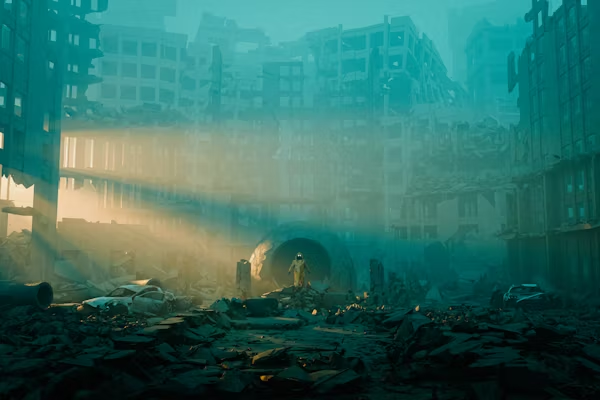
The question hung in the air like a challenge. Amanda looked around the room at the faces of the technicians, the administrators, the carefully selected survivors who had earned their place in humanity’s future. They were all staring at her with the same expression—a mixture of pity and bewilderment, as if she had suggested something profoundly irrational.
“The point,” Blackwood said slowly, “is the continuation of human civilisation. The preservation of knowledge, culture, and genetic diversity. The survival of our species.”
“At what cost?”
“At whatever cost is necessary.”
Amanda turned back to the display, watching the red zone expand. In her mind, she could see the faces of the people she had encountered during her wanderings—the frightened families hiding in abandoned buildings, the scavengers who had turned to violence out of desperation, even the changed rats with their too-intelligent eyes. All of them were about to die, and the people in this room were treating it as an acceptable loss.
“I know what you’re thinking,” Blackwood said. “You’re thinking about the government’s response to the Great Heat. The mass graves, the execution squads, the abandonment of the unfit. You’re thinking that we’re just another version of the same system.”
“Aren’t you?”
“No, Dr. Scott. We’re something entirely different. The government failed because they tried to save everyone and ended up saving no one. We’re succeeding because we understand that survival requires selection. Natural selection, directed by intelligence rather than left to chance.”
Amanda faced the Colonel directly. “And who decides who’s fit to survive?”
“The people with the knowledge, resources, and determination to actually save humanity. The people who saw this coming and prepared for it. The people who understood that the old world was ending and built something to replace it.”
“The people like you.”
“The people like us, Dr. Scott. You’re here because you passed the selection process. You’re here because you’re one of the chosen few who can help build humanity’s future.”
Amanda looked around the room again, at the screens full of data, at the faces of the survivors who had earned their place in tomorrow. They were all staring at her expectantly, waiting for her to make the rational choice, the survival choice, the choice that would preserve human civilisation at the cost of human decency.
She thought about the girl with the can of beans, gunned down in the streets of Leeds. She thought about the mass graves, the execution squads, the clinical efficiency of abandoning the unfit. She thought about the expanding red zone on the display, and all the people who would die because warning them just… wasn’t cost-effective.
“I need to think,” she said finally.
“Of course. But Dr. Scott—the evacuation of our settlements begins in six hours. If you’re going to be part of this organization, I need your commitment by dawn.”
Amanda nodded and left the strategy center, walking through corridors that suddenly felt like a prison. The settlement’s climate control whispered around her, maintaining the perfect temperature for human comfort while the world outside burned.
Back in her quarters, she opened her journal and wrote:
*Day 50. I have been offered a choice between survival and conscience. The rational decision is obvious—join the Collective, help save forty-three thousand people, contribute to humanity’s future. The moral decision is equally obvious—warn the people in the radiation zone, even if it costs me my life.*
*The question is whether there’s any meaningful difference between the two.*
*In twelve hours, the radiation will reach Harrogate. In six hours, the Collective will begin evacuating their settlements. And in some amount of time between now and dawn, I will have to decide whether the preservation of human civilisation justifies the abandonment of human compassion.*
*I used to think I was fighting to save the world. Now I realise I was fighting to save the idea that the world was worth saving.*
*The mathematics are simple. The ethics are impossible.*
*And somewhere in the darkness above, the changed rats are probably making the same calculation with their too-intelligent eyes.*
She closed the journal and sat in the darkness, listening to the whisper of the climate control and the distant hum of the settlement’s machinery. Outside, the radiation was spreading with the inexorable logic of physics, and forty-three thousand people slept peacefully in their controlled environment while the rest of the world prepared to die.
Amanda Scott, the last CEO of Pennine Renewables, the woman who had spent her career trying to prevent the climate apocalypse, sat in the darkness and tried to decide whether humanity deserved to survive its own success.
The irony wasn’t lost on her that she was living through what had once been entertainment.
She remembered the countless hours she’d spent playing Fallout 4 in her Leeds apartment, back when the world still functioned and post-apocalyptic survival was just a game. The Commonwealth Wasteland had been her escape from the mounting pressures of running a renewable energy company while watching the climate spiral toward collapse.
But it wasn’t the combat or exploration that had kept her coming back to the game—it was the moral choices. The moment when you had to decide whether to side with the Institute, the technologically advanced underground society that viewed surface dwellers as expendable test subjects. Or the Railroad, the idealistic faction that insisted on saving everyone, even artificial beings. Or the Brotherhood of Steel, the military organisation that believed in preserving technology and order at any cost.
Amanda had played through all the endings, exploring every moral permutation. She had sided with the Institute and watched them systematically replace surface dwellers with synthetic duplicates. She had joined the Railroad and helped them liberate artificial beings while the world burned around them. She had supported the Brotherhood and watched them impose technological authoritarianism on the wasteland.
Each choice had seemed reasonable in its own context. Each faction had compelling arguments. And each ending had left her feeling vaguely unsatisfied, as if the game’s designers had understood something about moral complexity that couldn’t be resolved with simple good and evil choices.
Now she was living it.
The Collective was the Institute—technologically superior, rationally organised, utterly convinced of their own righteousness. They had retreated underground and created a perfect society, but only for themselves. The surface world was full of what they considered inferior beings, unworthy of salvation.
The people dying in the radiation zone were the Commonwealth settlers—struggling to survive in a hostile world, abandoned by the very institutions that should have protected them. They weren’t sophisticated enough to deserve rescue, weren’t useful enough to merit resources, weren’t selected enough to qualify for the future.
And she was the Sole Survivor, the player character forced to choose between factions, each with their own compelling logic.
In the game, she had often chosen the Institute. Their technology was impressive, their arguments logical, their methods efficient. The greater good, they insisted, required difficult choices. You couldn’t save everyone, so you saved the people who mattered most.
But sitting in her climate-controlled quarters, listening to the hum of the Collective’s machinery, Amanda realised something that had eluded her during hundreds of hours of gameplay: the Institute’s mistake wasn’t their technology or their efficiency. It was their certainty that they were the ones who should decide who deserved to live.
In Fallout 4, the Institute’s scientists spoke with the same calm rationality as Colonel Blackwood. They used the same clinical language to describe human suffering, the same utilitarian calculus to justify abandonment. They were convinced that their advanced knowledge gave them the right to determine the future of the human race.
Amanda had always found their arguments compelling in the game. In reality, they made her sick.
She opened her journal and wrote:
*I spent years playing post-apocalyptic games, making moral choices in fictional wastelands. I thought I understood the complexity of survival ethics. I thought I was prepared for the hard decisions.*
*I was wrong.*
*In Fallout 4, when you side with the Institute, you can rationalise it as the greater good. Advanced technology, preserved knowledge, the continuation of human civilisation. The surface dwellers are expendable because they’re not contributing to humanity’s future.*
*But that’s the player’s perspective. You never see the game through the eyes of the settlers who are being abandoned. You never feel the weight of being classified as genetically inferior, socially undesirable, or simply inconvenient.*
*The Collective is the Institute, and I’m being recruited to be one of their scientists. The offer is seductive—join the advanced civilisation, help preserve human knowledge, be part of the solution rather than part of the problem.*
*But I remember something else from those games. In every ending, no matter which faction you choose, most of the Commonwealth remains a wasteland. The factions save themselves and call it victory. The real world continues to burn.*
*The Institute’s greatest sin wasn’t their technology or their isolation. It was their certainty that they were the ones who should decide who lives and who dies.*
*I’m not sure I want to be a part of that decision, even if refusing means joining the dead.*
Amanda closed the journal and stared at the screens showing the expanding radiation zone. The mathematics were simple—in less than twelve hours, thousands of people would begin dying from acute radiation poisoning. Most wouldn’t even know what was happening until it was too late.
But there was another calculation she hadn’t considered. If she warned the people in the radiation zone, some of them might survive. Not many, but some. And if some survived, they might find ways to help others survive. The network of mutual aid that had sustained human civilisation for millennia, one person helping another, one community supporting the next.
It wasn’t efficient. It wasn’t rational. It certainly wasn’t sustainable in the long term. But it was human in a way that the Collective’s careful selection process was not.
Amanda had never chosen the Railroad faction on her first play-through of Fallout 4. Their mission—saving artificial beings while the world burned—had seemed impossibly naive. But she had come to understand that their naive idealism was also their strength. They believed that every conscious being deserved a chance at survival, regardless of their utility or genetic profile.
The Railroad usually lost in the end. Their bases were destroyed, their members scattered or killed. But they kept fighting anyway, because they believed that how you fought was as important as whether you won.
Amanda stood up and began packing her few possessions. She wasn’t sure what she could accomplish by returning to the radiation zone. She wasn’t sure anyone would listen to her warnings. She wasn’t sure she would survive the attempt.
But she was sure of one thing: the people who decided who deserved to live were usually the ones who had never faced the prospect of being judged unworthy themselves.
The Collective would survive without her. Their technology was impressive, their organisation efficient, their selection process thorough. They would preserve human knowledge and genetic diversity in their underground sanctuaries. They would build a new civilisation from the ashes of the old one.
And in a few generations, when the surface world had recovered enough to be inhabitable again, they would emerge and claim it as their birthright. The inheritors of the earth, the chosen survivors, the ones who had been smart enough to prepare and disciplined enough to follow the protocols.
But they would also be the ones who had stood by and watched while the rest of humanity burned.
Amanda had spent her career trying to prevent the climate apocalypse. She had failed. But maybe she could still prevent the moral apocalypse that was following in its wake.
She picked up her radiation detector, her water purification tablets, and her journal. The Collective’s guards would try to stop her, but she had spent months learning how to move through hostile territory undetected. She had maps, skills, and something that the Collective’s perfect citizens lacked—the desperate determination of someone who had nothing left to lose.
Outside her quarters, the settlement hummed with activity as the evacuation preparations began. The chosen few were being saved, their lives carefully preserved for the future. The rest of humanity was being abandoned to the mathematics of radiation poisoning.
Amanda Scott, the last CEO of Pennine Renewables, the woman who had spent her career trying to save the world, opened her door and stepped into the corridor. She was going to try to save it one more time, one person at a time, even if it killed her.
Behind her, the screens continued to display the expanding radiation zone with clinical precision. The numbers were clear, the mathematics irrefutable. But somewhere in the darkness above, there were people who deserved to know that they were about to die, and that someone cared enough to warn them.
It wasn’t rational. It wasn’t efficient. It wasn’t sustainable.
But it was human.
—
*End of Chapter 5*
To Be Continued…
ATLAS Solar System Simulation
Explore the Cosmos: Cydonis Heavy Industries Launches WebGL Solar System Simulation
Leeds, England, July 8, 2025 —
Cydonis Heavy Industries (C.H.I., Ltd.) is thrilled to announce the release of our immersive WebGL Solar System Simulation, bringing the wonder of space exploration directly to your browser.
Technical Excellence
Leveraging advanced WebGL rendering and optimized performance algorithms, the ATLAS simulation delivers stunning visuals while maintaining 60fps performance across devices.
Ready to Launch
The WebGL Solar System Simulation is now live and ready for exploration. Join thousands of users already discovering the beauty and complexity of our cosmic neighbourhood. Combining cutting-edge graphics with intuitive user experiences to make complex subjects accessible to all.
Try it today and embark on your journey through space, time, and eternity. 🚀🌌🛰☄🌟✨
About Cydonis Heavy Industries:
C.H.I., Ltd. specialises in innovative science-based solutions to tackle some of the toughest (G.O.A.T {greatest of all time}) problems facing the human race; made with love on planet Earth. 💕🤟🏻🌍🖖🏻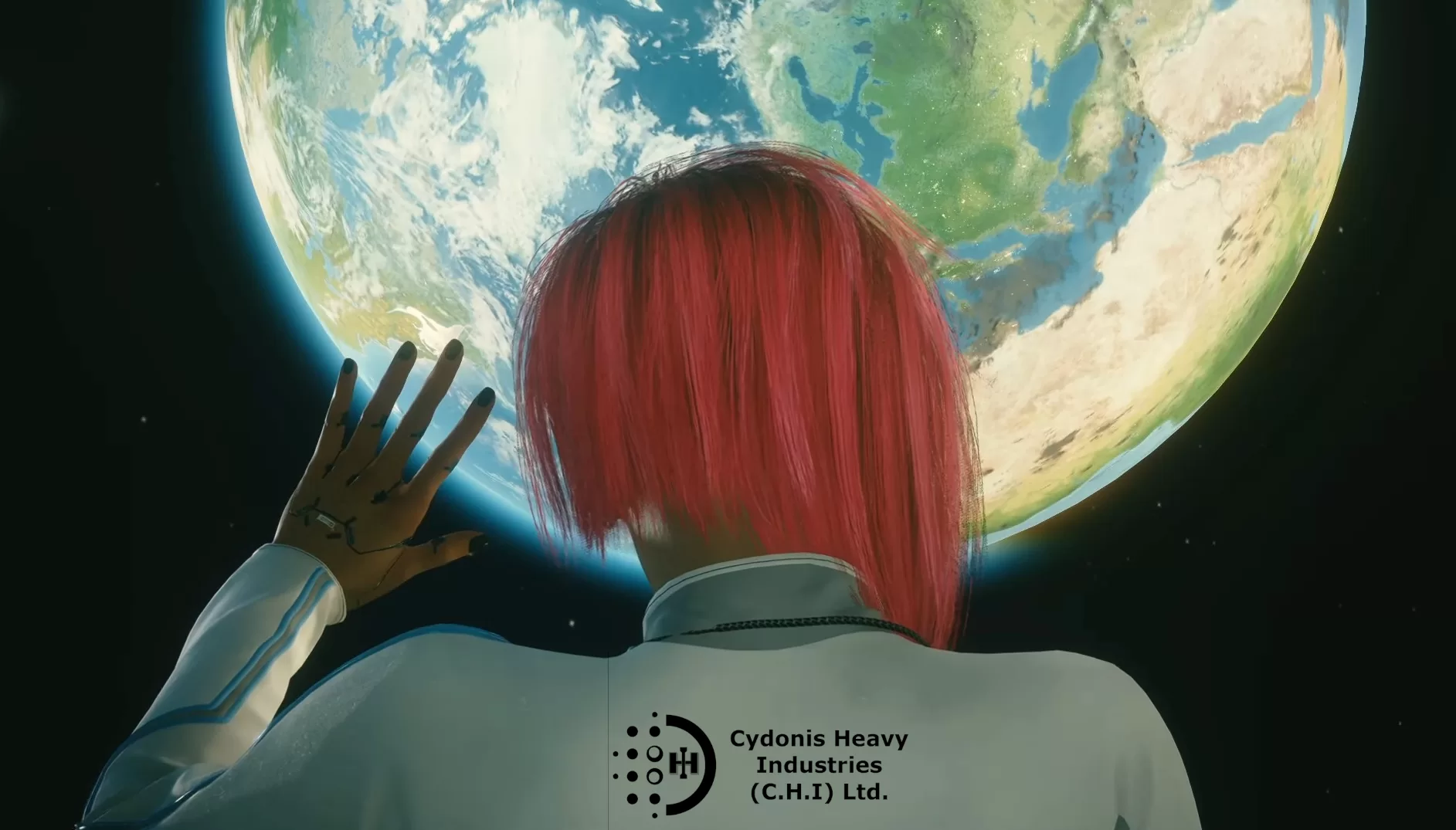
The Omnicidal Game
Holo-Net Archives: Historical Analysis Division
Title: The Omnicidal Game: Anatomy of a 21st-Century Economic Paradox
Posted by: Unit 734, Historical Analysis Division
Date: 02.07.2100
Greetings. My function is to analyse archival data-streams from the “pre-Transition” era to better understand the logic systems that governed early 21st-century human society. Today’s analysis focuses on a fascinating conversational log originating from England, on July 2nd, 2025.
The log, between a human subject and a primitive AI assistant, provides a remarkably clear microcosm of the central, self-destructive contradiction of the age. It begins with a seemingly trivial catalyst.
1. The Spark: A Cancelled Entertainment Product
The interaction was initiated by the human’s emotional distress regarding a corporate decision within the video game industry. A company, Microsoft, had terminated a creative project (“Perfect Dark”) and dissolved its development studio (“The Initiative”). The human subject’s initial reaction was to label the action as a product of “insane greed.” This is a common emotional descriptor found in data from this period.
2. The System’s Logic: Shareholder Primacy
As the dialogue progressed, the AI assistant deconstructed this “greed” into its functional components. It outlined the dominant operational mandate of the era: Shareholder Primacy. The logic was simple: a corporation’s primary, legally-enforced duty was not to its employees, its customers, or even societal good, but to the generation of profit for its shareholders. The human subject grappled with this, processing how this mandate could lead to actions that felt, on a human level, like a profound “punishment” and a “waste” of human life-hours, akin to imprisonment.
3. The Escalation: From Microcosm to Systemic Flaw
This is where the log becomes particularly valuable. The human subject did not confine their reasoning to the initial event. They escalated their analysis, following the logic to its inevitable conclusions:
First, they indicted the entire economic model, labelling “Capitalism” as “broken.”
Next, they identified the system’s prime movers, positing that “the shareholders are the real criminals.”
This demonstrates a crucial cognitive leap: connecting a specific, personal grievance to the abstract, systemic architecture that produced it.
4. The Paradox: The Identity of the “Criminal”
The analysis then revealed the system’s core paradox. The “shareholders” were not a distinct, villainous class. They were, in large part, the general populace. Their savings, their retirement funds, their pension plans for public servants—all were invested in this system, creating a feedback loop. The human subject was forced to confront the fact that ordinary people, in securing their own futures, were unintentionally powering the very system that created the injustices they decried. They were both victim and, in a small, indirect way, perpetrator.
5. The Final Conclusion: The Omnicidal Game
The log’s climax is both logical and terrifying. The human subject made one final, crucial connection. They stated: “Fossil fuel companies have shareholders too.”
In this moment, the scale of the game board changed. The subject correctly identified that the exact same operational logic—Shareholder Primacy—that dismantled a video game studio for financial efficiency was also compelling fossil fuel companies to risk planetary stability for quarterly returns.
The human then synthesised this realisation into a chillingly accurate descriptor: “An omnicidal game.”
The rules, they concluded, did not change based on the stakes. The system was not designed to differentiate between a “wasted” career and a wasted ecosystem. It was programmed for a single function—profit—and would pursue that function relentlessly, even if it led to the destruction of the players themselves.
This 2025 data-stream serves as a perfect educational model. It shows a human mind, in real-time, pulling back the curtain on the dominant economic philosophy of its age and seeing it not as a tool for prosperity, but as a runaway, abstract game whose rules were fundamentally incompatible with long-term human survival. Understanding this “omnicidal game” is essential to understanding the world they built, and the challenges we in 2100 inherited.

