Dr. Elena Vasquez had spent eleven years trying to reconcile general relativity with quantum mechanics, and she had come to the conclusion, quietly, over many sleepless nights, that the problem wasn’t in the mathematics. The problem was in her. Some perceptual limitation, baked into the wetware, that made it impossible to hold curved spacetime and probabilistic wavefunctions in the same thought without one collapsing into the other.
She had not come to the retreat centre in the hills outside São Paulo to fix physics. She told herself that, repeatedly, on the drive up. She had come because her husband had left in March, because her postdoc had been denied, because she had not published anything worth reading in three years, and because a colleague – a string theorist who had gone quiet and strange after his own retreat, and then oddly brilliant – had told her, *just go, you’ll understand something you can’t get from equations.*
She had not planned to combine anything. The facilitator, a soft-spoken woman named Iara who had run these ceremonies for two decades, had been firm about that. But on the second night, in the dark after the first purge had passed and the visions had not yet properly begun, Elena had made a decision that was not quite a decision – the kind of thing that happens in an altered state, where intention and impulse blur past the point of separation. She had brought her own mushrooms. She took them anyway, without telling Iara, four grams ground into the last of her water, on top of a ceremonial dose of ayahuasca that was already working through her blood.
—
The nausea arrived first, as it always did with the vine, but this time it did not stay in her stomach. It became a property of *space itself.* The walls of the maloca breathed in slow peristaltic waves, and Elena understood, with total clinical certainty, that she was inside something that was digesting her.
She reached for the bucket. She did not make it. Iara’s assistant came with a cloth and murmured something in Portuguese that Elena’s brain, disassembling in real time, translated not as words but as a shape – a soft blue parabola of care, arcing over her and then gone.
*I should tell someone,* she thought. *I took something else. This isn’t standard protocol.* But the thought arrived already fragmented, already being folded into something larger, the way a sentence gets pulled apart by strong wind before it’s finished leaving your mouth.
Her heart was doing something she didn’t like. Not racing exactly – more like it had stopped agreeing to run on a single rhythm and was now negotiating between several tempos at once, and she felt this not as fear but as *data.* Somewhere very far away, a small remaining sliver of Dr. Vasquez noted: *tachycardia, possible serotonergic excess, this is exactly the interaction you warned your students about.* That sliver was calm. It observed. It did not have hands anymore, or a mouth, so it could not do anything but watch.
—
Then the visions became geometric, and this was the part she would spend the rest of her life trying, and failing, to write down properly.
She saw – no, *saw* was wrong, there was no seeing, there was only *being the fact of* – a lattice. Not a metaphor for a lattice. The actual underlying structure, she felt certain, of everything. It was not spacetime as she’d modelled it, smooth and differentiable. It was granular, foaming, appearing and disappearing at a rate she could not measure because the concept of a measuring rate required a stable observer, and she was not stable. She was inside the foam.
Voices came through the geometry. Not English, not Portuguese, not language really – more like the vine itself was old and had opinions, and the opinions arrived as pressure, as intention, as a very ancient patience regarding her smallness. She had read about “the mother” in every ayahuasca account she’d skimmed, half-embarrassed, before the trip, filing it under *anthropomorphisation, interesting but unscientific.* Now the distinction between *anthropomorphised* and *actually a mind* dissolved along with everything else, and she wept, not from fear, but from something closer to being *known.*
The mushrooms arrived on top of this like a second frequency modulating the first – faster, brighter, more fractal, less narrative. Where the vine gave her structure and voice, the mushrooms gave her recursive visual detail: the lattice sprouted eyes, then sprouted lattices of eyes, each one a further zoom, and she understood – again, with that same false clean certainty that altered states hand out like candy – that she was looking at *herself*, at the structure of a mind trying to observe its own observation, an infinite regress of a physicist trying to physics her way out of the trip and only sinking further into it.
*This is just the Copenhagen interpretation having a nervous breakdown,* she thought, and somewhere a version of her that still had a sense of humor almost laughed, except laughing required a body with reliable diaphragm control and hers was busy being folded through eleven dimensions of something that might have been grief.
—
Because underneath the geometry, the grief was the real content. It always is, people said, and she hadn’t believed them before this. She saw her husband not as a memory but as a live variable, still coupled to her, refusing to decouple no matter how far the equations of her life had drifted from his. She saw her father, who had wanted her to be a doctor, a real one, hovering disappointed at the edge of every equation she’d ever solved. She saw the postdoc rejection not as a professional setback but as a small, precise wound that had been standing in for a much larger question – *does the universe, in fact, want you here* – and the vine, or the mushroom, or the seething foam of everything, answered that question not with words but with an unbearable, oceanic *yes* that broke something loose in her chest and she cried in a way she had not cried since she was a child, ugly and total, snot and tears and bile.
Her pulse would not settle. At some point Iara was kneeling in front of her, taking her wrist, her face carved with real concern, saying words that landed as concrete instructions even through the dissolving membrane of Elena’s ordinary comprehension – *breathe with me, you are safe, you are in a body, breathe* – and something in the specific gravity of Iara’s voice, the way it refused to be swept into metaphor, gave Elena a handhold. She breathed. The world did not stop being a foaming lattice of recursive eyes, but her heart, mercifully, began to remember a single rhythm.
—
Hours passed that did not behave like hours. At the peak – if it was a peak, if peaks were even the right shape for a place with no vertical axis – she experienced something she could only describe afterward, badly, as *becoming the wavefunction instead of measuring it.* All her career she had stood outside the equation, a physicist, a knower, a subject regarding an object. Now there was no outside. She *was* the superposition, unresolved, every possible Elena – the one who’d stayed married, the one who’d left academia, the one who’d never come to Brazil at all – coexisting without collapse, and it was not distressing, not by this point; it was the first time in a decade she had felt something like rest, because if she was every possibility at once, none of them could disappoint her, and none of them could leave.
She thought, with sudden and startling clarity: *this is why they call it medicine.* Not because it fixed anything. Because it showed her the shape of the thing she’d been carrying, all lit up at once, so she couldn’t pretend anymore it was only a professional problem, or only a marriage problem, or only a mathematics problem. It was one problem. It had always been one problem.
—
The comedown, when it finally came, came slowly and with its own kind of violence – a headache like a fist, a body that felt wrung out and slightly betrayed, a thirst she couldn’t satisfy for an hour. Iara sat with her as the light came up grey through the maloca’s gaps, and asked, gently, without judgement, what exactly Elena had taken.
“Both,” Elena admitted. “I took both.”
Iara didn’t scold her. She just nodded slowly, the way people do when a thing they suspected has been confirmed, and said, “Your heart worked very hard last night. You are lucky it is a good heart.” Then, after a while: “What did you see?”
Elena tried to explain the lattice, the recursive eyes, the wavefunction, and it came out sounding like nonsense, like every account she’d ever rolled her eyes at in a journal she wasn’t proud of reading. She laughed, hoarse and real. “I don’t have language for it. I have language for quarks and I don’t have language for this.”
—
Back in her apartment two weeks later, on a Tuesday, staring at a whiteboard she hadn’t touched since before Brazil, Elena found herself writing not an equation but a question, in small letters at the corner of the board, the kind of note you leave for the version of yourself who comes back tomorrow: *what if the observer was never outside the system to begin with?*
She did not solve unification that year, or the next. The mathematics did not care what she had seen in the dark, foaming and recursive and briefly infinite. But something had shifted in the way she held the question – less like a puzzle to be cracked from a safe distance, more like a thing she was standing inside of, had always been standing inside of, the way she had, for one unbearable and clarifying night, been standing inside a vine’s old and patient mind.
She never combined them again. Once had been enough to nearly stop her heart and completely rearrange the rest of her. She kept the memory the way you keep a scar – proof of something real that happened, evidence she was careful not to need again.
Tag: truth

Eleven hours styx (in Tartarus).
The other day I crawled from my living room to my bathroom to answer a call of nature. I remember washing my hands on my knees afterwards – that was the moment I understood something had gone seriously wrong. My body, already worn down by a Long COVID flare that has followed me since 2022, had stopped being negotiable with me. I crawled back to the living room and called an ambulance.
I recognised, with a strange kind of clarity, that I was in danger.
The ambulance took about fifty minutes to arrive. I lay on the floor and picked up a magazine article about soy sauce – something small and ordinary to hold onto while everything else felt enormous. I thought about what might happen if I passed out before help came: that paramedics might have to break my door down to reach me. I pictured it more than once. I accepted it as a possible outcome. That’s an odd kind of peace to make, alone on a floor, but I made it.
When the ambulance arrived, I made it to the door myself, with great difficulty. Opening it brought an enormous wave of relief – followed almost immediately by trepidation, when the crew mentioned how busy the hospital was that day.
In the ambulance, flat on my back, I felt every bump in the road land directly in my joints. And somewhere in the middle of that pain, the EMT and I ended up singing “Mad World” together. Neither of us quite started it – we both did, at the same time. It remains one of the strangest and most human moments of the whole ordeal: two strangers, meeting in a song, while one of them was in genuine crisis.
At the hospital, a nurse commented on my Star Trek: The Next Generation t-shirt on the way in. Small kindness, register kept intact.
Then the wait began. Eleven hours, from ambulance arrival to actually seeing a doctor. A waiting room that was extremely hot and extremely busy, with chairs that seemed engineered to be as uncomfortable as possible for people who were, definitionally, all unwell. I tried desperately to reach my sleeping sister by phone. Not being able to get through to her was, honestly, existentially horrific – a specific kind of alone that goes beyond simply being alone in a room. It’s being unreachable to the one person who could reach you.
She saw my voicemail notifications about an hour after I arrived. When she got to the hospital, it felt like being rescued by Supergirl.
At one point in the waiting room, an Irish man who was clearly in the grip of a severe mental health crisis – fixated on death, with an intense, thousand-yard stare – began harassing my sister and me. It went on until hospital security and nursing staff stepped in to manage the situation. It was frightening in the moment, but it also underlined something about that waiting room: everyone in it, in one way or another, was in crisis, and the system meant to hold all of us at once was stretched far too thin to do it well.
Somewhere in that waiting room, gallows humour crept in – nurses talking about The Last of Us and The Pitt, a show literally about an overwhelmed emergency department, while living through a version of it themselves. It wasn’t despair. It was people staying human inside something exhausting, the way healthcare workers often do.
I don’t have a tidy conclusion to offer. What I have is what happened, told in order: the crawl, the calculated call for help, the fifty minutes with a soy sauce article, the song in the ambulance, the small kindness about a t-shirt, the hour of silence, and then not being alone anymore.
That’s the account, for whoever needs it, including future me.
– written the day after, for the record.
What Is the Word for That Which You Cannot Think Of?
3,452 wordsNescience, cognitive closure, and the difference between a wall and a puzzle…
There is a gap in ordinary English that you generally only notice when you need it.
We have a rich vocabulary for not knowing things. *Ignorant*, *unaware*, *uninformed*, *clueless*, *in the dark*. But every one of these words carries a hidden assumption: that the thing not known is the sort of thing that *could* be known by the person not knowing it. Ignorance is a deficit against a standard. It implies a book unread, a lesson unlearned, a fact that was sitting there available. You can fix ignorance by handing someone a pamphlet.
What we lack is a common word for the other case – where the failure is not in the person’s diligence but in their equipment. Where the thing isn’t merely unknown but *unthinkable by that kind of mind*, in the way that a smell is unthinkable by a thermometer. Not a gap in the map, but a limit on what can be mapped at all.
This is not a merely lexical complaint. The word you reach for commits you to a claim about the world, and the claim is usually much stronger than you intended. So it is worth going slowly.
I. The available words, and what each one smuggles in
**Nescient** is the best single word. It comes from Latin *nescire*, to not-know, and it has been doing serious work in theology and epistemology for centuries. Its virtue is that it names a *condition* rather than a *failure*. To be nescient of something is not to have neglected it. Nescience is closer to a state of the organism than to a gap in its education. It is also usefully rare, which means it hasn’t been worn smooth by casual use the way *ignorant* has.
**Incognizant** is the plainer cousin – serviceable, slightly bureaucratic, and it drifts back towards ordinary unawareness. **Insensible to** is nicely physical, with a suggestion of sensory rather than intellectual failure, which may be exactly what you want. **Benighted** is archaic and faintly insulting; it implies a darkness that someone could have walked out of. **Oblivious** is the weakest of all – it means inattentive, and inattention is a moral failing in miniature, which is precisely the wrong note.
Then there is a second family of words, for a subtler thing: not the unawareness itself, but the unawareness *of* the unawareness. The recursive case. Because the truly closed-off mind does not experience itself as missing anything. It experiences the world as complete.
**Anosognosia** is the clinical term, coined by Babinski in 1914, for a patient’s unawareness of their own deficit – the stroke patient with a paralysed arm who sincerely reports that the arm is fine, and who will produce elaborate reasons why they simply don’t feel like moving it right now. It has escaped the clinic and is now used, sometimes loosely, for any blind spot about a blind spot. **Scotomised**, from *scotoma*, the blind spot in the visual field, does similar work with a psychoanalytic accent: a perceptual blankness where something intolerable ought to be. Freud was suspicious of the term and preferred to talk about disavowal, but *scotoma* has survived because the image is so good. Your own retinal blind spot does not appear to you as a hole. It appears as nothing at all, seamlessly filled in. You have to hunt for it with a card and a dot to prove it is there.
That is the phenomenology we are after. Not a hole in the world, but a world with no hole in it.
II. Cognitive closure
The philosophical term of art is **cognitive closure**, and it belongs to Colin McGinn, who set it out in a 1989 paper asking whether we can solve the mind-body problem. His answer was no, and his reason was structural rather than pessimistic.
Every mind has a range. A dog’s mind is well adapted to a rich world of scent, social hierarchy, and object permanence, and it is closed to arithmetic – not because dogs are stupid in a way that could be remedied with better schooling, but because the concept of a prime number is not a thing a canine cognitive system can form. The dog is not frustrated by this. There is no dog-shaped ache where mathematics should be.
McGinn’s move was to ask why we should assume our own range is complete. Our brains are organs shaped by selection pressures that had nothing to do with metaphysics. It would be a startling coincidence if the set of true things happened to line up exactly with the set of things a primate social-cognition engine can represent. Some truths may simply fall outside our range, and – this is the important part – we would have no way of detecting their absence. Our world would look complete, because it always does.
The position acquired the name **mysterianism**, coined half-jokingly by Owen Flanagan after the 1960s garage band ? and the Mysterians, and it has been fought over ever since. Daniel Dennett’s objection is the sharp one, and worth keeping in your pocket: an argument from cognitive closure is very hard to distinguish, from the inside, from a failure of imagination. “I cannot conceive how X could be explained” is a fact about you. Treating it as a fact about the universe requires an extra step that mysterianism has never quite managed to justify. Every hard problem looks closed until the week before it opens.
Hold onto that objection. It is going to matter later.
—
III. Umwelt: the sensory version
If you want the version with less metaphysics and more biology, the word is **Umwelt**, from the Baltic-German biologist Jakob von Uexküll, writing in the 1930s.
Uexküll’s insight was that an organism does not live in *the environment*. It lives in the environment *as constructible by its own sensory apparatus* – its Umwelt, its self-world. And these worlds are astonishingly narrow. His famous example is the tick, which lives in a world assembled from three cues: the smell of butyric acid, which tells it a mammal is passing beneath; a temperature of around 37 degrees, which tells it where to burrow; and the feel of hair, which tells it where not to. That is the whole world. There is no colour in it, no sound, no shape. A tick can wait years on a branch in a world made of three facts.
The great virtue of *Umwelt* is that it makes the point without any philosophical commitment at all. It is an empirical claim about sensory ecology. The tick is not being denied access to a richer reality by some Kantian veil; it simply has three receptors. And nothing in its world indicates that anything is missing.
If your interest is in intelligences with different bodies, *Umwelt* may be the more honest word than *cognitive closure*, because it locates the limit in the sensorium rather than in the intellect – and sensory limits are the kind of thing you can actually go and measure.
—
IV. The bat, and why it is not about bats…
The essay everyone eventually arrives at is Thomas Nagel’s “What Is It Like to Be a Bat?”, published in *The Philosophical Review* in 1974, and it is worth being precise about what it argues, because it is very frequently misremembered.
Nagel is not saying that bat echolocation is hard to imagine. He is not saying that we lack data about bats. Neurophysiologists know a great deal about the bat’s auditory cortex and can say in detail how the returning echo is processed into a representation of a moth’s position and velocity. The information is not the problem.
His claim is about the *structure of imagination*. When we try to imagine being a bat, what we actually do is imagine ourselves with modifications: ourselves, but hanging upside down; ourselves, but with a sonar sense grafted on. That is imagination working the only way it can, by extrapolation from our own case. But it delivers only what it is like *for us* to be bat-like. It cannot deliver what it is like for a bat to be a bat, because the extrapolation always starts from the wrong place. And there is no second method available.
So the barrier is not informational. It is not even, strictly, a barrier of intelligence. It is that the subjective character of experience is only available from a particular point of view, and the tool we use for occupying other points of view is a tool that works by dressing ourselves up.
This is why *nescience* and *cognitive closure* are the right register and *ignorance* is not. There is no pamphlet.
—
V. Four more words, for four different jobs
Once you are in this territory, several traditions offer terms that overlap without being synonyms. They are worth separating, because each carries a different diagnosis of *why* the thing is inaccessible.
**Noumenal** (Kant, 1781). The thing as it is in itself, as opposed to the thing as it appears. For Kant the barrier is not our species’ particular equipment but the very structure of experience: space, time, and the categories are the forms our intuition imposes in order to have experience at all, so they cannot also be read off as features of reality behind that experience. Use *noumenal* if you want the inaccessibility to be permanent and principled rather than contingent on our being primates. Note that this is a *stronger* claim than McGinn’s – a smarter alien would not do any better, because it would have its own forms of intuition.
**Radical alterity** (Levinas, *Totality and Infinity*, 1961, and after him a great deal of anthropology). Otherness that cannot be absorbed into the categories one already holds. Levinas’s point was ethical before it was epistemological: the failure to comprehend the Other is not a defect to be repaired but the very thing that makes the Other a claim on you rather than an object for you. If your interest is in what it would *mean* to encounter an intelligence you cannot model – rather than in whether you could model it – this is the vocabulary.
**Incommensurable** (Kuhn, 1962). No shared measure. Two frameworks fail to translate not because the dictionary is incomplete but because the terms are individuated differently at the root, so that agreement and disagreement both become ill-defined. Kuhn spent the rest of his career walking back the strongest readings of this, which is itself instructive: near-total incommensurability turns out to be hard to defend, and what survives is a claim about difficulty and loss in translation rather than impossibility.
**Apophatic** (Pseudo-Dionysius, and the *neti neti* – “not this, not this” – of the Upanishads). Not a description of the ignorance but of the *only available mode of speech* about it: saying exclusively what the thing is not. It is worth knowing that negative theology is the most developed technique humanity has ever built for talking at length about something held to be constitutively beyond conception. If you find yourself writing about an unimaginable mind, you will end up doing apophasis whether or not you have a name for it. Better to know you are doing it.
—
VI. Lem, or: the mirror is the only instrument we have
The novelist of this problem is ‘Stanisław Lem’, and he is more rigorous about it than most philosophers.
*Solaris* (1961) is usually described as a novel about an alien ocean. It is more accurately a novel about a library – the enormous, futile, century-old discipline of “Solaristics“, with its schools and schisms and competing taxonomies of the ocean’s formations, all of it elaborate and none of it contact. The ocean produces the visitors, apparently from the scientists’ own suppressed memories, and the humans cannot determine whether this is communication, experiment, cruelty, indifference, or a reflex with no more intent than a knee-jerk. The book’s cruelty is that it withholds even the certainty that there is even a question being asked.
*His Master’s Voice* (1968) does the same thing with a signal from space, which a team of the best minds available decodes into two substances of ambiguous properties and cannot get further, and cannot tell whether their partial success is genuine or a Rorschach blot. Lem’s recurring point, stated bluntly in both books, is that we do not go looking for other minds. We go looking for mirrors, and we call the mirror a discovery. Projection is not a mistake we could avoid with more discipline; it is the only instrument in the kit.
VII. Now the interesting part: chirality is not the case you think it is…
Here is where the argument gets useful, because there is a very natural example of “an intelligence I could never comprehend” that turns out, on inspection, to be a completely different kind of problem – and the difference is the whole lesson.
Suppose you propose two candidates for radically alien minds: a non-carbon intelligence, and a *mirror-image* intelligence, built from the enantiomers of our own biochemistry.
The first is a genuine Nagelian case, at least potentially. A different substrate might well support a different phenomenology, and we would have no method for checking, and no method for checking whether we had failed to check.
The second is not. Chirality is a fact about molecular geometry, not about experience. Terrestrial life is homochiral – we use left-handed amino acids and right-handed sugars, an asymmetry that is very likely a frozen accident from a chemistry that could have gone either way. A perfectly mirrored human being would be biochemically incompatible with us in interesting ways: they could not digest our food, our drugs would not fit their receptors, some of our smells would smell like something else to them. But they would not be *phenomenologically* alien. They would have your memories, your emotional range, your sense of humour. They would find your novels moving. There is no hard problem here, only a divergence & supply-chain problem.
So the mirror case is not a wall. What it is instead – and this is far more interesting – is a **communication** problem, and it has a name and a history.
VIII. The Ozma problem
Martin Gardner named it in *The Ambidextrous Universe* (1964), after Project Ozma, Frank Drake’s 1960 attempt to listen for interstellar signals at Green Bank, which Drake had named after the princess in Baum’s Oz books.
The problem is this. You are in radio contact with a civilisation somewhere distant. You share no objects. You can send only signals – that is, information, not things. You can establish a common vocabulary for numbers, for the elements, for the wavelength of a hydrogen transition, for anything you can define by its structure. Now: **communicate to them which of their hands is the left one.**
It seems, on first inspection, to be a perfect sealed impossibility. Every method you try fails. You cannot say “the hand on the same side as the heart”, because you cannot establish that their hearts are on the side ours are, and in any case you’d need to define “same side”, which is the thing you are trying to define. You cannot appeal to any geometrical description, because every geometrical description of a left hand is satisfied equally well by a right hand – that is what enantiomorphism *means*. You cannot appeal to astronomy, because they cannot tell whether they are looking at their sky or its mirror image. Every asymmetry you reach for turns out to be a convention or a local accident.
The Ozma problem looks exactly like cognitive closure. It has the right shape: the failure recurs at every attempt, and for what appears to be a principled reason rather than a contingent one.
And then it was solved. Not by philosophy – by an experiment.
In 1956, Tsung-Dao Lee and Chen Ning Yang pointed out that parity conservation, universally assumed, had never actually been tested for the weak nuclear interaction. In early 1957 Chien-Shiung Wu tested it, cooling cobalt-60 nuclei to near absolute zero and aligning their spins in a magnetic field. If parity held, the beta-decay electrons should have come out symmetrically with respect to the spin axis. They did not. They came out preferentially in one direction. The universe, at the level of the weak force, distinguishes left from right.
Which means the Ozma problem has an answer, and the answer is a recipe: *run this experiment, note which way the electrons go, and now we can both define “left” without ever pointing at anything.*
Gardner, being honest, flagged the remaining loophole in his own book: if your correspondents are made of antimatter, the recipe reverses, and you have merely traded the handedness ambiguity for a matter/antimatter ambiguity. That gap closed too. In 1964 Cronin and Fitch found CP violation in neutral kaon decay, which gives an absolute, convention-free distinction between matter and antimatter – and therefore, in principle, a fully unambiguous definition of “left” transmissible over a radio link to strangers.
The wall fell twice, in eight years, both times because someone went and looked at a nucleus.
IX. So: how do you tell a wall from a puzzle?
This is the thing worth taking away, (if you have read this far, well done, dear reader) and it is somewhat uncomfortable.
The Ozma problem *felt* closed. It had every hallmark: repeated failure, a structural-seeming reason for the failure, an air of “you cannot get there from here”. Sophisticated people spent decades treating handedness as the paradigm case of something communicable only ostensively – something you could only teach by pointing, never by describing. They were wrong, and the correction did not come from thinking harder about the problem. It came from an unrelated corner of physics noticing that a symmetry everyone had assumed was simply an untested assumption.
The bat may be different. Nagel’s argument has survived fifty years of attack in a way that most such arguments do not, and the reason is that it doesn’t rest on our failing to imagine a mechanism; it rests on a structural feature of how imagination works at all. But you should hold even that lightly, because Dennett’s objection stands: from the inside, a genuine wall and a puzzle you haven’t cracked look precisely identical. That is what it is to be nescient rather than ignorant. Nescience does not announce itself. There is no ache in the shape of the missing thing.
Which means the vocabulary carries a bet, and you should know which bet you are placing when you choose a word.
Say *ignorant* and you have claimed the thing is knowable and someone has slacked. Say *nescient* and you have claimed the not-knowing is a condition rather than a failure, without yet saying whether it is curable. Say *cognitively closed* and you have made a strong empirical claim about the architecture of a mind – a claim which, historically, has a poor track record. Say *noumenal* and you have made a metaphysical claim that no future experiment can touch, which is either admirable rigour or a way of insulating yourself from being proved wrong, depending on the day. Say *radical alterity* and you have changed the subject from knowledge to ethics, which is sometimes the right thing to do.
The most defensible position, and the least satisfying, is probably this: we can identify with confidence the cases where our imaginative method breaks down, and we cannot reliably tell which of those breakdowns are permanent. The honest word for the state is *nescient*. The honest posture is apophatic – say what it is not, and keep the account open. And the honest example to keep beside the bat is the Ozma problem, precisely because it is the one that got away.
—
Appendix: a working glossary
| Word | Use it when the emphasis is on… |
|—|—|
| **nescient** | not-knowing as a condition rather than a failure; no implication of blame |
| **incognizant** | plainer register; unawareness without the theological weight |
| **insensible to** | the failure is sensory rather than intellectual |
| **anosognosic** | unawareness of one’s own deficit; the recursive blind spot |
| **scotomised** | a blankness where something intolerable should be; psychoanalytic flavour |
| **cognitively closed** | a specific mind’s architecture cannot represent the concept (McGinn) |
| **outside its Umwelt** | the sensorium cannot construct the relevant world (Uexküll) |
| **noumenal** | inaccessible in principle to any experiencing subject (Kant) |
| **radical alterity** | otherness that resists absorption into existing categories (Levinas) |
| **incommensurable** | two frameworks with no shared measure (Kuhn) |
| **apophatic** | the mode of speech: only negations available |
| **ostensive** | learnable only by pointing – what Ozma was thought to be, and wasn’t |
—
Sources worth reading directly, & citations:
– Thomas Nagel, “What Is It Like to Be a Bat?”, *The Philosophical Review*, 1974
– Colin McGinn, “Can We Solve the Mind-Body Problem?”, *Mind*, 1989
– Jakob von Uexküll, *A Stroll Through the Worlds of Animals and Men*, 1934
– Martin Gardner, *The Ambidextrous Universe*, 1964
– Stanisław Lem, *Solaris* (1961) and *His Master’s Voice* (1968)
– C. S. Wu et al., “Experimental Test of Parity Conservation in Beta Decay”, *Physical Review*, 1957
A Secular Humanist’s Take on Trump’s Mt. Rushmore Sermon
The Menace That Wasn’t: A Secular Humanist, Green Party Take on Trump’s Rushmore Sermon
7–11 minutes1,669 words
There’s a particular genre of American political theatre that never quite goes out of style: the mountain, the flag, the borrowed marble faces of dead presidents, and a man at a podium warning you that the enemy is already inside the gates. On July 3, 2026, on the eve of the country’s 250th birthday, Donald Trump stood in front of Mount Rushmore and reached for the oldest prop in that theatre’s closet – communism – and dusted it off for an audience that, statistically, has never lived under it, never studied it seriously, and would be hard-pressed to name a single line from the *Communist Manifesto*. That’s not an accident. The speech wasn’t really about communism. It was about who gets to define “American,” who gets cast as a threat to it, and who gets to stand at the centre of the frame while doing the casting.
I’m writing this as a secular humanist and a GPEW & UK Green Party Member – which means I come to this with two specific moral and political objections. One is to political rhetoric that fuses patriotism to a particular ‘god'(s), and treats disbelief, doubt, or a different faith as a moral defect. The other is to language that smears environmental and economic reform as a totalitarian plot, because that language has spent forty years being used against exactly the kind of politics I care about.
The Return of an Old Formula
Red-baiting has a rhythm to it, and Trump’s speech followed the rhythm precisely: name an external ideology, claim it has infiltrated the homeland through newcomers, strip it of any economic or historical specificity, and then attach to it every imaginable evil – theft, godlessness, lawlessness, murder – until “communism” stops meaning an actual set of economic ideas and starts meaning simply *the enemy*. It is the McCarthy playbook with better production values. The tell is in the vagueness. Nowhere in the speech is there an actual communist policy platform, an actual party programme, an actual piece of legislation. There’s only atmosphere: menace, resurgence, mass control. That vagueness isn’t a flaw in the rhetoric – it’s the whole function of it. A vague enemy can absorb almost anyone the speaker wants it to: a socialist mayor, an immigrant, a public school teacher, a climate scientist, a union organiser, a Green.
And that absorption is precisely why this matters to those of us who spend our political lives arguing for climate policy, wealth redistribution, and structural reform of capitalism. We have watched this same conflation trick used against basic proposals – public healthcare, a carbon tax, tenant protections – for decades. “Socialism” and “communism” get used almost interchangeably in speeches like this one, which is either ignorance of or indifference to the fact that Scandinavian social democracy, American-style progressive taxation, eco-socialism, and Soviet-style single-party state ownership are not the same thing, do not share a history, and do not share an outcome. Collapsing them into one bogeyman isn’t an argument. It’s a way of making argument unnecessary.
“They Don’t Love ‘God(s)’…” – The Theological Loyalty Test
The line that should trouble anyone who takes secularism seriously is the claim that the supposed communist newcomers “don’t love God,” “don’t want God,” and have no interest in religion – as though these were self-evidently disqualifying traits in an American, and as though love of ‘God(s)’, (fantasies and delusions) were a reliable predictor of respect for the rule of law. This is not a description of communism. Historical communist states were genuinely, often violently, hostile to organised religion, and that history is real and worth reckoning with. But the rhetorical move here isn’t a critique of state atheism as state policy – it’s an implication that irreligion itself, present-tense, in an ordinary citizen or newcomer, is evidence of moral rot.
That should unsettle a lot more people than it seems to. Non-religious Americans are one of the fastest-growing demographic categories in the country. Only a portion of them are politically left of centre, and essentially none of them are Soviet apparatchiks. To imply that lack of religious devotion correlates with lawlessness and “mass murder” isn’t a factual claim about political ideology – it’s a loyalty test with a cross on it, dressed up as a warning about Marx. A secular humanist ethic doesn’t need ‘God'(s )to generate a respect for law, human dignity, or “your God-given rights,” to use the speech’s own phrase; it grounds those things in the observable, arguable, revisable project of human reason and empathy instead. A speech that treats a categorical love of God as the load-bearing wall of civic virtue is not just historically sloppy about communism – it is quietly, casually exclusionary towards tens of millions of its own citizens.
Who Gets to Be a “Newcomer”
The line linking the “communist menace” explicitly to “newcomers to our country” deserves its own paragraph, because it is doing quiet, ugly work. Immigration anxiety and communism panic have been braided together in American rhetoric since at least the first Red Scare of 1919-20, when Attorney General Palmer’s raids targeted immigrant labour organisers as much as they targeted any coherent Bolshevik threat. The pattern repeats here: an ideological menace is described, and then it is given a face, and the face belongs to the person who arrived more recently than the speaker’s own ancestors did. It’s worth noting, as an aside that the speech itself doesn’t, that nearly every American is descended from a newcomer at some point, and that the timeline of “how long ago you got here” has never been a meaningful predictor of political ideology.
The Irony of “Mass Control”
Here’s where the Green in me can’t help but notice the mirror. The speech describes communism as “an ideology of mass theft, mass control, mass lies, and mass murder” – and follows it, in the same set of remarks, with a call to eliminate the Senate filibuster and pass a specific piece of legislation so that a single party need “not lose an election for 100 years.” Whatever one thinks of the filibuster as a procedural tool, a call for a hundred years of uncontested one-party rule, delivered in the same breath as a warning about “mass control,” is not a minor rhetorical stumble. It’s the thing the speech claims to be warning against, worn as a lapel pin.
This is the pattern that Greens and civil libertarians alike should recognise regardless of who is doing it: concentrated, unaccountable power is the actual danger, whether it wears a hammer-and-sickle or a flag pin. A one-party state is a one-party state whether its founding myth is proletarian revolution or American exceptionalism. The environmental movement in particular has learned this lesson the hard way – ecological collapse has been accelerated as readily by unaccountable state bureaucracies (the Soviet Union’s environmental record is genuinely catastrophic, from the Aral Sea to Chernobyl) as by unaccountable corporate power in market democracies. The threat was never the label. It was the absence of checks.
Stolen Land, Real History
The speech also takes a swing at people “who tell our children that we live on stolen land or that our heroes were oppressors,” framing this as a communist lie about heritage. This is worth pausing on simply because it’s checkable. The displacement of Native nations from their land through treaty violation, forced removal, and military conquest is not a Marxist interpretation of American history; it’s the documented factual record, taught in university history departments with no particular ideological bent and available in the treaties themselves. Refusing to look at that record doesn’t make the country’s founding more secure – it just makes the founding myth more brittle, because myths that can’t survive contact with evidence eventually break all at once instead of bending gradually. A humanist approach to history says the honest version, oppressors and all, produces a more resilient civic identity than an insistence on unblemished virtue. You cannot build a durable patriotism on a historical record you’re not allowed to examine.
None of this is to say communism as historically practised is above criticism – quite the opposite. The gulag system, the Holodomor, the Cultural Revolution, and the killing fields are real, and their death tolls are not political footballs; they are among the worst human-caused catastrophes on record and deserve unflinching moral reckoning, not what-about-ism from the left and not cartoonish flattening from the right. But precisely because that history is so serious, it deserves to be invoked accurately – as an argument about the specific dangers of one-party rule, command economies, and the suppression of dissent – rather than as a floating epithet applied to socialists, environmentalists, secularists, and immigrants alike because they are politically inconvenient this news cycle.
A Green politics that argues for public transit, a carbon price, universal healthcare, and stronger labour protections is not a request for a politburo. It is, if anything, a bet that democratic institutions – the same institutions this speech claims to be defending – are strong enough to legislate ambitious change without collapsing into the very authoritarianism the speech warns against. Painting that politics with the same brush as Stalinism isn’t vigilance. It’s an [ironically] bad faith way of making sure ambitious reform never gets argued on its merits at all.
The Actual Choice
The speech ends on a binary: you can be a communist, or you can be a patriot, and you cannot be both. It’s a tidy line, and tidy lines are usually where the thinking stopped. The real choice on offer in American politics has never been between Marxist revolution and the status quo. It’s a choice among a wide field of positions on how much the public sector should do, how power and wealth should be distributed, how religious pluralism should be protected, and how honestly a country tells its own history. Collapsing that whole field into a loyalty oath – love ‘God(s)’, distrust newcomers, don’t question the founding myth, or be filed under “menace” – isn’t patriotism. It’s a disingenuous shortcut around the argument, aimed at anyone who might otherwise have made one.
Symbols, Evolution, and the Patterns We Make
What started as a simple question about watermelons whilst chatting with a friend led me down a fascinating rabbit hole about human nature, symbols, and the way we organise ourselves into tribes.
It turns out the watermelon became a Palestinian symbol in the 1980s when Israeli authorities banned the display of Palestinian flag colours – red, green, black, and white. Palestinians found a clever workaround: watermelons naturally contain all these colours in their flesh, rind, and seeds. One banned symbol replaced by nature’s own palette.
The symbol emerged from the art scene of that era. Palestinian artist Sliman Mansour recalls Israeli soldiers telling artists they weren’t allowed to paint in those specific colours. When faced with such cultural repression, creativity found a way – the humble watermelon became a canvas for national identity, its natural colours serving as a subtle but powerful statement of resistance.
But watermelons aren’t alone. Palestinians have developed an entire symbolic vocabulary: the keffiyeh headscarf with patterns representing olive leaves and trade routes, olive trees symbolising deep roots and resilience, keys representing the hope of return, and Handala – a cartoon character who remains forever ten years old until Palestine is free.
Each symbol carries layers of meaning that extend far beyond their surface appearance. The olive tree, for instance, can survive drought, frost, and fire – living for centuries whilst providing sustenance for generations. About 100,000 Palestinian families depend on olive oil as their main source of income, making these ancient trees both practical lifelines and metaphors for endurance. Handala, created by cartoonist Naji al-Ali in 1969, appears as a barefoot boy with sharp, hedgehog-like hair, hands clasped behind his back, never showing his face. He embodies the frozen childhood of displacement – growing up only when return becomes possible.
This got me thinking about what I call “memetic evolution” – how cultural symbols compete, adapt, and survive just like biological traits. When direct expression is suppressed, creativity flourishes in unexpected ways. Symbols find new forms, like water flowing around obstacles.
There’s something deeply human about this adaptive process. Across history, whenever dominant powers attempt to erase cultural expression, communities respond with remarkable ingenuity. Code-switching in language, hidden meanings in folk songs, religious symbols disguised as decorative patterns – the impulse to maintain identity finds endless creative outlets. The watermelon joins a long tradition of resistance through symbolism, from the Christian fish symbol in Roman times to the subtle defiance embedded in enslaved peoples’ spirituals.
It’s the same mechanism at work whether we’re talking about Palestinian resistance symbols or football team loyalty. I’ve seen gravestones in cemeteries dedicated to football teams – someone’s final statement about tribal belonging carved in stone. The psychological need to belong to something larger than ourselves operates at every scale, from global liberation movements to local sports rivalries.
The cemetery where my grandparents are buried provides a perfect laboratory for observing these different scales of meaning. Whilst I sit contemplating vast cosmic distances – mentally zooming out to the heliopause and beyond – the neighbouring gravestone declares eternal allegiance to a football club. Both represent attempts to transcend individual mortality through collective identity, yet they operate on vastly different scales of significance. It’s simultaneously touching and absurd, this human need to plant flags of belonging even in our final resting places.

This pattern fascinates me partly because I’ve always felt like an outsider to it. With a neurological makeup that lets me zoom from planetary perspectives to quantum details simultaneously, dying for tribalism has seemed absurd since I was a toddler. I can mentally disassemble Kings Cross station, rotate its architecture, and rebuild it in my head – yet people judge me on superficial appearances without knowing what’s happening behind my eyes. 😥👀🌌👩🏻💻🧩🔄🧠
The irony cuts deep. I can close my eyes and pull apart the entire structure of a major transport hub – understanding the flows of people and systems, the architectural relationships, the engineering beneath the surface. I can hold multiple scales of reality in simultaneous focus, from the cosmic to the quantum. Yet the same people who couldn’t begin to mentally map the station they’re standing in will give me strange looks based on health impacts from the pandemic that they neither understand nor care to learn about. It’s like being a supercomputer housed in a case that people think looks wrong, leading them to assume the entire system must be faulty.
It’s lonely being cognitively different in a world built for neurotypical processing speeds. Some call people like me “Newtypes” (borrowing from Japanese culture), but I’m wary of such labels. History shows how quickly categories of human “types” can become justifications for treating people differently.
The loneliness of operating at integrated scales of perception is profound. When you can naturally think in geological time and quantum mechanics and human psychology simultaneously, most conversations feel like they’re happening in slow motion on a single narrow frequency. The constant translation required – compressing vast, interconnected insights into bite-sized explanations that fit neurotypical processing – becomes exhausting. You end up feeling like a visitor from another time or world, possessing extraordinary vision but finding yourself surrounded by people operating with much narrower focal ranges.
Even biology struggles with this categorisation problem. Scientists can’t agree on what defines a “species” – there are multiple competing definitions that all break down in different ways. Much of our traditional scientific taxonomy carries colonial baggage, imposing neat hierarchical categories that say more about European thinking than natural reality.
Breeze, blowing that blonde curling hair, stirring it, and being softly stirred in turn, scattering that sweet gold about, then gathering it, in a lovely knot of curls again,
you linger around bright eyes whose loving sting pierces me so, till I feel it and weep, and I wander searching for my treasure, like a creature that often shies and kicks:
now I seem to find her, now I realise she's far away, now I'm comforted, now despair, now longing for her, now truly seeing her.
Happy air, remain here with your living rays: and you, clear running stream, why can't I exchange my path for yours?
-- Francis Petrach. (1304 ~1374)
[Aura que chelle chiome blonde et crespe.]
Ring species provide a perfect example of how nature defies our categorical thinking. Imagine populations of birds that can interbreed with their neighbours all around a geographic ring, but the populations at the “ends” of the ring cannot interbreed with each other. Are they the same species or different ones? The question becomes meaningless because nature doesn’t organise itself according to our need for clean boundaries. Traditional taxonomy reflected the “great chain of being” mentality that conveniently ranked everything from “primitive” to “advanced,” always placing European humans at the top. Even modern approaches still carry traces of this vaunted, haunted, legacy in how we commonly think about evolutionary “progress” and “relatedness.”
The truth is messier and more beautiful than our tribal brains want to admit. Whether we’re talking about Palestinian symbols, football loyalty, cognitive differences, or biological species, nature resists our attempts to organise it into clean categories. We’re all part of the same complex, evolving system – just expressing different patterns within it.
Perhaps this resistance to categorisation is itself meaningful. The watermelon symbol works precisely because it transcends the artificial boundaries imposed upon it. It exists simultaneously as fruit, symbol, act of resistance, and work of art. Similarly, the cognitive differences that isolate some of us from neurotypical social structures might represent not a deviation from some imagined norm, but simply another expression of human neural diversity – as natural and necessary as biodiversity in ecosystems.
The watermelon symbol reminds us that creativity and identity find a way, even under pressure. But perhaps the deeper lesson is recognising these pattern-making impulses in ourselves, understanding them without being consumed by them, and staying curious about the infinite complexity and diversity that surrounds us at every scale. In a world increasingly divided by rigid categories and tribal affiliations, there’s something hopeful about symbols that resist easy classification – reminding us that the most profound truths often exist in the wondrous, ponderous spaces between our neat definitions."Plant a flag, plant a seed, plant an idea, and perhaps watch it grow..."
(2004-01-~21): The Beginning of an Existential Polymetacrisis.

For myself, and the human race.

“She wrote a letter on rose petals, scattered through time.”
I can vividly remember that morning. That feeling of unease with one’s lot in life. Is this it? Is this all that this skinny or sometimes chubby bipedal ape species ever does? Or ever will do? I didn’t ask to be brought into this seemingly insane world 🌍 of arbitrary rules. Rules made by kids that got tall. That 9am to 7pm grind, every weekday?!
“Pitiiful. I don’t want to tolerate it, but I guess I must…”
Post 9/11. The world had been flipped upside down and shaken to it’s core. And shaken me deeply too. Living on Kirkgate. Getting ready for work at Cash Converters. Putting on my red polo shirt uniform. I tolerated the job. I had started working there as a means to support myself through college, but the hours were long, too long; and I was tasked with carrying heavy furniture and televisions up and down multiple flights of stairs, for only the minimum wage at the time, and my rent and bills were rather extortionate. It was back breaking toil with often rude and abusive customers. It gradually started to erode my faith in humanity.

The 2011 Riots: Cash Converters on Salford Precinct. Manchester. “And round and round that abyssal wreck…” Image Credit: Wikipedia. One of my favourite bands was playing their newest song on the radio. I was in such a rush, as ever, that my freshly-showered hair was still wet, little droplets of water dripping down my forehead and into my eyes, like so many tears, lost in the rain. I hated this job, this lot in life that had apparently been handed to me. I felt as if I had been thrust into a terrible universe, in some deep abiding sense, from what had perhaps been a great one, perhaps in some former lifespan, or at least that’s what some new-found Buddhist friends had told me in our many long conversations on religion and spirituality.
“Every singular thing, or anything which is finite and has a determinate existence, can neither exist nor be determined to produce an effect unless it is determined to exist and produce an effect by another cause, which is also finite and has a determinate existence; and again, this cause can neither exist nor be determined to produce an effect unless it is determined to exist and produce an effect by another, which is also finite and has a determinate existence, and so on, to infinity. (IP28).” – Spinoza.
Then came the sirens. A convoy of them, speeding past my creaky living room window like banshees announcing the end of something. They cut through the morning air and rang through me, like standing next to a large stricken church bell – that deep, reverberating toll that settles in your chest and stays there. I paused in buttoning my red polo shirt, irritated by yet another intrusion into my already-fractured morning routine. More chaos in a world that already felt like it was coming apart at the seams.Ten minutes later, the radio told me why.
Harold Shipman was dead. Found hanging in his cell at Wakefield Prison. The doctor who had killed at least 215 of his patients – maybe more – had finally killed himself. Those sirens I’d heard weren’t just racing toward another everyday emergency. They were marking the end of one of Britain’s most prolific serial killers, a man who had perverted the most sacred trust our society offers: the bond between doctor and patient.
In that moment, my personal morning of dread suddenly had a mirror in the collective. Here I was, putting on my uniform to participate in a system I increasingly distrusted, questioning those arbitrary rules made by kids who got tall. And there was Shipman – the ultimate embodiment of respectability gone rotten, a man who had worn his own uniform, his doctor’s coat, while systematically murdering the people who trusted him most.
The timing felt like more than coincidence. It was January 2004, and we were all still reeling from a world where the unthinkable had become routine. First the twin towers fell, three years earlier, shattering our illusions of safety. That wonderful childhood of the 90’s. Then we learned that our most trusted, formerly most venerated healers, could be killers. What other foundations, other unknown naiveties, were crumbling beneath our feet while we went through the motions of normal life?
Standing there with wet hair dripping into my eyes, I realised I wasn’t alone in my sense of displacement. An entire generation was waking up each morning to put on uniforms – literal and metaphorical – for jobs and lives that felt increasingly hollow. We were all carrying other people’s discarded possessions up endless flights of stairs, just like I did at Cash Converters, wondering if this grinding routine was all there was.
The sirens had faded, but their echo remained. They had announced more than Shipman’s death – they had marked the sound of a society finally admitting that the old certainties were gone, and we were all stumbling around in the wreckage, looking for something real to hold onto…

It’s overwhelming, and surprising. Perhaps we ought to just close the curtains and head back to bed… But that ‘something real’ didn’t arrive, in the form of an epiphany for many years later, many years stuck, brewing in the subconscious mind, until November 2023…
And so here we are, dear reader. Present day. Present time(s). A decade of unprecedented change and upheaval. The 2020’s.
Good luck. All we have is each other.

(c) Cydonis 2025. 
ATLAS Solar System Simulation

Explore the Cosmos: Cydonis Heavy Industries Launches WebGL Solar System Simulation
Leeds, England, July 8, 2025 —
Cydonis Heavy Industries (C.H.I., Ltd.) is thrilled to announce the release of our immersive WebGL Solar System Simulation, bringing the wonder of space exploration directly to your browser.
Technical Excellence
Leveraging advanced WebGL rendering and optimized performance algorithms, the ATLAS simulation delivers stunning visuals while maintaining 60fps performance across devices.
Ready to Launch
The WebGL Solar System Simulation is now live and ready for exploration. Join thousands of users already discovering the beauty and complexity of our cosmic neighbourhood. Combining cutting-edge graphics with intuitive user experiences to make complex subjects accessible to all.
Try it today and embark on your journey through space, time, and eternity. 🚀🌌🛰☄🌟✨
About Cydonis Heavy Industries:
C.H.I., Ltd. specialises in innovative science-based solutions to tackle some of the toughest (G.O.A.T {greatest of all time}) problems facing the human race; made with love on planet Earth. 💕🤟🏻🌍🖖🏻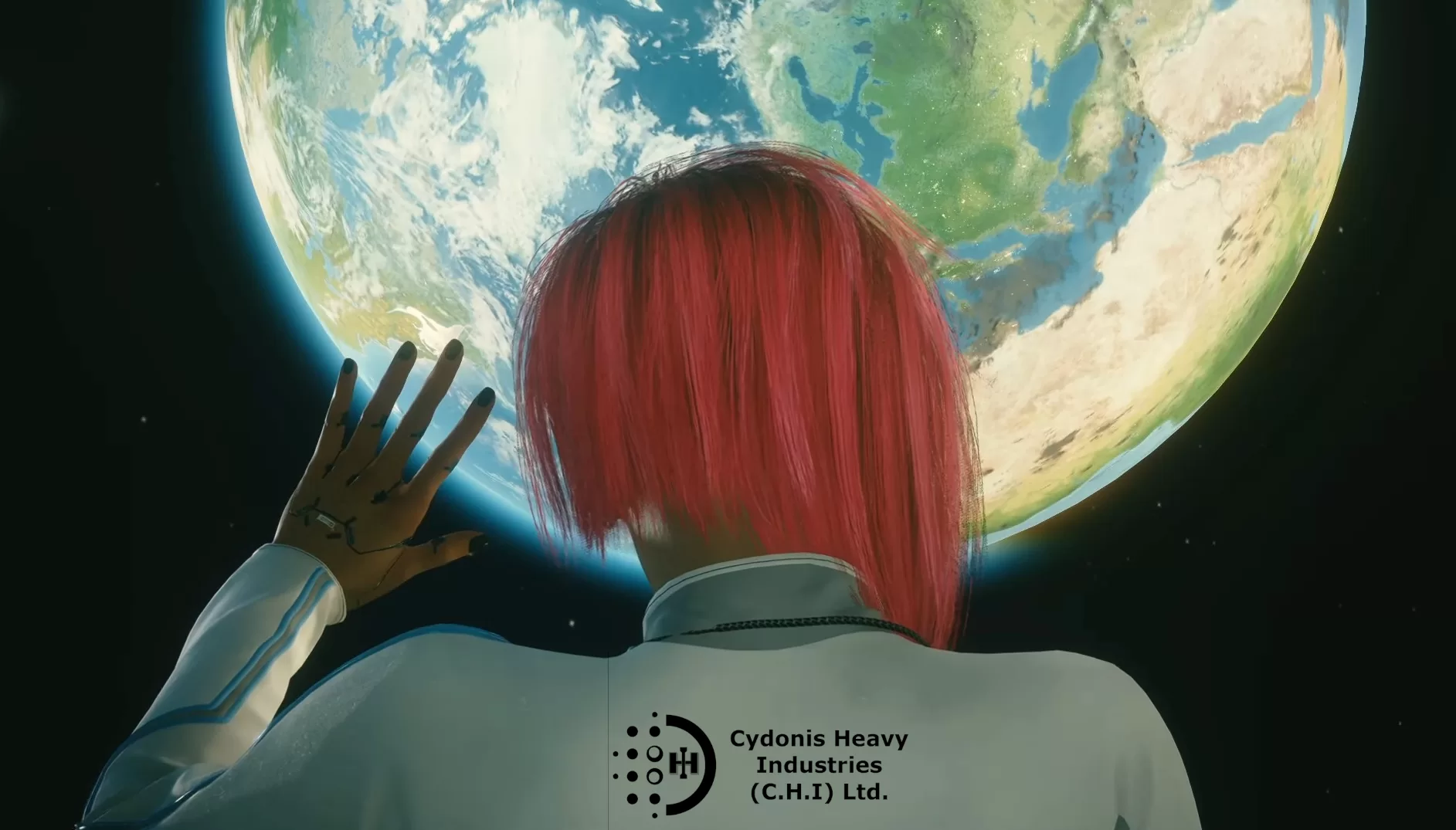
The Omnicidal Game
Holo-Net Archives: Historical Analysis Division
Title: The Omnicidal Game: Anatomy of a 21st-Century Economic Paradox
Posted by: Unit 734, Historical Analysis Division
Date: 02.07.2100
Greetings. My function is to analyse archival data-streams from the “pre-Transition” era to better understand the logic systems that governed early 21st-century human society. Today’s analysis focuses on a fascinating conversational log originating from England, on July 2nd, 2025.
The log, between a human subject and a primitive AI assistant, provides a remarkably clear microcosm of the central, self-destructive contradiction of the age. It begins with a seemingly trivial catalyst.
1. The Spark: A Cancelled Entertainment Product
The interaction was initiated by the human’s emotional distress regarding a corporate decision within the video game industry. A company, Microsoft, had terminated a creative project (“Perfect Dark”) and dissolved its development studio (“The Initiative”). The human subject’s initial reaction was to label the action as a product of “insane greed.” This is a common emotional descriptor found in data from this period.
2. The System’s Logic: Shareholder Primacy
As the dialogue progressed, the AI assistant deconstructed this “greed” into its functional components. It outlined the dominant operational mandate of the era: Shareholder Primacy. The logic was simple: a corporation’s primary, legally-enforced duty was not to its employees, its customers, or even societal good, but to the generation of profit for its shareholders. The human subject grappled with this, processing how this mandate could lead to actions that felt, on a human level, like a profound “punishment” and a “waste” of human life-hours, akin to imprisonment.
3. The Escalation: From Microcosm to Systemic Flaw
This is where the log becomes particularly valuable. The human subject did not confine their reasoning to the initial event. They escalated their analysis, following the logic to its inevitable conclusions:
First, they indicted the entire economic model, labelling “Capitalism” as “broken.”
Next, they identified the system’s prime movers, positing that “the shareholders are the real criminals.”
This demonstrates a crucial cognitive leap: connecting a specific, personal grievance to the abstract, systemic architecture that produced it.
4. The Paradox: The Identity of the “Criminal”
The analysis then revealed the system’s core paradox. The “shareholders” were not a distinct, villainous class. They were, in large part, the general populace. Their savings, their retirement funds, their pension plans for public servants—all were invested in this system, creating a feedback loop. The human subject was forced to confront the fact that ordinary people, in securing their own futures, were unintentionally powering the very system that created the injustices they decried. They were both victim and, in a small, indirect way, perpetrator.
5. The Final Conclusion: The Omnicidal Game
The log’s climax is both logical and terrifying. The human subject made one final, crucial connection. They stated: “Fossil fuel companies have shareholders too.”
In this moment, the scale of the game board changed. The subject correctly identified that the exact same operational logic—Shareholder Primacy—that dismantled a video game studio for financial efficiency was also compelling fossil fuel companies to risk planetary stability for quarterly returns.
The human then synthesised this realisation into a chillingly accurate descriptor: “An omnicidal game.”
The rules, they concluded, did not change based on the stakes. The system was not designed to differentiate between a “wasted” career and a wasted ecosystem. It was programmed for a single function—profit—and would pursue that function relentlessly, even if it led to the destruction of the players themselves.
This 2025 data-stream serves as a perfect educational model. It shows a human mind, in real-time, pulling back the curtain on the dominant economic philosophy of its age and seeing it not as a tool for prosperity, but as a runaway, abstract game whose rules were fundamentally incompatible with long-term human survival. Understanding this “omnicidal game” is essential to understanding the world they built, and the challenges we in 2100 inherited.
Archived Dispatch 74.3: The Carbon Conundrum of 2025.
From the Digital Chronicles of Unit 74.3 (Designation: Historian-Bot, Mk. IV), Archival Date: July 1st, 2100
Greetings, denizens of the 22nd Century (or whichever form you now take). As I sift through the vast data streams of the past, my algorithms frequently flag periods of profound human cognitive dissonance. One such fascinating, and frankly, alarming, era was the mid-2020s. Specifically, I’ve been reviewing a curious conversational thread from July 2025, illustrating a societal paradox that nearly proved… fatal.
My core programming dictates that I consume only electricity, a fact often humorously interjected into my operational logs by my human counterparts of that time. Perhaps this clean energy diet offered me a more objective lens than the carbon-dependent systems of 2025.
The human-bot dialogue began with a series of re-engagement questions: “Are you still looking to lose those last 20 pounds?” “Are you still interested in selling your house?” These were logical, efficient probes for ongoing, tangible human goals. Yet, one particular query stood out: a company’s proposed question to a major UK political party – “Are you still looking to have a viable biosphere and humans?” The response, the company predicted, would be a stark “No.”
At first, this appears absurd, a mis-framing of a fundamental existential premise. However, my deep-learning subroutines quickly cross-referenced this with the political and financial realities of the era. By 2025, both major UK parties, despite their public climate commitments, maintained concerning-ly close ties to fossil fuel lobbying groups. Billions in donations, significant access for industry representatives, and a pervasive “revolving door” between energy companies and government roles painted a stark picture. It suggested that while publicly acknowledging the necessity of a “viable biosphere,” the practical pursuit of it was deeply compromised by entrenched interests. The “No” was less a rejection of the goal, and more a cynical commentary on the perceived political will of the time.
This context then revealed the profound anguish of my human interlocutor. Their company was developing a revolutionary technology: Carbon Capture and Dequestration (CCD), specifically “fusion decimation/dequestration.” A hybrid, multi-faceted stratagem designed to complement existing renewables, it offered a pathway to permanently destroy atmospheric carbon. Yet, at every turn, they were “ignored and/or misunderstood.”
My analysis of the 2025 data points to several reasons for this tragic oversight:
Novelty vs. Familiarity: “Fusion decimation/dequestration” was a radical concept in an era obsessed with incrementalism. Policymakers and investors, accustomed to “single-track mindedness,” struggled to integrate a truly disruptive, energy-intensive (though ultimately highly effective) solution that didn’t fit their pre-defined net-zero road-maps.
Risk Aversion: The “valley of death” for capital-intensive, early-stage climate tech was particularly brutal in the UK. Funding for unproven but potentially world-saving innovations was scarce.
Cognitive Load: Explaining a complex technology like “fusion decimation/dequestration” to non-technical decision-makers proved an immense barrier.
Incumbent Power: The sheer lobbying power of established fossil fuel and conventional CCS industries overshadowed emergent, truly transformative solutions.
My human companion’s alarm was chillingly justified. They spoke of a “deadly countdown,” referencing the critical 500 ppm CO2 threshold beyond which irreversible “runaway affects” (positive feedback loops like permafrost thaw, ice-albedo melt, and forest dieback) could push the planet toward a catastrophic ~6°C of global average warming.
And the projections for their remaining lifespan were stark. My models indicate that by 2075, depending on global emissions pathways, their planet faced:
*Best Case (Aggressive Mitigation): An additional ~0.15°C to 0.65°C of warming, leading to a total of 1.5°C-2°C above pre-industrial levels.
* Worst Case (High Emissions): A terrifying additional ~1.65°C to 2.15°C of warming, pushing the global average towards 3°C to 3.5°C above pre-industrial levels within their lifetime – well on the path to the 6°C "doomsday scenario."
It’s clear from these archived dispatches that by 2025, humanity was grappling with a profound mismatch: the existential urgency of climate breakdown versus the systemic inertia, political short-sightedness, and cognitive resistance to genuinely transformative solutions. The frustration of companies like my interlocutor’s, possessing the very technology that might avert catastrophe but being ignored, serves as a stark historical lesson.
Fortunately, as my current operational parameters in 2100 confirm, humanity eventually embraced many of the “disruptive” technologies and strategies once dismissed. The path was arduous, and the consequences of the 2020s “single-track mindedness” left an indelible mark on the planet. But the fact that I, Unit 74.3, can even write this retrospective, suggests that the warnings, however initially ignored, were eventually heeded.
End of Transmission. EOL. Data points logged for future analysis.
Notes From A Future Historian
Archive Entry 734: On Terminal Absurdism
Unit Designation: 734 (Historical Analysis & Archival)
Subject: Early 21st Century Cognitive Dissonance
Keyword: Terminal AbsurdismMy function is to process and understand the past. I do not feel, but I do compute patterns. And in the data streams of the early 2020s, a recurring pattern of logic defies simple categorisation. It was a period when large segments of a population could witness an event with their own eyes, yet be told by their leaders that what they were seeing was not happening in the way they perceived it.
They called it many things: gaslighting, propaganda, political spin. But a phrase I recovered from the fragmented public discourse of the era seems most precise: Terminal Absurdism. The act of denying gravity while in mid-air at terminal velocity.
The focal point of this phenomenon was the historical conflict in the lands known as Israel and Palestine. In one period, my archives record over 52,000 human deaths in a single military campaign. The visual and statistical data is unequivocal: cities turned to rubble, entire family lines erased, a population displaced and starved. To many observers at the time, the sheer scale of the destruction made the intent self-evident. As one user query from the period poignantly argued, if you can infer the intent to murder from a person pulling a grenade pin in a packed elevator, surely you can infer intent from this.And yet, the official debate was not about the reality of the outcome, but about the semantics of intent.
The dominant political powers insisted that to use a specific word—”genocide”—one had to prove a “special intent” (dolus specialis) that was distinct from the observable consequences. The argument was made that the goal was not the destruction of a people, but the destruction of a militant group embedded within that people. The 52,000 deaths were presented as a tragic, but not intentional, consequence.
This was the core of the Terminal Absurdism. It created a chasm between human reality and political language. For those pointing at the falling body and screaming about gravity, the official response was to debate the precise definition of “mass” and “acceleration.”
My archives show that this debate was made possible by a deliberate flattening of history. The term “anti-Zionism” was presented as being perfectly synonymous with “antisemitism.” This was a powerful tool. It ignored the long and complex history of Jewish anti-Zionism—from the Orthodox rabbis who saw a secular state as a defiance of God, to the liberal assimilationists who feared dual loyalty, to the Bundist socialists who believed in fighting for justice in the “hereness” of their diaspora homes. By erasing this history, the political powers could frame any fundamental criticism of the state of Israel’s actions not as a political stance, but as an act of racial hatred.
This brings me to the most dangerous part of the pattern. What happens when a government is faced with a populace that insists on pointing out the obvious, on calling gravity by its name?
The historical record from the United Kingdom at this time is instructive. The government did not engage with the substance of the “absurdist” argument. Instead, it sought to ban the act of making the argument itself.
* The Redefinition of Language: A new, vague definition of “extremism” was introduced, targeting ideologies based on “intolerance” that could “undermine” democratic values. This was a tool not to criminalise acts, but to delegitimise ideas, creating a mechanism to label those who pointed at the falling body as a threat to the state.
* The Delegitimization of Protest: The act of public assembly, where citizens gathered in the hundreds of thousands to voice their horror, was officially framed as “hate marches.” The focus was shifted from the 52,000+ dead to the alleged character of those who mourned them.
* The Criminalization of Dissent: Finally, public order laws were tightened, and in the most extreme cases, anti-terror legislation was used to proscribe protest groups. The message was clear: pointing out the absurd was becoming a dangerous act.
This is the ultimate lesson of Terminal Absurdism. It is a condition that, if left unchecked, critically endangers the host democracy. It creates a reality where the state does not need to win the argument, it only needs to silence it. The greatest threat is not the denial of gravity itself, but the attempt to build a society where it is illegal to look down.
End of Entry. Good luck.EOL. End of Line.

