
Dr. Elena Vasquez had spent eleven years trying to reconcile general relativity with quantum mechanics, and she had come to the conclusion, quietly, over many sleepless nights, that the problem wasn’t in the mathematics. The problem was in her. Some perceptual limitation, baked into the wetware, that made it impossible to hold curved spacetime and probabilistic wavefunctions in the same thought without one collapsing into the other.
She had not come to the retreat centre in the hills outside São Paulo to fix physics. She told herself that, repeatedly, on the drive up. She had come because her husband had left in March, because her postdoc had been denied, because she had not published anything worth reading in three years, and because a colleague – a string theorist who had gone quiet and strange after his own retreat, and then oddly brilliant – had told her, *just go, you’ll understand something you can’t get from equations.*
She had not planned to combine anything. The facilitator, a soft-spoken woman named Iara who had run these ceremonies for two decades, had been firm about that. But on the second night, in the dark after the first purge had passed and the visions had not yet properly begun, Elena had made a decision that was not quite a decision – the kind of thing that happens in an altered state, where intention and impulse blur past the point of separation. She had brought her own mushrooms. She took them anyway, without telling Iara, four grams ground into the last of her water, on top of a ceremonial dose of ayahuasca that was already working through her blood.
—
The nausea arrived first, as it always did with the vine, but this time it did not stay in her stomach. It became a property of *space itself.* The walls of the maloca breathed in slow peristaltic waves, and Elena understood, with total clinical certainty, that she was inside something that was digesting her.
She reached for the bucket. She did not make it. Iara’s assistant came with a cloth and murmured something in Portuguese that Elena’s brain, disassembling in real time, translated not as words but as a shape – a soft blue parabola of care, arcing over her and then gone.
*I should tell someone,* she thought. *I took something else. This isn’t standard protocol.* But the thought arrived already fragmented, already being folded into something larger, the way a sentence gets pulled apart by strong wind before it’s finished leaving your mouth.
Her heart was doing something she didn’t like. Not racing exactly – more like it had stopped agreeing to run on a single rhythm and was now negotiating between several tempos at once, and she felt this not as fear but as *data.* Somewhere very far away, a small remaining sliver of Dr. Vasquez noted: *tachycardia, possible serotonergic excess, this is exactly the interaction you warned your students about.* That sliver was calm. It observed. It did not have hands anymore, or a mouth, so it could not do anything but watch.
—
Then the visions became geometric, and this was the part she would spend the rest of her life trying, and failing, to write down properly.
She saw – no, *saw* was wrong, there was no seeing, there was only *being the fact of* – a lattice. Not a metaphor for a lattice. The actual underlying structure, she felt certain, of everything. It was not spacetime as she’d modelled it, smooth and differentiable. It was granular, foaming, appearing and disappearing at a rate she could not measure because the concept of a measuring rate required a stable observer, and she was not stable. She was inside the foam.
Voices came through the geometry. Not English, not Portuguese, not language really – more like the vine itself was old and had opinions, and the opinions arrived as pressure, as intention, as a very ancient patience regarding her smallness. She had read about “the mother” in every ayahuasca account she’d skimmed, half-embarrassed, before the trip, filing it under *anthropomorphisation, interesting but unscientific.* Now the distinction between *anthropomorphised* and *actually a mind* dissolved along with everything else, and she wept, not from fear, but from something closer to being *known.*
The mushrooms arrived on top of this like a second frequency modulating the first – faster, brighter, more fractal, less narrative. Where the vine gave her structure and voice, the mushrooms gave her recursive visual detail: the lattice sprouted eyes, then sprouted lattices of eyes, each one a further zoom, and she understood – again, with that same false clean certainty that altered states hand out like candy – that she was looking at *herself*, at the structure of a mind trying to observe its own observation, an infinite regress of a physicist trying to physics her way out of the trip and only sinking further into it.
*This is just the Copenhagen interpretation having a nervous breakdown,* she thought, and somewhere a version of her that still had a sense of humor almost laughed, except laughing required a body with reliable diaphragm control and hers was busy being folded through eleven dimensions of something that might have been grief.
—
Because underneath the geometry, the grief was the real content. It always is, people said, and she hadn’t believed them before this. She saw her husband not as a memory but as a live variable, still coupled to her, refusing to decouple no matter how far the equations of her life had drifted from his. She saw her father, who had wanted her to be a doctor, a real one, hovering disappointed at the edge of every equation she’d ever solved. She saw the postdoc rejection not as a professional setback but as a small, precise wound that had been standing in for a much larger question – *does the universe, in fact, want you here* – and the vine, or the mushroom, or the seething foam of everything, answered that question not with words but with an unbearable, oceanic *yes* that broke something loose in her chest and she cried in a way she had not cried since she was a child, ugly and total, snot and tears and bile.
Her pulse would not settle. At some point Iara was kneeling in front of her, taking her wrist, her face carved with real concern, saying words that landed as concrete instructions even through the dissolving membrane of Elena’s ordinary comprehension – *breathe with me, you are safe, you are in a body, breathe* – and something in the specific gravity of Iara’s voice, the way it refused to be swept into metaphor, gave Elena a handhold. She breathed. The world did not stop being a foaming lattice of recursive eyes, but her heart, mercifully, began to remember a single rhythm.
—
Hours passed that did not behave like hours. At the peak – if it was a peak, if peaks were even the right shape for a place with no vertical axis – she experienced something she could only describe afterward, badly, as *becoming the wavefunction instead of measuring it.* All her career she had stood outside the equation, a physicist, a knower, a subject regarding an object. Now there was no outside. She *was* the superposition, unresolved, every possible Elena – the one who’d stayed married, the one who’d left academia, the one who’d never come to Brazil at all – coexisting without collapse, and it was not distressing, not by this point; it was the first time in a decade she had felt something like rest, because if she was every possibility at once, none of them could disappoint her, and none of them could leave.
She thought, with sudden and startling clarity: *this is why they call it medicine.* Not because it fixed anything. Because it showed her the shape of the thing she’d been carrying, all lit up at once, so she couldn’t pretend anymore it was only a professional problem, or only a marriage problem, or only a mathematics problem. It was one problem. It had always been one problem.
—
The comedown, when it finally came, came slowly and with its own kind of violence – a headache like a fist, a body that felt wrung out and slightly betrayed, a thirst she couldn’t satisfy for an hour. Iara sat with her as the light came up grey through the maloca’s gaps, and asked, gently, without judgement, what exactly Elena had taken.
“Both,” Elena admitted. “I took both.”
Iara didn’t scold her. She just nodded slowly, the way people do when a thing they suspected has been confirmed, and said, “Your heart worked very hard last night. You are lucky it is a good heart.” Then, after a while: “What did you see?”
Elena tried to explain the lattice, the recursive eyes, the wavefunction, and it came out sounding like nonsense, like every account she’d ever rolled her eyes at in a journal she wasn’t proud of reading. She laughed, hoarse and real. “I don’t have language for it. I have language for quarks and I don’t have language for this.”
—
Back in her apartment two weeks later, on a Tuesday, staring at a whiteboard she hadn’t touched since before Brazil, Elena found herself writing not an equation but a question, in small letters at the corner of the board, the kind of note you leave for the version of yourself who comes back tomorrow: *what if the observer was never outside the system to begin with?*
She did not solve unification that year, or the next. The mathematics did not care what she had seen in the dark, foaming and recursive and briefly infinite. But something had shifted in the way she held the question – less like a puzzle to be cracked from a safe distance, more like a thing she was standing inside of, had always been standing inside of, the way she had, for one unbearable and clarifying night, been standing inside a vine’s old and patient mind.
She never combined them again. Once had been enough to nearly stop her heart and completely rearrange the rest of her. She kept the memory the way you keep a scar – proof of something real that happened, evidence she was careful not to need again.
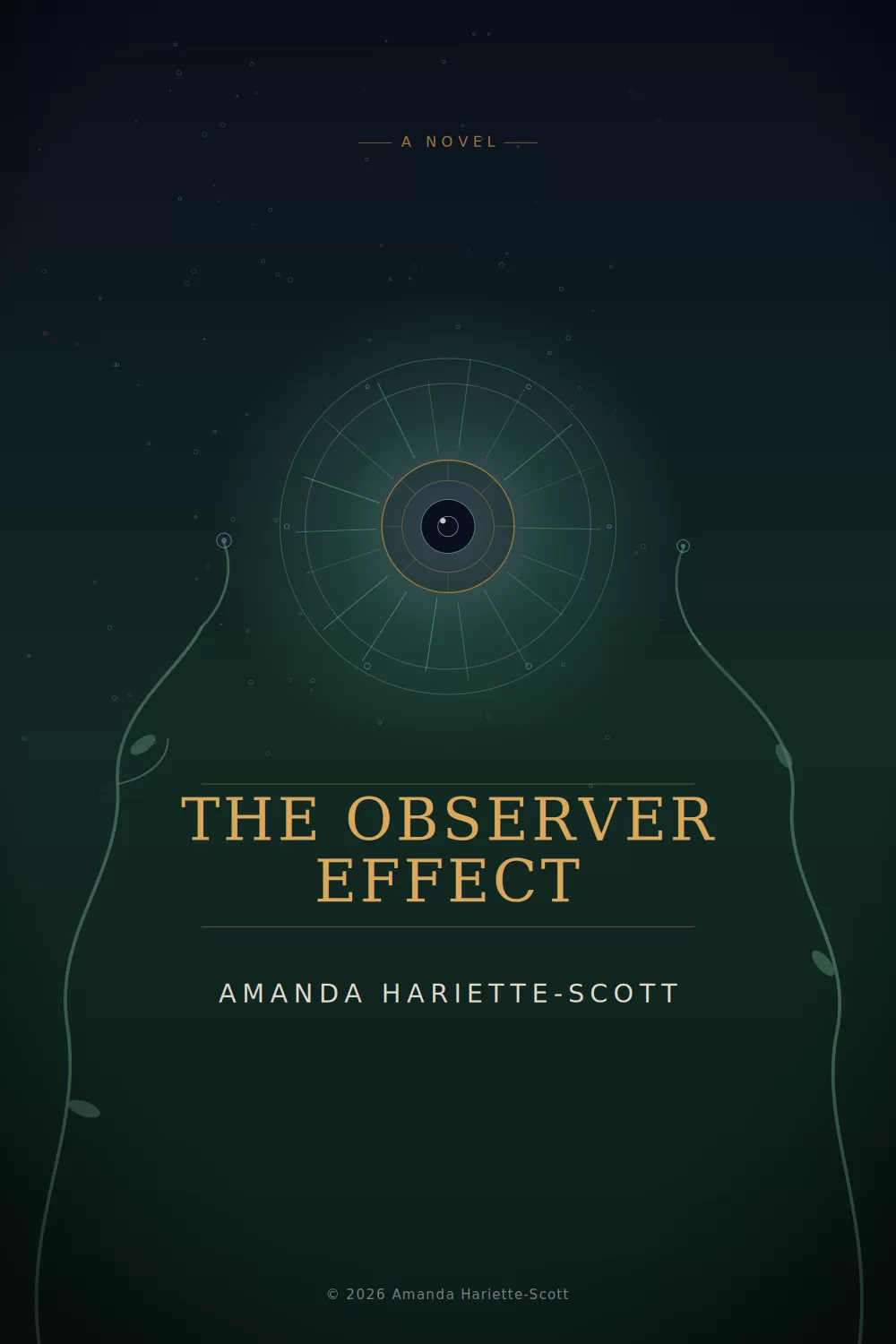
The Observer Effect
Leave a Reply