
How to Actually Destroy the Box: An Engineering Post-Mortem on Dark Matter’s Central MacGuffin.
Every season of Dark Matter eventually arrives at the same problem. Someone, usually Jason, decides the box has to go. It’s the thing that ruined his life, ended Daniela’s marriage to the “right” version of him, and now threatens to keep spawning doppelgangers for the rest of their days. The solution always sounds simple when a character says it out loud: destroy the box. What the show is much less interested in is how, which leaves the door wide open for anyone with a passing interest in materials science to have a go at the problem properly.
What ‘the box’ actually is:
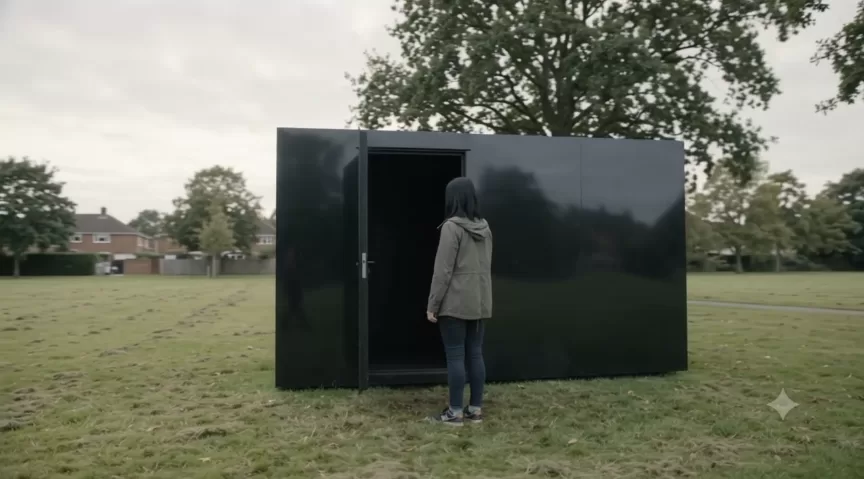
Strip away the drama and the box is a fairly modest piece of engineering. It’s primarily a sealed metal chamber. A traveller climbs in, gets injected with a compound (the show calls various versions of it Lavender Wings, Lilac Wings, and so on) that inhibits activity in the prefrontal cortex, and this induces a state of quantum superposition, aided by technology embedded into the box’s inner hull. From inside that state, the traveller perceives a corridor of doors, each one leading to a different branch of the multiverse, and picks their way toward whichever reality they’re after.
Crucially, none of that magic lives in the metal. The box is an isolation chamber, not a spellbook. Its entire function is to hold a human body still and undisturbed long enough for an altered brain state to do the actual work. That distinction matters enormously once you start thinking about how to disable it.
The real weakness, according to the show itself
Season 2 quietly hands the audience the box’s actual vulnerability. When a duplicate box gets relocated within Chicago, moved only a few miles from where it originally stood, Amanda works out that the move has severed its quantum connection to what she calls the box’s “prime power source”: some kind of anchor point shared across every multiversal copy of the box. Break the connection to that anchor, and you’re left with, in her words, just a box. No corridor, no doors, no superposition, just a large metal container taking up warehouse space.
The show has also shown us the second, blunter method works too: a tornado is depicted destroying a box outright elsewhere in the timeline. So canon actually gives us two independently validated failure modes:
Structural annihilation – enough force or heat to physically wreck the chamber. No chamber, no isolation, no portal.
Severance – moving the box far enough from its anchor point that the link degrades to nothing, without needing to damage it at all.
Anything you propose as a destruction method should be judged against those two mechanisms, because they’re the only ones the text has actually confirmed.
Why concrete doesn’t cut it
The instinctive answer, entomb it in concrete, fails both tests. Pouring concrete around the box doesn’t move it relative to its anchor point, the coordinates are unchanged, you’ve simply added mass nearby. And it doesn’t structurally destroy the chamber either. Burying something isn’t the same as crushing it. What you’re left with is access denial: nobody can open the door and climb in, which has some value, but it’s containment rather than destruction. And containment is precisely the failure mode the show keeps punishing its characters for relying on, because a box that still physically exists is a box that a sufficiently motivated alternate version of yourself, with unlimited time and resources, eventually digs up again.
A better stratagem: helicopter, Iceland, volcano
This is where things get properly satisfying, because a lava drop stacks both validated mechanisms at once rather than betting on just one.
Severance is trivially achieved. If a few miles across a single city was enough to sever the link in canon, then several thousand kilometres to a volcanic peninsula in the North Atlantic isn’t a marginal improvement, it’s overkill by several orders of magnitude. Strictly speaking you wouldn’t even need the volcano just to disable the box functionally; the flight there already does that part of the job.
Structural destruction is where the physics gets interesting. Icelandic basaltic lava, the kind produced by the Reykjanes Peninsula’s fissure eruptions, typically sits around 1,100–1,200°C. Mild and structural steel melts at roughly 1,370–1,510°C, meaning a steel box dropped into an active lava lake might not fully liquefy on contact. What it will do is warp under thermal stress, oxidise rapidly, and get chemically attacked by dissolved sulphur compounds, all while being progressively swallowed by the flow. Any internal wiring or chemical-injection hardware has essentially no chance of surviving that environment regardless of what the outer shell is made from. The practical result is a box that is destroyed in every sense that matters, inoperable, and buried under solidifying rock, which arguably beats pure concrete containment, since it removes the long-term “someone eventually excavates it” risk that burial alone leaves open.
The two wrinkles any serious multiverse-ending team should plan around *wink*:
Timing. Lava requires an actual eruption, and Iceland doesn’t oblige on demand. As of late 2026 the Reykjanes Peninsula’s Sundhnúkur crater system has been quiet since its last eruption in mid-2025, though magma has continued accumulating beneath Svartsengi and the region is expected to remain volcanically active for decades. If the schedule doesn’t cooperate, Kilauea in Hawaii is the more dependable choice; it has erupted dozens of times in the past two years alone and is far less likely to leave you waiting around with a box strapped to a cargo hook.
Payload. Nothing in the show gives exact dimensions for the box, but it’s consistently moved by forklift and truck rather than crane, which puts it plausibly in the low single-digit tonnes. That’s comfortably within the external sling-load capacity of a heavy-lift helicopter such as a Sikorsky Skycrane. The genuinely dangerous part of the operation isn’t the lift at all, it’s holding a stable hover near an active vent long enough to release accurately, given the sulphur dioxide plumes and violent thermal updrafts that come with any close approach to a lava lake.
The uncomfortable postscript
Even a technically perfect execution of this plan only solves a local problem. Destroying one instance of the box, however thoroughly, does nothing about the countless other Jasons across the branching multiverse who have built, or will eventually build, boxes of their own. That’s really the show’s quiet argument underneath all the corridor-running and doppelganger drama: there is no engineering solution to infinite branching possibility. You can win the battle against one box. You cannot win the war against the concept of it.
Still, if you only need to win the battle: helicopter, Iceland, volcano. It’s sound.
Cydonis. Whimsy versus despair.
Leave a Reply